Artificial intelligence can no longer be explained solely by algorithms and models. Behind every training session and every generated response are servers, processors, networks, cooling systems, and power supplies that form an increasingly demanding physical infrastructure.
This hardware infrastructure is changing the priorities of the entire industry. Demand for computing power in data centers has grown significantly, and with it, the pressure on chip manufacturers, component suppliers, and companies that need to finance large-scale hardware purchases.

AI is played on iron.
The AI business is no longer solely a software race. Training models and deploying inference services requires equipment capable of handling massive amounts of data, maintaining stable communications, and dissipating significant heat. In this context, hardware has become the primary bottleneck for many projects.
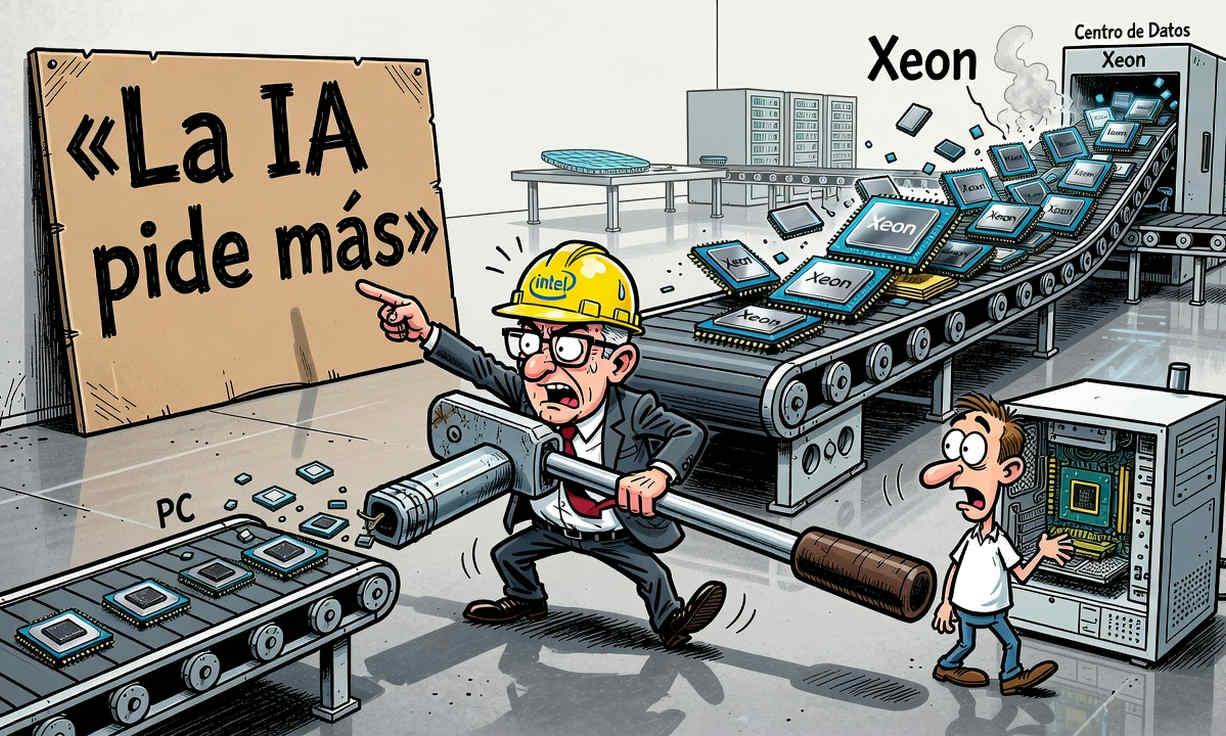
Demand is not evenly distributed. While the personal computer market shows signs of weakness, platforms for data centers and AI applications are attracting much of the interest. Manufacturers are redirecting capacity toward server processors, accelerators, and networking solutions , because that's where the buying pressure is most intense.
Investment and financing: the bill goes up
Expanding this infrastructure is not cheap. Companies face significant spending commitments on data centers, equipment, land, civil works, and components. Some large technology companies have begun exploring financing options linked to hardware purchases , such as lines of credit or asset-backed structures, to avoid relying solely on cash flow.

The logic is simple: if the business opportunity is measured in years, the investment is also planned long-term. However, taking on debt to buy equipment and build data centers requires careful calculation of repayment terms, interest rates, and future profitability. Not all companies can maintain that pace without straining their finances.
Factories, packaging and materials
The effort isn't limited to installing more servers. Semiconductor manufacturers are expanding factories, advanced packaging lines, and the capacity to assemble increasingly complex chips. However, production doesn't depend on a single plant : it involves wafers, precision equipment, substrates, specialized materials, and processes spread across several countries.
This is where the less visible challenges emerge. The lack of advanced organic substrates, manufacturing lead times, and the availability of hardware components can delay processor releases even with increased factory capacity. Bottlenecks shift from one stage to another, requiring coordination among suppliers at different points in the supply chain.
It's also unwise to interpret each expansion as an automatic increase in raw material consumption. The industry is working to reduce the use of critical materials, replace some components, and optimize processes to contain costs. In other words, more infrastructure doesn't always mean more consumption per piece of equipment , although it does require greater planning and a reliable supply.
Energy and refrigeration, the physical limit
AI-dedicated data centers are particularly energy-intensive. High-density racks require significantly more power and cooling than conventional facilities, putting pressure on the electrical supply. Energy costs and network capacity have become as critical as chip availability.
Therefore, the debate surrounding AI hardware also includes efficiency. Liquid cooling, fanless designs, embedded systems, and equipment built for demanding environments all aim to reduce power consumption and improve reliability. The race is not just about raw power , but about delivering that power with less waste and greater stability.
What does this mean for Europe and Spain?
In Europe, the deployment of AI depends on three pillars: computing power, robust electrical grids, and technical talent. Spain has advantages in connectivity and space for infrastructure, but it needs to strengthen its grid, improve efficient cooling, and enhance its supply chain to avoid remaining solely in the announcement phase.
The opportunity also lies in specialized hardware. Industrial equipment, edge hardware systems , and communications for critical environments are gaining traction in sectors such as transportation, defense, and security. For European companies, integrating AI into reliable and durable devices may be a more realistic niche than competing to manufacture the world's most advanced chips.
The full picture reveals a sector advancing at two speeds: demand for AI is driving multi-million dollar investments, factory expansions, and new financing models, but supply is facing limitations in materials, components, energy, and timelines. Hardware has become the decisive factor in determining how far artificial intelligence can grow in the coming years.

Table of Contents