
The new Arduino Ventuno Q has been presented as one of the most serious contenders for bringing artificial intelligence to the so-called edge , that is, directly to the device, without depending on the cloud. This board aims to bridge the gap between the world of traditional prototyping and advanced robotics , with a very clear focus on what many are already calling physical AI : machines that perceive, process, and act in the real world.
Unlike traditional Arduino boards designed for simple projects, the VENTUNO Q is a near-industrial-grade, single-board computer with enough power to run language, vision, and speech recognition models locally. The company, celebrating its 21st anniversary with this launch , aims to enable businesses and independent developers in Spain and the rest of Europe to build robots, machine vision systems, or interactive assistants without having to assemble a complete PC or rely on external servers.
A board created to bring AI to the physical world
The VENTUNO Q is specifically designed to democratize AI development at the edge and bring it to devices that interact with their environment, such as mobile robots, robotic arms , or industrial inspection systems. It's not just about running complex models, but about doing so while controlling critical hardware in real time.
The board is based on a dual-core architecture very similar to that of the UNO Q, but with a significant leap in power. On one hand, it integrates a Qualcomm Dragonwing IQ8 processor, designed to handle traditional and generative AI workloads , both language and vision-based. On the other, it incorporates an STM32H5 microcontroller dedicated to deterministic control tasks, such as motor movement and low-latency sensor readings.
Thanks to this approach, the board can run AI models entirely locally , without an internet connection, enabling the creation of machines that perceive, decide, and act in milliseconds. This approach is particularly attractive in fields such as service robotics, industrial automation , and security, where relying on the cloud is risky or simply not feasible.
Arduino itself points to very specific use cases: offline voice assistants based on local language models, smart mirrors that respond to gestures, information kiosks in airports or stations, and traffic monitoring devices that process data at the edge without sending massive streams to a central server.
In the field of education and research, the VENTUNO Q is also presented as a learning platform for generative AI and computer vision , designed for universities, vocational training centers and laboratories that want to build realistic prototypes without starting from scratch with fragmented hardware.
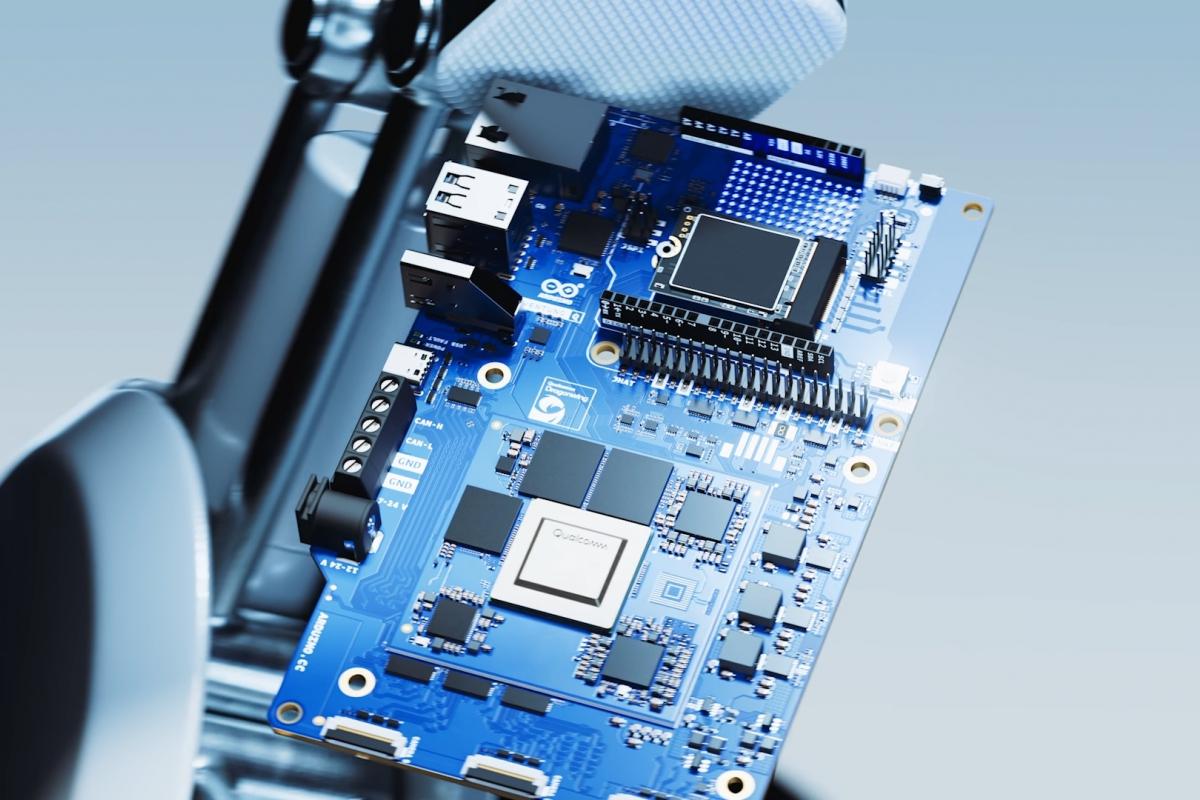
Qualcomm Dragonwing IQ8 processor and NPU up to 40 TOPS
At the heart of the board is the Qualcomm Dragonwing IQ8 (IQ-8275) SoC , specifically designed for edge AI applications. This chip integrates an eight-core Arm Cortex CPU (next-generation Kryo architecture) and an Adreno 623 GPU , designed to accelerate graphics and parallel computing.
The key component for artificial intelligence is the Hexagon Tensor NPU , capable of delivering up to 40 TOPS of inference power. This places the VENTUNO Q in a similar range to some recent laptop processors in terms of AI, but packaged on a compact board with power consumption tailored to the embedded world. This inference power is crucial for running complex models locally.
This system allows for the execution of computer vision, speech recognition, language analysis, and sensor fusion models directly on the board. Examples include the local execution of LLM- type models (such as Qwen), VLM for vision and language, as well as solutions for gesture recognition, pose estimation, and real-time object tracking .
In terms of graphics, the system also integrates a Qualcomm Spectra 692 ISP for processing images from cameras, which is essential for advanced machine vision projects , from quality inspection on production lines to robots that navigate using Visual SLAM.
This computing power makes it possible for the board to serve both as a general-purpose SBC with Linux and as the brain for complex robots that need a fast response even without an internet connection, something especially relevant in European industrial environments with strict privacy and availability requirements.
Dual-brain architecture: AI and real-time control
The VENTUNO Q combines the main processor with an STM32H5F5 microcontroller , based on a 250 MHz Arm Cortex-M33 core . This second component acts as the control brain, separating critical real-time tasks from heavy AI workloads and the Linux operating system itself.
This mixed -criticality approach prevents a peak load from a vision model or language from interfering with sensitive processes such as robot braking, valve closure, or the operation of a robotic arm on an assembly line. The STM32H5 has 4 MB of Flash memory and 1,5 MB of RAM , and runs Arduino Core on Zephyr OS , a system designed for deterministic tasks.
Meanwhile, the Dragonwing IQ8 processor can run Ubuntu or Debian , making it easy to use common AI development libraries and tools, from vision frameworks to container engines like Docker. This combination allows Python, C++, and classic Arduino sketches to coexist on the same board , with a clear separation between the decision plane and the action plane.
This architecture is reminiscent of the traditional combination of a Raspberry Pi with an additional Arduino board for motor control, but now everything is integrated into a single platform, with optimized internal communication and lower latency . For those working in advanced robotics in Europe, this means simplifying designs that previously required multiple boards, extra cables, and separate power supplies.
Furthermore, the integration of ROS 2 (Robot Operating System 2) ready workflows allows the VENTUNO Q to connect relatively directly to existing robots, simulators, and industry-standard tools, facilitating the leap from a laboratory prototype to a plant-deployed system.
Memory, storage, and expansion possibilities
One of the most striking changes compared to previous boards from the brand is the jump in memory. The Arduino VENTUNO Q incorporates 16 GB of LPDDR5 RAM , a figure that puts it well above the UNO Q and many general-purpose SBCs geared only towards lightweight prototyping.
For storage, the motherboard comes standard with 64 GB of eMMC memory , sufficient for the operating system, medium-sized AI models, and applications. For those needing more, an M.2 connector is provided for external NVMe Gen4 drives , allowing for expansion with high-speed SSDs without resorting to bulky external solutions.
This combination of RAM and storage makes it possible to run several inference models concurrently and build complex applications that combine vision, language and control, for example a robot that sees, hears and responds with voice while moving through a dynamic environment.
According to the released data, this configuration is designed for intensive AI multitasking , from running a local LLM for dialogue to gesture recognition models or multi-camera video analysis in parallel. For European projects that require keeping sensitive data local—such as those in healthcare, industry, or government—having this capability within the device itself is particularly relevant.
In practice, the VENTUNO Q can function both as a micro PC with Linux connected to a monitor, keyboard and mouse, and as the brain embedded in a robot, depending on the usage scenario and the needs of the project.
Connectivity and industrial orientation
Beyond its computing power, the board stands out for its set of interfaces clearly geared towards robotics and automation . In terms of physical I/O, the VENTUNO Q includes native CAN-FD, PWM lines, and high-speed GPIO , designed to control motors, read industrial sensors, and communicate with other controllers in demanding environments.
For machine vision, the design includes up to three MIPI-CSI connectors , partially multiplexed via the JMEDIA connector, enabling the assembly of 360-degree vision configurations or systems with stereoscopic cameras. Furthermore, it is compatible with USB cameras , facilitating the use of peripherals available on the European market without requiring specific hardware.
In terms of network connectivity, the board offers Wi-Fi 6 on the 2,4, 5, and 6 GHz bands , Bluetooth 5.3 , and a 2,5 Gbit/s RJ45 Ethernet port . This last option is particularly useful for installations requiring the transmission of large volumes of data , such as high-resolution images or LiDAR sensor point clouds, without relying solely on wireless networks.
The video section includes an HDMI output that shares lines with MIPI-DSI on the JMEDIA connector, as well as the option to use DisplayPort Alt Mode via USB-C . This allows the VENTUNO Q to function as a lightweight desktop computer or as a display console in embedded systems with a screen.
Regarding audio, it includes two microphone inputs, a headphone output, a line output, and an ear output , all accessible via the JMISC connector. This setup allows for the easy construction of voice assistants, interactive terminals, or public address systems with local audio and speech processing.
Compatibility with the Arduino and Raspberry Pi ecosystem
One of the strengths of the VENTUNO Q is its integration with the existing hardware ecosystemThe board maintains compatibility with family shields Arduino UNOThis allows for the reuse of modules already used in thousands of educational and professional projects in Spain and the rest of Europe.
Furthermore, it offers support for Modulino nodes, Qwiic sensors, and Raspberry Pi HATs , opening the door to a wide variety of expansions without the need for complex adapters. This approach multiplies the possibilities for use, from small educational robots to more complex mobile platforms equipped with specialized sensors.
The board can connect to a PC via USB-C and function as a classic development device, or as a standalone , directly powered SBC , depending on the scenario. For those already working with Raspberry Pi, the presence of an RPi-style connector and UNO headers facilitates the transition without having to rearrange all the electronics.
In terms of software, integration with Arduino App Lab allows you to combine traditional sketches with Python and ready-to-use AI models . The board also offers integration with Edge Impulse Studio for creating custom models, making it easier to develop specific solutions for sectors such as the agri-food industry, logistics, or home automation in the European context.
Additionally, support for Docker containers in the main processor's Linux environment introduces an approach closer to that of modern servers and clouds, allowing developers to package their AI, networking, and vision control services as reusable modules.
Power supply, ports, and physical format
The Arduino VENTUNO Q offers several power options to suit different environments. It can be powered via USB-C with 5V up to 3A , use a 5,5 x 2,1 mm connector with a 12 to 24V input , or use a screw terminal that supports between 7 and 24V, in addition to the 7 to 24V input available on the JOMEGA connector.
In terms of USB connectivity, the board includes a USB-C port with host/device role switching, power delivery, and video output, along with two USB 3.0 Type-A ports and two additional USB 3.0 ports accessible via the JOMEGA connector. This variety allows you to connect everything from cameras and external storage to standard input peripherals.
For industrial communications, the board incorporates one CAN-FD channel with an exposed PHY on a screw terminal and several additional CAN-FD channels without a PHY via the JOMEGA connector and UNO Shield headers. This combination is well-suited for autonomous vehicle, mobile robotics, and industrial automation projects , where CAN-FD is a widely used standard.
The physical format of the board, with approximate dimensions of 160 × 100 × 25,8 mm , places it in a manageable size for integration into custom cases, desktop robots or control cabinets, while maintaining space for heat dissipation and connectors.
With this design, the VENTUNO Q positions itself as a viable option for both R&D laboratories and European SMEs that want to experiment with AI on their own equipment without making the immediate leap to much more expensive industrial solutions.
Applications: robotics, machine vision, and local assistants
Arduino and Qualcomm present the VENTUNO Q as a versatile platform for projects ranging from service robots and industrial arms to inspection systems and interactive terminals . The combination of local AI and deterministic control opens the door to machines that not only capture data but also react in real time.
In robotics, examples include vision-guided picking and placing arms , robots that follow a person in changing environments, and autonomous platforms that navigate using Visual SLAM and path optimization . Compatibility with ROS 2 and multiple sensors facilitates its use in projects seeking to move from simulation to the real world.
In the field of vision and detection, the plate allows the creation of safety systems capable of identifying risky behaviors , traffic control devices that analyze complex patterns, or quality inspection solutions based on vision models that detect minute defects or missing parts in a production line.
For assistants and interactive systems, the VENTUNO Q can run fully offline voice assistants , information kiosks in stations or airports, and smart mirrors or displays that react to gestures and voice with very low latency. All of this without needing to send audio or image data to the cloud, something increasingly valued in terms of privacy and regulatory compliance in the European Union.
In the educational and research field, the board is proposed as a tool to teach generative AI, computer vision and robotics in university courses, training cycles and laboratories, allowing the transition from theory to functional prototypes with a single hardware.
Availability and focus on the European market
Arduino has announced that the Ventuno Q will be available in the second quarter of 2026 through its official store and a network of distributors that includes familiar names in Europe such as DigiKey, Mouser, Farnell, RS , and other specialized wholesalers. The board will be integrated into an ecosystem that, according to the company, already includes tens of millions of developers worldwide.
Regarding the cost, various sources suggest the target price will be below $300 , although a final figure and the exact euro equivalent have not yet been confirmed. This price range would place the VENTUNO Q above more general-purpose single-board computers (SBCs) like Raspberry Pi, but with a distinctly different proposition focused on AI and advanced robotics.
For companies, educational centers, and advanced makers in Spain and other European countries, the combination of AI power, industrial connectivity, and compatibility with the Arduino ecosystem can be especially interesting when prototyping cognitive robotics, automation, and edge computing applications without yet entering much more expensive proprietary solutions.
The arrival of the Arduino VENTUNO Q thus represents a significant step in the brand's evolution towards projects where perception, decision and action are integrated into a single board , with a proposal designed both for those already familiar with Arduino and for teams seeking a compact platform for physical AI and robotics in real-world environments.
Table of Contents
- 1 A board created to bring AI to the physical world
- 2 Qualcomm Dragonwing IQ8 processor and NPU up to 40 TOPS
- 3 Dual-brain architecture: AI and real-time control
- 4 Memory, storage, and expansion possibilities
- 5 Connectivity and industrial orientation
- 6 Compatibility with the Arduino and Raspberry Pi ecosystem
- 7 Power supply, ports, and physical format
- 8 Applications: robotics, machine vision, and local assistants
- 9 Availability and focus on the European market