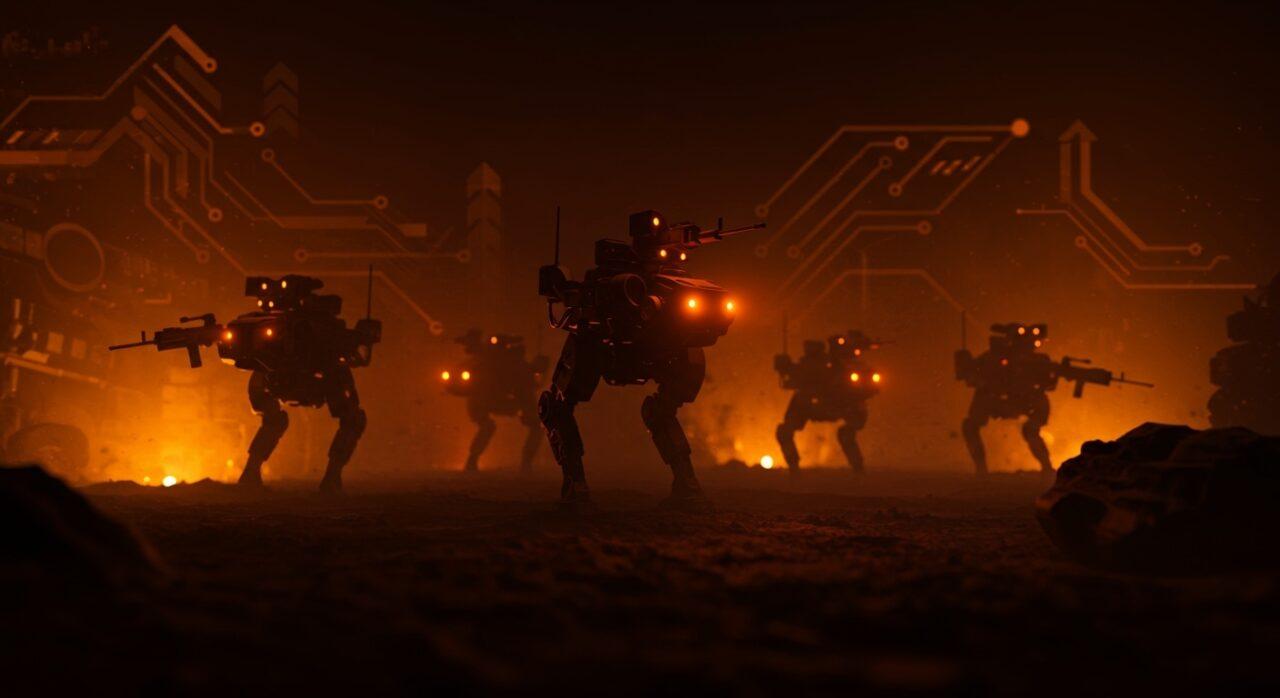
China has made autonomous military robotics a central pillar of its modernization strategy, developing a new generation of robot dogs capable of operating in groups like a pack of wolves. These AI-controlled systems are beginning to move from the laboratory to participate in complex military exercises and public demonstrations designed to showcase its technological prowess.
Far from being a mere experiment, these armed quadruped units have already been tested in urban combat maneuvers and simulated landings, integrated with drones and other unmanned systems. Although their deployment is focused on Asia, the development is generating concern in Europe, where the potential impact of this new generation of robots on security, industry, and the ethical debate surrounding the use of autonomous weapons is being closely monitored.
A pack of robo-dogs under the same "brain"
In its latest five-year plan, Beijing has identified physical AI, semiconductors, and 6G as cornerstones for creating an ecosystem of connected robots that function as a vast, distributed cloud. Within this roadmap, military robot dogs have become one of the most visible symbols of this commitment to battlefield automation.
The so-called "wolf packs" are made up of several quadruped robots that share information through a common sensor network. Each robot communicates with the others and with a central intelligence that coordinates movements, adjusts formations, and assigns tasks. The idea is for the group to act like a swarm: if one unit detects a threat, the rest react in a synchronized manner.
In demonstrations broadcast by Chinese state television, "cleaning" operations were recreated in urban environments , with robots moving through narrow streets, entering buildings, and covering different sectors of a simulated city. The system is presented as a "collective brain" that assigns roles within the group and allows it to make autonomous decisions in real time.
In this context, China insists that its main objective is to reduce the exposure of human soldiers to high-risk missions by replacing some troops with these platforms to minimize its own casualties. At the same time, the country is sending a message to the world about its ability to deploy intelligent swarms capable of operating even when conventional communications are unstable or jammed.
Technical characteristics: weight, load and tactical capabilities
Each of these "robo-wolves" has dimensions and features designed to combine mobility, payload, and stability in challenging terrain. Open sources agree that the weight is around 70 kilograms per unit, with the capacity to carry approximately another 25 kilograms of additional equipment, such as weapons, sensors, or supplies.
The quadrupedal structure allows for good adaptation to the environment: climbing stairs, navigating obstacles , traversing beaches, or moving through rubble in urban settings. Current models reach speeds of around 15 km/h on uneven terrain, with more advanced versions capable of achieving higher speeds under favorable conditions.
In terms of vision and perception, these robots integrate a set of distributed cameras and sensors that provide 360-degree coverage, combining real-time images with depth data and other environmental parameters. This information feeds AI algorithms that determine routes, identify potential threats, and help maintain tactical formations.
One of the key aspects is the human-machine interface: it involves interfaces that would allow a single operator to manage multiple units simultaneously, combining robot dogs and drones. Control would be achieved through consoles, haptic gloves, gestures, or even voice commands, so the soldier acts more as a supervisor of a group of autonomous agents than as the pilot of a single vehicle.
Roles within the pack: reconnaissance, support, and attack
The key to this system lies not only in the hardware, but also in how the collective swarm intelligence distributes tasks among the different members of the pack. Each robot assumes a different role depending on the mission, mimicking the dynamics of a real wolf pack.
The demonstrations described units dedicated to advanced reconnaissance , which deploy ahead of the rest of the force to map the terrain, locate enemy positions, and relay information to their comrades. Code names such as "Shadow" were mentioned for these types of roles.
Other units act as logistical support, transporting ammunition, medical supplies , or additional equipment to forward positions. In this case, their mission is not to fire, but to keep the group supplied and enable armed units to continue operating for longer periods.
Finally, some robots are specifically designed for direct combat, equipped with grenade launchers, missile launchers, or automatic rifles . In Chinese propaganda, units nicknamed "Bloody" are used to reflect this offensive profile. Their task is to open fire once the rest of the unit has surrounded or blocked the target.
The swarm AI coordinates all these components: it decides which robot covers which area, which one is exposed, which one is kept in reserve, and how to execute an ambush or encirclement of a specific point. In theory, the system would be able to adapt on the fly if any unit is destroyed, reassigning its functions to the rest of the group.
Autonomy, human control, and current limitations
One of the most delicate aspects of these types of projects is the balance between machine autonomy and human oversight . Developers and official spokespeople emphasize that, although these robots can identify and even track targets on their own, firing lethal weapons would still require human confirmation.
This red line is intended to address international criticism of fully autonomous weapons, a debate that is also a concern in Europe and in forums such as the UN. Official discourse insists that AI is focused on swarm coordination, navigation , and priority selection, but that the final decision to open fire remains with an operator.
Even so, the described capabilities go far: there is talk of algorithms capable of prioritizing targets , neutralizing the most dangerous threats first and leaving less critical points for later. In environments where satellite communications may fail or be blocked, the robots have reportedly demonstrated the ability to maintain certain collaborative functions based on a mutual understanding of the group's intentions.
The Chinese authorities themselves acknowledge that the system has significant shortcomings. One of the main ones is the robots' lack of armor , which makes them vulnerable even to light infantry fire. Currently, these platforms are relatively easy to destroy if there is a direct line of fire, so their effectiveness depends largely on surprise, mobility, and coordination.
Another clear limitation is energy autonomy . Because it relies on batteries, the effective time on the battlefield remains limited, necessitating careful planning of usage cycles, recharging, and unit replacement. Furthermore, the system requires robust communication channels to fully realize its swarm potential, making it vulnerable to interference, electronic attacks, and network outages.
Demonstrations, real-world use and projection towards Europe
The most widely publicized demonstrations have showcased these robots in urban combat simulations and amphibious landing operations, where they are combined with unmanned aerial vehicles and other ground systems. In some cases, live-fire exercises have been reported, reinforcing the idea that these are not simply mock-ups or conceptual videos.
Beyond the strictly military sphere, China has showcased these platforms in civilian settings such as fire departments , where they are used for fire reconnaissance, access to high-risk areas, and the exploration of buildings on the verge of collapse. This military-civilian duality is one of the key messages Beijing is trying to convey: the same technology can be used for both combat and protection and rescue operations.
In Europe, these advances are viewed with a mixture of technological interest and strategic concern. On the one hand, Chinese capabilities are accelerating the internal debate on the development and regulation of autonomous systems , from the potential impact on NATO to the implications for the European defense industry. On the other hand, they are pushing EU countries to clarify their position on lethal autonomous weapons and the ethical limits they wish to impose.
Some European robotics and defense industries are already working on unmanned ground platforms and advanced command and control systems, but the pace and scale of production announced by China set the bar very high. The possibility of large swarms of robots being deployed in future conflicts necessitates a reassessment of military doctrines and response capabilities, including cyber defense and electronic warfare.
In the medium term, the European Union will likely have to harmonize its legal framework regarding the use of AI in weaponry, balancing the need to remain competitive against powers such as China with the desire to preserve more restrictive international norms and humanitarian principles .
Beyond the military: civilian applications and technological pressure
The development of this "wolf pack" fits into a broader strategy in which robotics is conceived as a dual-use technology , with applications in both defense and civilian sectors. China has hinted at potential uses in mining, monitoring critical infrastructure, construction in hard-to-reach areas, and search and rescue operations after natural disasters.
For the international technology industry, including the European ecosystem, these advances confirm that swarm AI and the coordination of multiple autonomous agents will be key components in the next wave of automation. The same principles that allow a swarm of robots to surround a target in a city can be applied to logistics , warehouse management, or autonomous transport networks.
Also significant is the progressive decline in the cost of physical robotics . Although specific figures may vary, open estimates indicate that the unit price of these robots, equipped with advanced weaponry and sensors, is considerably lower than that of comparable conventional weapons systems. This downward trend suggests that, over time, we will see more affordable civilian versions derived from these platforms.
All of this is happening while key ethical and legal issues remain unresolved. International bodies and human rights organizations insist on the need to establish clear rules regarding the limits of autonomy in the use of force , something that directly affects how these technologies are designed and exported. Europe, with its regulatory tradition, will play a significant role in this debate.
China's advance with its wolf robots highlights a trend that is hard to ignore: the combination of robotics, swarm AI, and large-scale production is transforming not only how war is waged, but also how we conceive of the work of machines and humans in high-risk environments.
The deployment of these autonomous wolf packs reflects China's determined commitment to military robotics, supported by a network of shared sensors, coordinated decisions, and specialized roles that make each robot dog a piece of a much larger system. Although they still face challenges with armor, energy, and dependence on secure communications, the message to Europe is clear: the next phase of technological and strategic competition will revolve around the ability to integrate swarms of intelligent machines, under human control but with an ever-increasing degree of autonomy, both on the battlefield and in sensitive civilian applications.

Table of Contents
- 1 A pack of robo-dogs under the same "brain"
- 2 Technical characteristics: weight, load and tactical capabilities
- 3 Roles within the pack: reconnaissance, support, and attack
- 4 Autonomy, human control, and current limitations
- 5 Demonstrations, real-world use and projection towards Europe
- 6 Beyond the military: civilian applications and technological pressure