
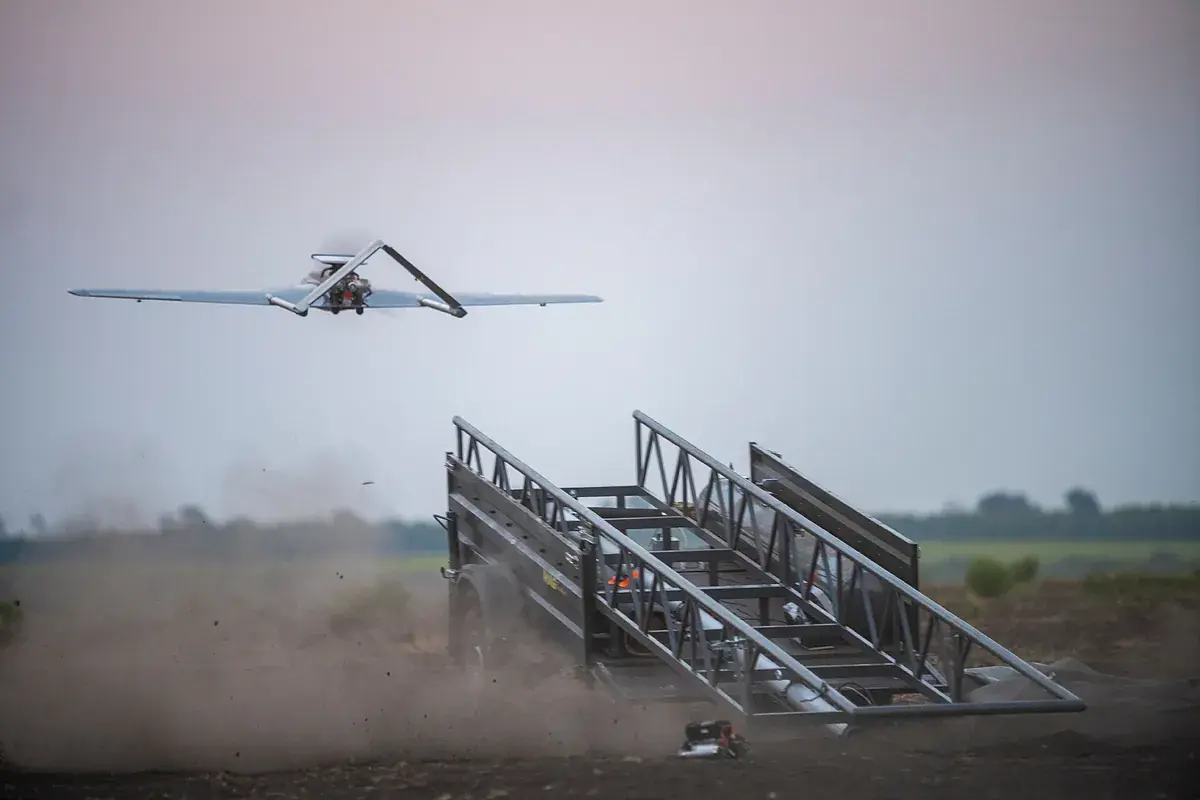
Drones have become a central element in the European security landscape. While Ukraine uses them as a long-range weapon to strike Russian infrastructure, several NATO countries are facing unexpected vulnerabilities in their own unmanned systems. The combination of mass attacks, espionage incidents, and suspicious sightings has put drones in the crosshairs of governments and armed forces across the continent.
In recent weeks, the war in Ukraine has demonstrated that drones are not only surveillance tools but also weapons capable of penetrating deep into enemy territory. At the same time, the UK has uncovered a scandal revealing how Chinese-made components can be incorporated into Western military equipment, compromising the security of operations. Germany, for its part, is investigating the presence of unidentified drones over sensitive facilities, suggesting a possible hybrid attack campaign.

The war in Ukraine is also being fought with drones

The Russian Ministry of Defense claimed to have intercepted hundreds of drones overnight, with figures ranging from 397 to 502 depending on the day. The Ukrainian strategy aims to keep the entire Russian refining and fuel storage network under pressure , causing shortages and price increases in various regions. According to data from EA Analytics, Russian refining fell in July to its lowest level since 2002, about a third below the seasonal average.
Meanwhile, Russia has responded with massive bombing campaigns against Ukrainian cities, including Kyiv, where a drone and missile attack killed four people, including a child. Ukrainian air defenses managed to shoot down 135 of the 151 drones launched by Russia , but were unable to intercept the ballistic missiles due to a lack of Patriot missile systems. Ukrainian Foreign Minister Andriy Sybiha has urged Western partners to strengthen the country's air defenses.
Espionage and vulnerabilities in military drones

In the UK, a Telegraph investigation has revealed that cameras mounted on the Royal Navy's K3 Scout drones were sending data to an IP address in China. The drones, manufactured by Kraken Technology Group, incorporated subcontracted Chinese components that carried out so-called 'heartbeat communications'—small data exchanges that confirmed the device's status. Although the British Ministry of Defence maintains that no sensitive data was transmitted, the incident has led to the drones being taken offline and a loss of confidence in the platform.

The scandal erupts at a delicate time, as the K3 Scout helicopters were intended for deployment in the Strait of Hormuz and have participated in NATO exercises. The fear is that they may have been near meetings of senior military officials with cameras active , which could have compromised classified information. Conservative MP Alicia Kearns has demanded an urgent audit of all military equipment in search of hidden Chinese technology, while the Labour government attempts to forge closer trade relations with Beijing.
This case highlights China's dominance in global technology supply chains, even for equipment marketed as Western. The British Royal Navy acquired 20 K3 Scout unmanned vessels for £12,3 million as part of Project Beehive, and the United States has also contracted Kraken for its special operations forces. The company maintains that the cameras complied with NDAA regulations, but trust in the platform has been seriously damaged.
Germany on alert for hostile drones
Germany has also raised alarms following the sighting of two drones over the Mechernich military base in the west of the country and the discovery of a drone carrying explosives at Leipzig-Halle Airport. The Leipzig incident, which occurred at the end of last week, forced the closure of the runway, and a cargo plane collided with an unidentified flying object . The Federal Prosecutor's Office has taken over the investigation, and Interior Minister Alexander Dobrindt has described it as a hybrid attack perpetrated by highly professional actors, without ruling out the involvement of foreign powers.

Mechernich is a special army facility that stores components for the Patriot missile systems, which are in high demand by Ukraine. Military police investigated the sighting, and the case has been transferred to the police in Euskirchen . These incidents follow the mysterious drone flights over European airspace last year, which led to flight cancellations in Berlin and Munich, and which Russia denied being behind.
The situation reflects a growing concern about the use of drones for hostile purposes in Europe. As Ukraine and Russia exchange large-scale drone attacks, NATO countries must address vulnerabilities in their own systems and potential espionage activities . Investment in unmanned technology is increasing, but so are the risks associated with its use and supply chain.
Ultimately, drones have become a double-edged sword: they are essential for defense and surveillance, but they also pose a threat when they fall into the wrong hands or when their components are unreliable. Europe finds itself at a crossroads, trying to harness their advantages while mitigating the dangers they present.
