Fast charging has become the most influential factor in the electric car experience: it affects long journeys, the planning of stops, and even the battery's health. It's not all about finding a high-power charging station; temperature, the battery's state of charge, and how the system manages energy all play a role. The convenience of refueling in minutes comes with a technical downside that should be carefully considered.
In recent months, the conversation has shifted from simply announcing kilowatt capacity to two more practical issues: how the infrastructure is being deployed and how to prevent fast charging from taking its toll. There are promising developments, albeit with some caveats , because much of the testing is done with isolated cells or modules, not with cars driving for years.

A growing network, but with pending tasks
Galicia has surpassed 2.300 charging points in service, 339 more than a year ago. Of the recent additions, 211 handle power outputs of 50 kW or higher, representing nearly two-thirds of the new connections. The effort to increase charging power is evident , but the starting point is still hampered by a majority of slow charging points.
The less encouraging statistic concerns the number of non-functioning charging stations: 894 installations remain out of service, 162 more than twelve months ago, representing approximately 27% of the 3.261 charging points on Galician roads. These outages have become as significant a problem as the lack of charging points , because a map showing downed charging stations does not inspire confidence in drivers.
The European target for 2030 is far from being met: Galicia would need to activate 58 charging stations per week, 247 per month, or 3.010 per year over the next few years to approach the goal of 14.974 installations in operation. The current pace is insufficient to close this gap , and, moreover, the slow rollout is hindering the purchasing decisions of those still undecided between electric vehicles and other alternatives.
In terms of power, the Galician charging network remains dominated by slow charging: 1.572 charging points below 50 kW, representing 66% of all active charging points. Of these, 1.442 are below 22 kW and 130 operate between 22 and 50 kW. New installations are improving the situation somewhat : the number of charging points at 50 kW or more has reached 797, a 36% increase, and now accounts for one in three operational charging points.
The leap is most evident in the high-power segment. Connections of 150 kW or more have reached 328, a 75% increase, representing 14% of the network compared to the previous 9%. Superchargers of 250 kW or more have doubled to 200 charging stations, a key infrastructure for long journeys and for electrifying heavy transport.
One-minute breaks: the idea that reduces burnout
One of the most striking lines of research proposes not continuous charging, but rather fractional fast charging. The test was conducted with 48 commercially available NMC cells with graphite anodes, rated at 20 amp-hours and manufactured in 2011. The protocol alternated six two-minute bursts of high intensity with one-minute breaks: twelve effective minutes spread over approximately seventeen real-world minutes, within a window of roughly 20% to 80% charge. The pause was not arbitrary, but rather an integral part of the experiment.

After 1.009 cycles, the cells subjected to this scheme retained more than 84,7% of their original capacity, with a moderate increase in internal resistance. In the comparable continuous regime, capacity had fallen below 80% around cycle 217. The difference was too large to ignore , even though the result came from a laboratory environment.
The technical explanation relates to the movement of ions. When the current is very high, the ions arrive faster than the graphite can absorb them uniformly; this promotes unwanted reactions, increases resistance, and can facilitate the deposition of metallic lithium. During breaks, the ions redistribute themselves, and some of the accumulated electrochemical voltage decreases. Upon opening the cells, less deterioration was observed in the electrodes and changes in the protective graphite layer.
The warning is also part of the finding. When applying an even higher current and covering almost the entire charging range, the interruptions did not prevent a rapid loss of usable capacity. Simply pausing is insufficient if the cell cannot handle that current. Furthermore, the result corresponds to a specific chemistry, NMC with graphite, and it has not been demonstrated that the same occurs in LFP or other compositions. The sample was small: four units per main group and none in a moving car.

In a potential second life, a cell from the six-stage protocol completed approximately 1,000 additional cycles with nearly 80% health remaining. Between the two phases, it delivered 64,6 kWh compared to 34,2 kWh in the comparable continuous charging regime, representing 89% more energy stored during testing. It's important to clarify that this doesn't translate to 89% more range per charge. The potential improvement lies in how the car schedules charging , not in the driver unplugging the battery every two minutes.
Cool without flooding the battery
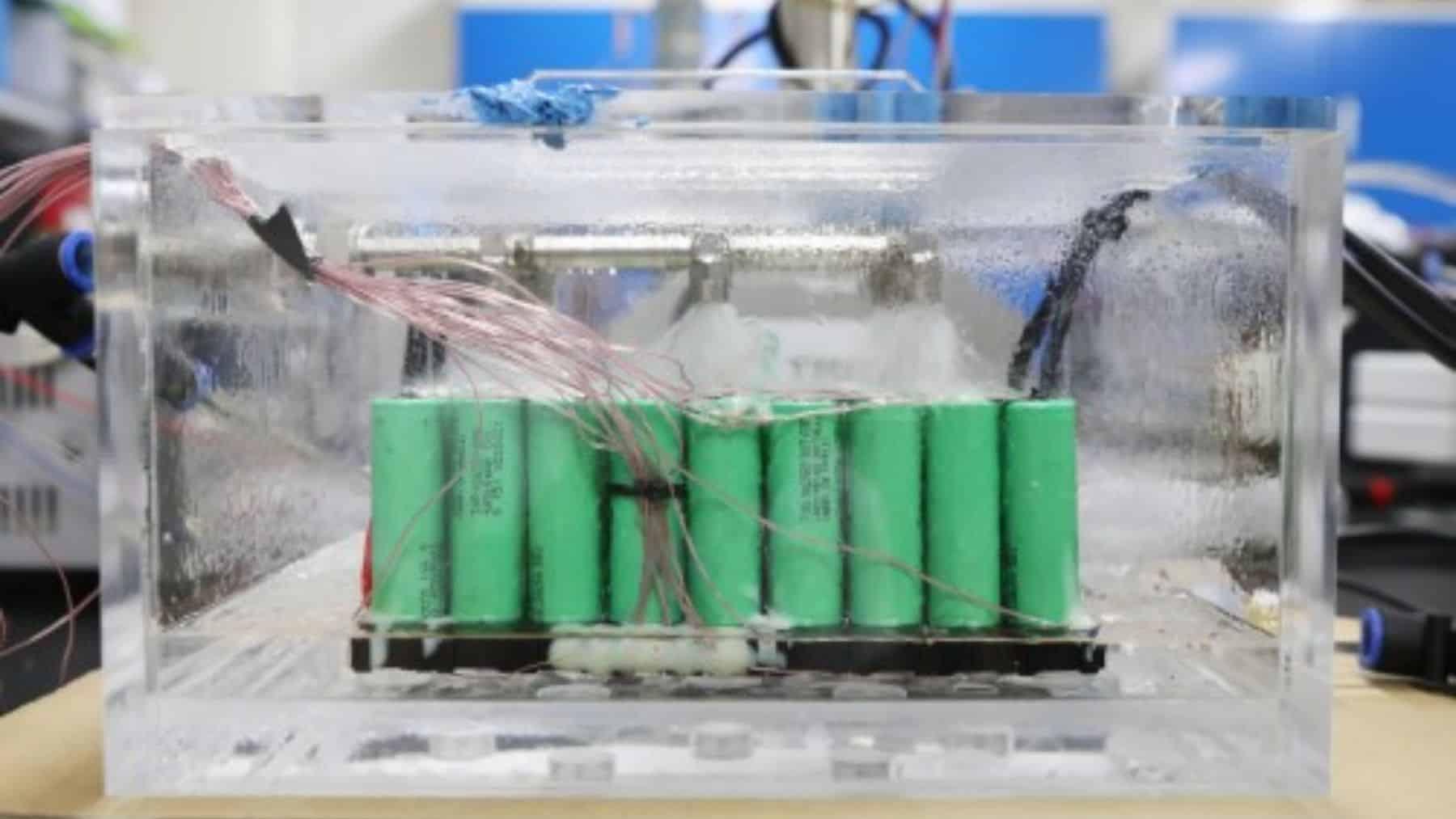
Heat is the invisible brake on fast charging. When the cells heat up, the system reduces power to protect itself; if the temperature gets out of control, aging accelerates and the risk of thermal runaway increases. The impact of heat and cold is crucial to actual performance. One solution that has been tested is immersing the battery in a dielectric fluid, but a complete pack can require 100 liters of fluid, with the associated costs and weight. Significant cooling isn't always free, either in terms of weight or cost.
A research team has proposed an alternative: leaving only the bottom of the module in contact with the liquid and spraying the fluid from above. The liquid falls onto the cells, absorbs the heat, and recirculates from the bottom. With this combination of spraying and partial immersion, the module remained below 35°C even under very rapid load, using between 10% and 20% of the liquid that would be required for full immersion. This represents approximately 85% less fluid.
The advantage isn't just thermal. Less liquid means less weight, less volume, and lower cost; it can also simplify maintenance in data centers with battery backups. Furthermore, the dielectric doesn't burn, so it acts as an extra layer of safety if a cell malfunctions. The next step is to use artificial intelligence to search for fluids with better properties. All of this is still in the laboratory phase , and it remains to be seen how it performs in a large battery pack with hundreds of cells and years of use.
Reasonable doubts remain: the uniformity of the spray on large modules, the durability of the fluid in contact with connectors and electronics, the maintenance of nozzles and pumps, and the final cost of the system. Hot spots are a known enemy of lifespan, and a system that doesn't distribute the fluid well could create new problems. The idea is good, but it's not a complete solution.
Plug-in hybrids and motorcycles are also getting on board with fast charging
Fast charging isn't limited to pure electric vehicles. Škoda has unveiled a plug-in hybrid version of its large SUV, the Kodiaq, with a combined output of 200 kW, equivalent to 272 hp, 68 hp more than its predecessor. The battery has a gross capacity of 25,7 kWh and a usable capacity of 19,7 kWh, and supports DC fast charging at 50 kW, a rare feature among plug-in hybrids. The Laurin & Klement trim level sits at the top of the range , featuring massaging seats and unique exterior details.
In the realm of two wheels, Zero is preparing a CCS port and a Level 3 fast-charging module for its new Street and Dual Sport motorcycles during 2027. The system will also be retrofittable on S and DS models starting with the 2022 model year. For versions with batteries up to 17,3 kWh, the company anticipates charging from 20% to 80% in under 30 minutes. Furthermore, the Level 2 Rapid Charge system adds 6 kW, reaching 12,6 kW, and allows for the same charging time in under 45 minutes. The innovation lies not only in the power but also in the possibility of retrofitting motorcycles already sold.
The overall picture suggests separating the marketing hype from what's already available. The network is growing and gaining power, but it still suffers from broken installations and distant goals; protocols with pauses and spray cooling point to longer-lasting batteries, although these are currently only laboratory results; and plug-in hybrids and motorcycles are starting to incorporate fast charging in segments where it was previously rare. The key for the user remains the same: use power wisely and let the vehicle manage its temperature and limits.
Table of Contents