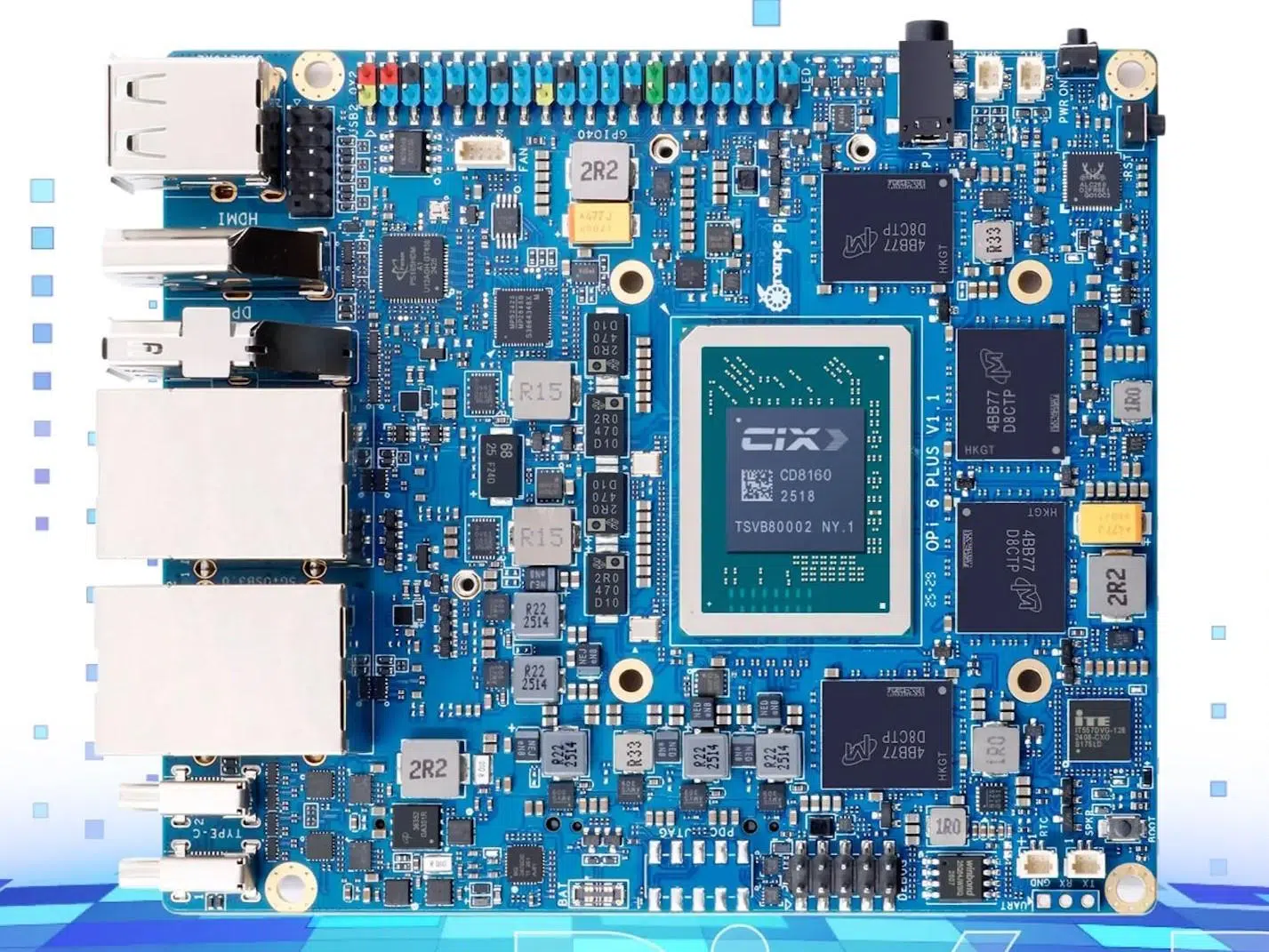
The Orange Pi 6 Plus bursts onto the single-board computer scene as a proposition that's closer to a mini PC than a traditional SBC. Manufactured by the Chinese group Shenzhen Xunlong, it's shaping up to be one of the most serious alternatives to the Raspberry Pi for those seeking raw power, extensive connectivity, and the ability to run AI workloads locally without breaking a sweat, similar to the Orange Pi AI Studio Pro.
This model breaks with the trend of the brand's entry-level range by opting for a larger, more powerful form factor with a clear focus on high-performance applications . We're talking about a 115 x 100 mm board that integrates a 12-core Arm SoC, a latest-generation GPU, and an NPU with dozens of TOPS, in addition to up to 64 GB of LPDDR5 memory and dual M.2 2280 slots for NVMe SSDs. All of this places it in a different league, closer to compact desktop systems like the Orange Pi 5 Ultra than to low-power SBCs.
A larger plate for a more ambitious project
The change in focus is noticeable at first glance: at 115 x 100 mm , the Orange Pi 6 Plus is bulkier than the average for its segment. This extra surface area translates into more ports, better ventilation, greater memory capacity, and space for several M.2 slots—a rare combination for boards the size of a credit card.
The idea is clear: the manufacturer has prioritized versatility and sustained power, with clear nods to desktop setups, lightweight AI workstations, home servers, and industrial automation environments, rather than limiting itself to simple maker projects, similar to the Orange Pi 5 Pro.
Processor, GPU and NPU: 12 Arm cores and AI acceleration
At the heart of the Orange Pi 6 Plus beats the CIX CD8180/CD8160 SoC , a 64-bit Arm chip with a total of 12 CPU cores organized into three clusters: four Cortex-A720 cores up to 2,8 GHz, four Cortex-A720 cores up to 2,4 GHz, and four Cortex-A520 cores at 1,8 GHz. This heterogeneous arrangement aims to balance performance and efficiency depending on the workload, allowing switching between high-performance threads and light tasks without wasting energy.
The graphics performance also takes a significant leap forward with the Arm Immortalis-G720 MC10 GPU , designed to accelerate 3D desktop interfaces, design applications, and games, thanks to a modern graphics engine and acceleration algorithms. This opens the door to realistic use as a mini PC, with added benefits when pushing graphics or running demanding graphical desktops.
Artificial intelligence is another of its strengths. Depending on the source, 30 TOPS are mentioned for the NPU and up to 45 TOPS for total computing power combining CPU + NPU + GPU. This figure puts it competitive with some modern x86 solutions in terms of edge AI, and allows for projects such as real-time video analytics, vision model inference, audio or NLP, or multiple compressed LLM instances running locally.
It's worth noting that different product materials report varying TOPS values, which is relatively common in the industry due to differences in measurement methods, firmware versions, or the combined acceleration of multiple SoC blocks . In practice, the leap in performance compared to typical SBCs is very significant, opening up use cases previously reserved for PCs.
High-quality memory: up to 64 GB LPDDR5-5500
Memory is another of the device's major strengths. The Orange Pi 6 Plus supports up to 64 GB of LPDDR5-5500 with a 128-bit bus, far exceeding the norm for this type of board. Versions are planned with 16 GB, 32 GB, and 64 GB of memory, soldered and distributed across four chips (4 x 4 GB, 4 x 8 GB, 4 x 16 GB depending on the configuration), which contributes to both bandwidth and overall system stability.
This capability is key for AI tasks, lightweight virtualization, containers, full desktops, or complex builds, where having ample RAM makes the difference between barely working and working with ease. Ultimately, it's a component that propels the Orange Pi 6 Plus towards professional and semi-workstation applications.
Storage: Dual M.2 2280 NVMe and more
For storage, the motherboard offers two M.2 2280 M-Key slots compatible with NVMe SSDs, a rare feature in a single-board computer (SBC). This allows for configurations ranging from a single high-capacity SSD to dual-drive setups, separating system and data or combining speed and endurance as needed.
In addition, it includes a dedicated M.2 2230 E-Key slot for wireless modules, allowing you to add a Wi-Fi/Bluetooth card without using up USB ports. It also features a microSD/TF card reader and SPI Flash support, expanding boot, recovery, and lightweight firmware storage options.
Connectivity and expansion: ports for everything
The increased size allows for truly generous connectivity. The Orange Pi 6 Plus features two USB 3.0 Type-C ports supporting data, video, and power; two additional USB 3.0 Type-A ports; and two USB 2.0 Type-A ports for less demanding peripherals. This allows you to connect multiple devices without needing an external hub.
In terms of video, the board includes DisplayPort 1.4 , HDMI 1.4, and eDP (Embedded DisplayPort), making it possible to work with more than one screen or choose the most suitable interface depending on the monitor or integrated panel. This versatility is especially useful for workstations, kiosks, digital signage, or industrial projects with embedded panels.
The networking section has a peculiarity: some specifications mention dual Ethernet with a bandwidth of up to 5 Gbps per port, while others specify two Gigabit ports. In any case, the focus is clear: high-performance wired connectivity on two ports for load balancing, aggregation, or network separation.
The interface list is completed with details designed for integrators: 3,5mm audio input, two stereo speaker connectors, 40-pin GPIO header (UART, I2C, SPI, PWM), touch interface, dual 4-lane MIPI-CSI for cameras, fan connector, RTC and battery, plus an extra 9-pin USB 2.0 header and three status LEDs.
- 2 x USB 3.0 Type C (data, video and power)
- 2 x USB 3.0 Type A + 2 x USB 2.0 Type A
- DisplayPort 1.4, HDMI 1.4 and eDP
- 2 x Ethernet (documentation mentions up to 5 Gbps per port)
- 3,5mm audio input + 2 speaker connectors
- microSD/TF card reader and SPI Flash support
- 2 x M.2 2280 M-Key (PCIe for NVMe)
- 1 x M.2 2230 E-Key (for Wi-Fi/Bluetooth)
- Dual 4-lane MIPI-CSI interface and touch connector
- 40-pin GPIO (UART, I2C, SPI, PWM), 9-pin USB 2.0 header, fan connector, RTC and battery
Fuel consumption and feeding: prepared for heavy loads
Power comes at a price in terms of consumption. This board is designed to work with a USB-C power supply of up to 100W , suggesting it can handle intensive workloads while simultaneously powering peripherals and displays through its ports. It's not your typical low-wattage SBC: this is closer to mini PC territory.
This power headroom, when properly managed, provides a significant buffer for scenarios with multiple NVMe SSDs, multiple active USB ports, high-speed networks, and combined CPU, GPU, and NPU usage. In enclosed systems or environments with high ambient temperatures, active cooling is essential to prevent performance losses due to overheating.
Operating systems: Linux, Android, and Windows options
In terms of software, the manufacturer announces compatibility with GNU/Linux distributions such as Debian and Ubuntu , as well as Android, covering everything from server and development environments to multimedia interfaces and mobile apps adapted for desktop.
Windows compatibility is also indicated , presumably for the IoT version for ARM, given that the traditional desktop version has been limited by licensing agreements with Qualcomm on Arm devices. In any case, there are signs that this could change, which would broaden the range of uses for those who rely on Windows software on Arm architecture, as demonstrated by the Orange Pi Win Plus model.
As an open-source motherboard, the project offers a solid foundation for developers who need to document, tweak kernels, compile drivers, or integrate specific accelerations. This open-source approach multiplies the possibilities for customization and adoption in professional niches.
Real-world performance and use cases
On paper, the combination of 12 cores, a modern GPU and an NPU with dozens of TOPS allows it to aspire to tasks that previously required the use of a full PC: lightweight workstations for AI development , local inference of vision models, edge computing with multiple containers, home servers with simultaneous services or office workstations with multiple screens.
The brand explicitly mentions uses such as smart offices, edge computing, smart security, industrial automation, retail, home servers, AI workstations, and high-performance personal computing. It also cites specific examples of live camera video analytics , such as early fire detection in remote locations without relying on the cloud.
If you work with graphics, the Immortalis-G720 MC10 support and the presence of DisplayPort/eDP simplify the connection of high-resolution or integrated panels, and allow you to run desktop 3D applications, industrial design or scientific visualization with a margin that conventional SBCs often fall short of.
For makers and integrators, the abundance of GPIO, MIPI-CSI for two cameras, touch interface and multiple USB ports open up a huge range: from interactive kiosks to vision robots, to HMI panels in control environments and prototypes of commercial products.
Comparison with other boards and product guidance
Compared to popular SBCs, the Orange Pi 6 Plus is in a different league. This is not only due to its CPU and NPU, but also its memory (up to 64 GB LPDDR5 ), dual M.2 2280 NVMe drives, and doubled network connectivity. In practice, it's closer to a modern NUC or Arm mini-ITX boards designed for light workstations.
It has been noted that the Raspberry Pi 5 alternative measures around 4,5 x 3,9 inches , while the Orange Pi 6 Plus measures 115 x 100 mm. Beyond the dimensions, the key point is that this Orange Pi model doesn't compete on ultra-low price or minimal power consumption; its focus is on performance and expandability, with a correspondingly low energy and economic cost.
To place it in the market, it's helpful to compare it to the Radxa Orion O6 mini-ITX, which uses the same CIX CD8180/CD8160 chipset with AI figures around 28,8 TOPS according to the manufacturer. Meanwhile, Orange Pi claims up to 45 TOPS combined . This reinforces the idea that we're dealing with an Arm platform aspiring to be a high-performance mini PC.
Ports and details that make the difference
Beyond the main specifications, there are small design decisions that greatly enhance integration: the 9-pin USB 2.0 header for expanding internal ports, the fan connector, the inclusion of an RTC and battery, and the three status LEDs for quick diagnostics. These elements facilitate deployment in custom cases or embedded environments.
Support for two cameras via MIPI-CSI, each with four lanes, is ideal for computer vision solutions where parallel capture, stereoscopy, or combining a context camera with a specialized camera is required. The touch interface and eDP simplify integration with professional displays or industrial panels without the need for adapters.
Price and availability: what we know
At the time these specifications were published, Orange Pi had not yet confirmed the price of the 6 Plus. The product page is live, and it is expected to be sold through usual channels such as Amazon and AliExpress. It is expected to cost more than a Raspberry Pi 5, in line with its ambition and hardware.
For market reference, the aforementioned Radxa Orion O6 mini-ITX board (same chipset) has an official price of around $227, and can be found for sale for prices exceeding $460 . This isn't a direct translation of the Orange Pi 6 Plus's MSRP, but it does provide an indication of the target market and expectations.
For those wishing to delve deeper into practical analysis, there is additional material available online, such as an extensive review published by third parties, for example, in this technical review . These types of resources help to assess real-world performance, compatibility, and thermal behavior with different heatsinks.
Community support and development
The open-board philosophy, documentation, and support for popular Linux distributions make the ecosystem familiar to developers and administrators. From a software perspective, having well-integrated AI accelerations and video/camera pipelines with mature drivers will be key to getting the most out of the hardware.
For businesses and advanced makers, having forums, repositories, and clear guides is just as important as the TOPS score. Adding ports, RAM, and M.2 slots is fantastic, but the crucial factor will be being able to run containers, frameworks (like ONNX Runtime, TensorRT equivalents depending on support, or Arm accelerators), and multimedia stacks seamlessly.
Who is the Orange Pi 6 Plus for?
If you're coming from an entry-level SBC and need to build a usable desktop environment with multiple applications, containers, IDEs, and browsers running simultaneously, this board is a perfect fit. It's also ideal if you're looking for edge computing solutions with real-time model inference, edge analytics, and fast NVMe storage for lightweight databases or caching.
In professional settings, it excels in automation, machine vision, interactive kiosks, signage and industrial control , where the combination of eDP, touch, GPIO, dual network and M.2 for SSD and Wi-Fi/BT reduces dependence on external accessories and simplifies final product integration.
The Orange Pi 6 Plus combines a 12-core Arm SoC with a modern GPU and powerful NPU, up to 64GB of LPDDR5 memory , dual M.2 2280 NVMe drives, an M.2 slot for wireless connectivity, a wide array of ports (including DisplayPort 1.4, HDMI 1.4, and eDP), dual high-performance Ethernet, and support for Linux, Android, and Windows IoT options. This combination places it closer to a mini PC than a traditional single-board computer (SBC), with the corresponding increase in power consumption (up to 100W USB-C power supply) and, presumably, a higher price, but with the reward of performance and expandability worthy of larger machines.
Table of Contents
- 1 A larger plate for a more ambitious project
- 2 Processor, GPU and NPU: 12 Arm cores and AI acceleration
- 3 High-quality memory: up to 64 GB LPDDR5-5500
- 4 Storage: Dual M.2 2280 NVMe and more
- 5 Connectivity and expansion: ports for everything
- 6 Fuel consumption and feeding: prepared for heavy loads
- 7 Operating systems: Linux, Android, and Windows options
- 8 Real-world performance and use cases
- 9 Comparison with other boards and product guidance
- 10 Ports and details that make the difference
- 11 Price and availability: what we know
- 12 Community support and development
- 13 Who is the Orange Pi 6 Plus for?