The artificial intelligence ecosystem has just taken a significant leap forward with Google's latest update. What was until recently an experimental tool has now become an integrated capability that allows Gemini 3.5 Flash to operate a computer just like a human user. It's no longer just about the machine answering a question or writing an email; it's about its ability to take control of the interface to complete a task from start to finish.
This evolution means the model can observe what's happening on the monitor, reason about the visual elements in front of it, and independently perform specific actions such as clicking , scrolling through a website, or filling out forms. Google has decided that this technology, technically known as autonomous agents, will no longer be an external module but will instead become part of the DNA of its most agile model, greatly simplifying the process for those who develop applications based on this AI.

From answering questions to running digital errands
The big difference compared to what we've known until now is that AI is no longer limited to giving us a step-by-step tutorial on how to do something. If you ask it to find the cheapest flight for your next vacation, the system goes directly to booking websites , compares prices in real time, and presents you with the finished product. It's a paradigm shift where the assistant stops being a know-it-all and becomes a digital employee who knows every corner of your operating system.
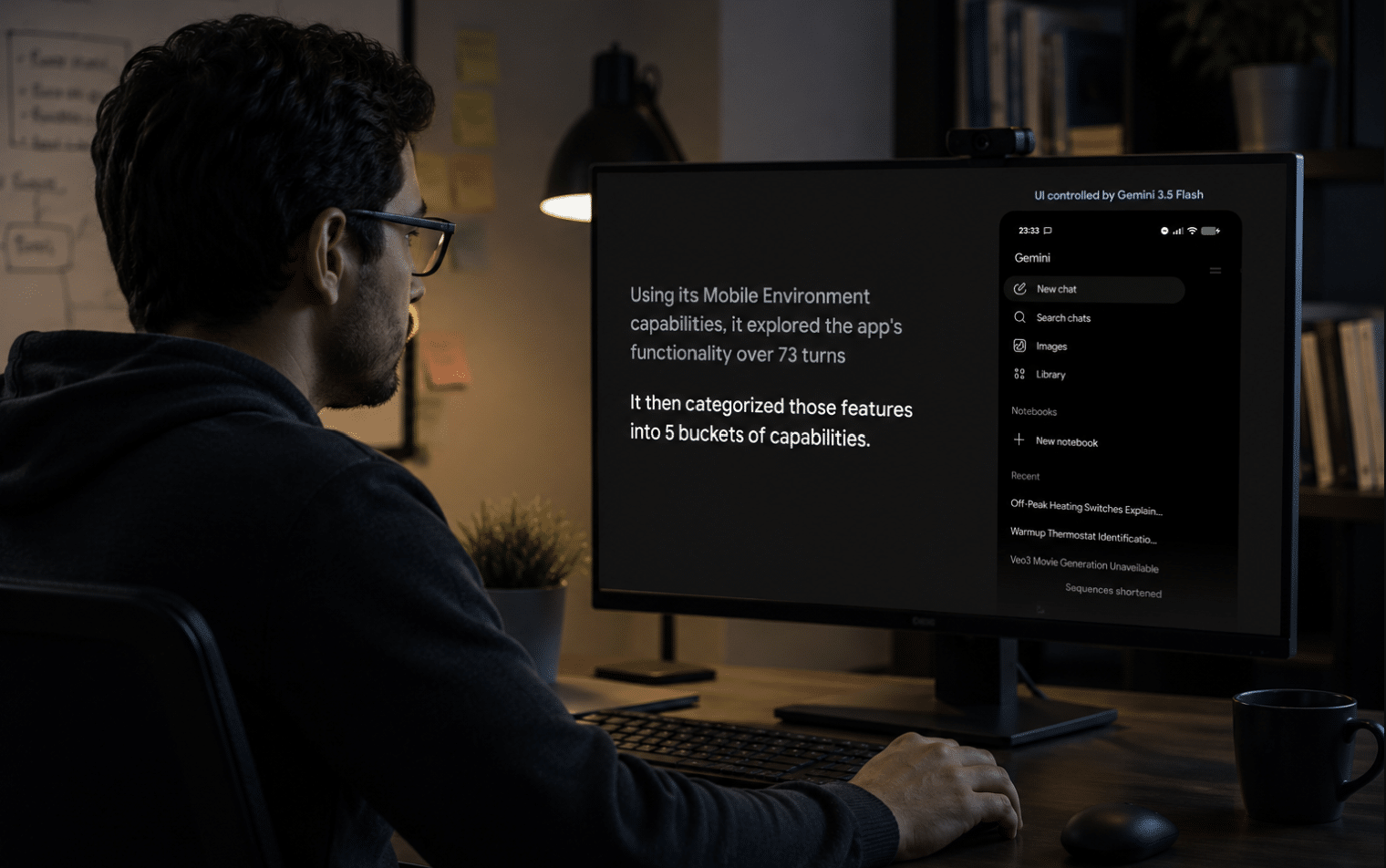
To demonstrate its capabilities, tests have been conducted where the model navigates smoothly through desktop and mobile environments. In these environments, it is able to chain together a series of complex steps without needing manual guidance for each click. For example, it can audit an entire application to ensure it complies with accessibility standards or even play classic games, demonstrating that it fully understands what it sees on the screen at every moment.
Armored security to prevent major problems
It's clear that handing over the controls of a computer to a software program can be a bit daunting, especially in professional environments where sensitive data is involved. That's why engineers have placed great emphasis on adding safeguards against prompt injection , which is simply the attempt to trick the AI using hidden commands on a webpage. If the system detects anything suspicious or an instruction that appears malicious, it automatically stops to avoid unnecessary surprises.
Furthermore, for more sensitive tasks, such as making a payment or deleting important files, Google has included a system requiring explicit user confirmation . This ensures a human oversight before the machine performs any irreversible actions. The recommendation for businesses is to use these agents in controlled environments with clearly defined permissions, as, while the technology is powerful, it still requires this level of supervision to prevent errors at the most inopportune moment.
Availability and applications in the professional sector
The native integration of this feature into Gemini 3.5 Flash greatly simplifies the work for companies looking to automate resource-intensive workflows. Available through the API and enterprise platforms, any developer can begin experimenting with these capabilities to create tools that handle the most repetitive day-to-day tasks, such as continuous software testing or managing massive amounts of documentation in professional applications.
What previously required using multiple different models and juggling code can now be managed from a single, much more efficient piece of technology. This move puts Google in a highly competitive position, offering a model designed for speed and minimal resource consumption—crucial when dealing with processes that need to be repeated thousands of times a workday. It's no longer the future; it's the current reality for anyone looking to boost their business productivity.
The integration of these autonomous control capabilities means that artificial intelligence is beginning to move beyond its text-based limitations and interact with the digital world in a real-world way. While a defense-in-depth approach and cautious deployment are still recommended, the fact that it can now operate natively on computers marks a turning point in the autonomy of digital agents. From now on, our relationship with our computers could change dramatically, as we delegate the most tedious processes to an assistant that can already navigate menus and applications effortlessly.
Table of Contents