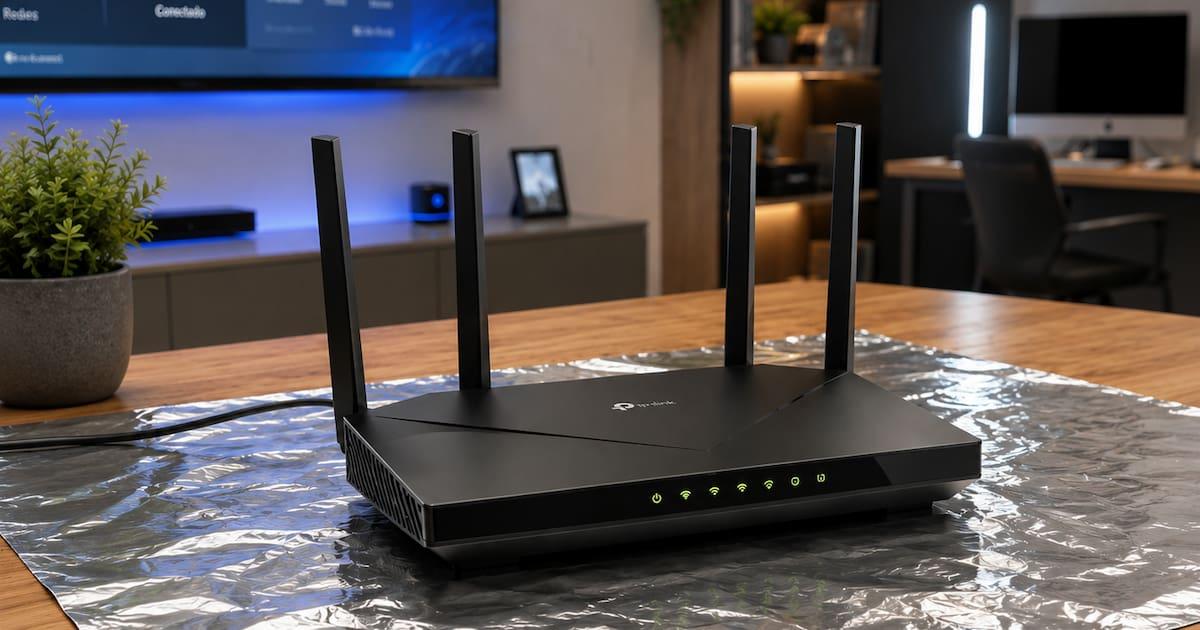
In many Spanish homes, dealing with an unstable Wi-Fi connection is a daily occurrence, especially when load-bearing walls or room layouts disrupt the data flow. Whether we're working from home or enjoying our favorite series , having the video stop due to a weak signal is a frustrating experience we've all had at some point, and one we try to fix however we can.
To try and tackle this problem without spending a penny on expensive repeaters, several homemade and expert tricks for boosting WiFi signal have emerged online, seemingly straight out of a science fiction movie. Among them, the use of aluminum foil and coins strategically placed on the modem has become a viral trend promising miracles, although it's worth analyzing what's true and what's simply user suggestion.
The science behind aluminum foil as a reflector
Although it might sound like a joke, placing a metal sheet behind antennas has a perfectly logical physical explanation. Routers emit radio waves in a 360-degree arc, losing a significant amount of power towards walls or unoccupied areas. By placing a conductive surface behind the antenna, it acts like a mirror for the electromagnetic waves , allowing the signal to bounce and concentrate in the direction we actually need for browsing.
In fact, researchers at Dartmouth University validated this idea a few years ago, demonstrating that 3D-printed, metal-coated reflectors could improve signal strength by up to 50% in specific locations. At home, a simple curved piece of cardboard covered in aluminum can give you a boost of between 10% and 20%, which isn't bad at all for a practically free fix that can be assembled in two minutes.
However, you need to be careful with how you position it, because if you completely enclose the device, all you'll achieve is a Faraday cage effect that will block the connection. Ideally, you should give it a parabolic shape and place it directly behind the device, pointing the open end towards the room where you usually have the worst reception, always making sure the metal doesn't touch the antennas directly to avoid short circuits or other interference.

What about the coin trick?
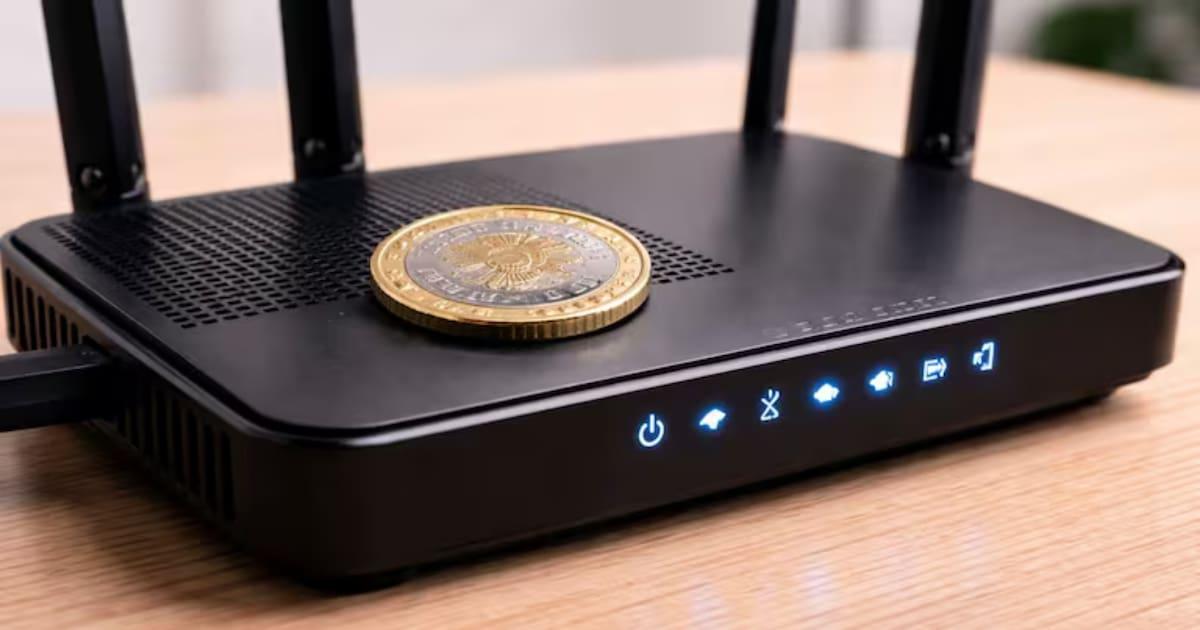
Moving on to the topic of coins, the story changes a bit and enters more the realm of digital urban legends. Some users vehemently defend the idea that placing a coin on the router's chassis helps stabilize the frequency or even dissipate heat from the internal processor. However, telecommunications technicians are quite skeptical, as the size of a coin is insufficient to interact effectively with the wavelengths and frequencies of modern Wi-Fi.
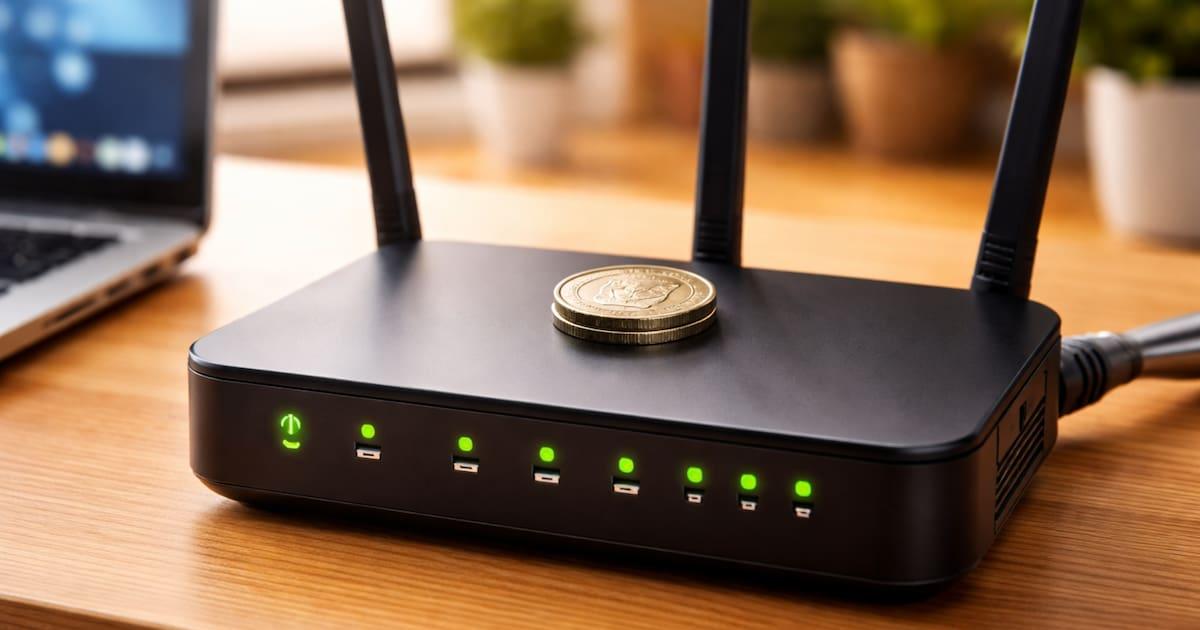
This trick has most likely become popular because many modern modems are extremely lightweight, and network cables often pull them off the table. In these cases, the coin simply acts as a weight, preventing the router from moving and ensuring its antennas are in the optimal position. The metal of the coin doesn't magically improve speed; it simply prevents the device from ending up pointing towards the floor or a dead corner due to the cable's pull.
Precautions to avoid frying the router
Regardless of whether we use aluminum foil or coins, the biggest risk we run is overheating. Routers need to breathe and usually have ventilation grilles on the top or sides; if, in an attempt to gain a couple of megabytes, we block the hot air outlet , performance will plummet due to thermal safety, and in the long run, the device will end up failing much sooner than expected.
If after trying these solutions you find things aren't improving, remember that the most effective solution is still to place the equipment in a high, central location, away from appliances like microwaves, which emit on similar frequencies and disrupt the signal. Ultimately, these small metal hacks might get you out of a pinch, but they're no substitute for proper home network planning or using more up-to-date technology if your house has many floors or very thick walls.
Understanding that wireless signals behave like invisible light allows us to grasp why these materials have such a significant impact on our daily internet browsing. While aluminum offers a physical solution for redirecting data flow to where it's most needed, other elements like coins have a more symbolic or mechanical impact, reminding us that sometimes the best way to improve internet access is simply to clear the path of obstacles and allow the waves to travel with the least possible resistance.

Table of Contents