Until recently, maintaining a server's temperature was a purely technical matter that went largely unnoticed, but things have changed dramatically. With the widespread adoption of generative artificial intelligence, cooling has become the determining factor in deciding how much computing power we can deploy and how much it will cost to keep it running.
The problem is that current racks are reaching brutal power densities, easily exceeding 50 kW. This has made it clear that traditional air conditioning is no longer sufficient, forcing the industry to make an abrupt leap towards direct liquid cooling , which has gone from being a laboratory experiment to the standard for anyone wanting to compete in the sector.
The disruptive concept of Hot Water Cooling
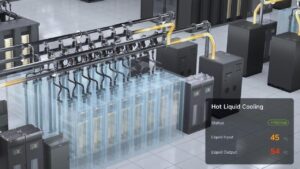
It might sound crazy to try to cool a processor using hot water, but that's precisely where the magic lies. We're talking about systems where the coolant enters at temperatures of 40°C or even 45°C , something that a few years ago would have seemed like a recipe for disaster.
This technique, reminiscent of the temperature of a jacuzzi, is based on basic physics principles. AI chips generate so much heat that a fluid composed of 75% water and 25% propylene glycol can absorb the thermal load, even though the water is already hot. The fluid enters at 45°C and exits the circuit at around 55°C, allowing the processor to operate without its performance being affected by the hot water cooling for AI applications.
The main advantage is that, by operating at higher temperatures, the temperature difference with the outside air is much greater. This allows the system to function passively in most temperate climates using external radiators, eliminating the need for energy-intensive electric chillers.
Advanced architectures: Cold plates and smart CDUs
Simply changing the liquid isn't enough; the entire system needs to be redesigned. The key lies in the cold plates with internal microstructures. A high-quality plate captures between 80% and 90% of the generated heat, allowing the data center to rely on dry chillers with minimal energy consumption.
On the other hand, we have the CDUs (Coolant Distribution Units). To prevent them from becoming a system bottleneck, Eaton proposes that these units be intelligent and coordinated with the electrical architecture. When the power and cooling systems speak the same language, much greater reliability is achieved from the chip to the power grid, establishing a new standard for AI infrastructure.
- Energy saving: Energy costs can be reduced by between 20% and 40%.
- More computing: By freeing up energy budget from the coolers, more GPUs can be powered, achieving a 33% increase in production from the AI factory.
- Water sustainability: By using closed circuits that are only filled once, evaporation towers are eliminated, reducing water consumption by almost 100%.

The case of NVIDIA's Rubin architecture
NVIDIA has taken this to the next level with its Rubin architecture. They've done away with the noisy fans, which typically exceed 85 decibels, and sealed the server motherboards, creating an end-to-end liquid cooling system . Essentially, they've achieved NVIDIA's disruptive shift for AI by reinventing how heat is dissipated from the server.
However, it's not all good news. Although NVIDIA has solved the water problem within its facilities, the external environmental impact remains a challenge. The power generation required for these centers still relies heavily on natural gas and coal, which consume enormous quantities of water during their electricity production process.
Despite these external challenges, the transition is irreversible. As power density increases, air cooling becomes insufficient, and liquid cooling becomes an essential, not optional, solution to ensure chips don't fail prematurely and maintain peak performance.
The path to sustainable AI involves integrating thermal management with electrical distribution, optimizing every watt to convert it into computing power. Adopting closed-loop hot water systems not only improves business profitability by saving on electricity, but also sets the standard for the digital infrastructure of the next decade.