Thermal management in data centers has ceased to be a mere technical detail and has become the central axis defining the viability of Artificial Intelligence. With the explosion of generative AI, we are seeing racks with power densities exceeding 50 kW, rendering traditional air conditioning inadequate and completely impractical. This is not a slow change, but rather an abrupt transition to direct liquid cooling of the processor, which is no longer a laboratory experiment but the foundation of any installation that wants to remain competitive.
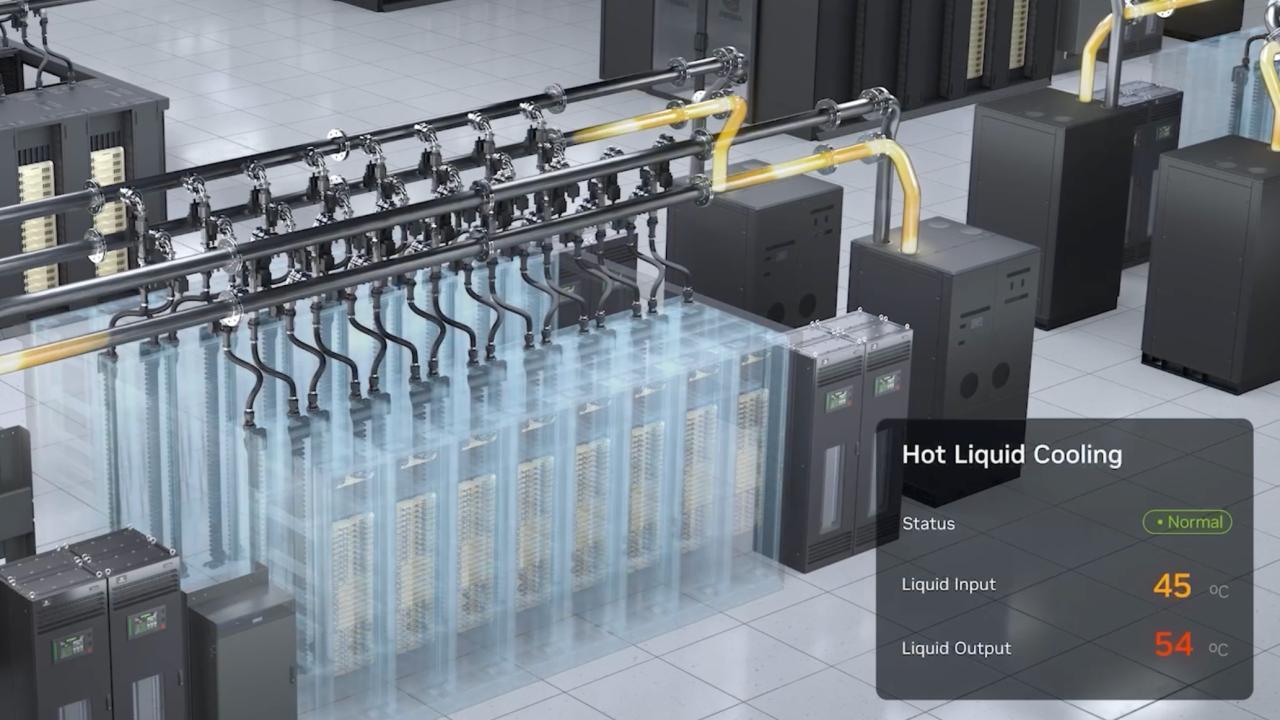
In this new scenario, the concept of hot water cooling , where the coolant enters at temperatures exceeding 40 or even 45 °C, is revolutionizing data center design. It's not simply a matter of changing the liquid; it requires rethinking the electrical architecture and distribution systems. Today, success isn't measured solely by PUE, but by evaluating how much actual computing power can be extracted from each kilowatt connected to the electrical grid, making thermal efficiency a matter of pure and simple profitability for the business.

The technical leap: Why use hot water?
At first glance, cooling chips with 45°C water sounds crazy, almost like using hot tub water, but this is precisely where the magic of efficiency lies. The logic is simple: the higher the temperature of the circulating liquid, the easier it is to expel the heat to the outside without needing to resort to energy-guzzling compressors or chillers. This allows data centers to use closed-loop dry coolers , virtually eliminating reliance on evaporative cooling and reducing water consumption to almost zero in favorable climates.
For this to work, advanced cold plates with internal microstructures are essential . These high-precision components allow 80% to 90% of the heat to be captured directly in the GPU or CPU. If the plate is mediocre, the system fails; if it's high-quality, heat can be managed at the chip level so effectively that the energy budget previously spent cooling the air can now be redirected to power more GPUs , resulting in increased computing power and aligning with the current thermal hardware revolution.

Critical components: CDU and network architecture
The heart of this system is the intelligent Refrigerant Distribution Unit ( CDU ). These units not only move the refrigerant but also act as the brain that coordinates the cooling process with the electrical architecture. When both systems are designed together, much greater reliability is achieved from the chip to the network , preventing the CDU from becoming an operational bottleneck.
- Cold Plates: Designed to handle thermal outputs up to 1.500 W, compatible with NVIDIA, AMD or Intel silicon.
- Intelligent CDUs: They manage flow rates and capacities ranging from 105 kW to 2,3 MW.
- Rack manifolds: Stainless steel collectors that ensure that the flow between the plates and the CDU is smooth and leak-free.
- Rear Door Heat Exchangers (RDHx): Solutions that remove heat using liquid-cooled air with capacities up to 75 kW.
The implementation of these technologies allows liquid cooling to be up to 3.000 times more effective than air at capturing thermal energy. Furthermore, by reducing noise and carbon emissions, much more sustainable and safer operating environments are created, decreasing reliance on heavy infrastructure such as traditional CRAHs or condensers.

Economic impact and the vision of "AI Factories"
We are moving from viewing the data center as a cold room full of servers to understanding it as an optimized industrial plant . This "AI factory" concept aims to maximize token production and the training of massive models. According to industry data, the integration of advanced liquid cooling can result in energy savings of between 20% and 40% , which directly impacts the bottom line.
The strategy of giants like NVIDIA, with their reference platforms such as DSX and the Rubin generation, aims for a 100% liquid-cooled infrastructure . This involves eliminating internal fans entirely, integrating networking, computing, and power into a single ecosystem. By optimizing thermal design, it's possible to achieve up to 33% more computing output per power connection, allowing more power to be packed into a smaller footprint.
Although this may seem like a panacea, transitioning from a well-tuned air cooling system to a liquid one involves operational risks and considerable integration complexity. However, when racks exceed 50 kW, liquid cooling ceases to be optional . It is no longer a luxury for HPC or scientific computing, but an indispensable requirement to sustain the workload of Large Language Models (LLM) without equipment failures due to overheating or reduced lifespan.
Table of Contents