

Generative artificial intelligence has taken such a massive leap that data centers are falling behind. We're no longer talking about simple servers, but racks with a power density that's practically smoking, easily exceeding 50 kW. In this scenario, thermal management has gone from being a technical detail to the bottleneck that determines how much computing we can run and at what price.
To solve this problem, direct liquid cooling of the chip has become the norm . Forget giant air conditioners that move cold air; now the trend is to deliver the liquid directly to where the processor is heating up. This change is crucial because Long Language Models (LLM) demand a much more aggressive and efficient cooling infrastructure to prevent hardware degradation.

Nvidia's disruptive concept and "jacuzzi" cooling
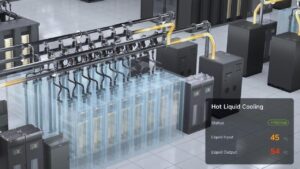
Nvidia has entered the fray with a proposal that, at first glance, sounds crazy: using hot water for cooling. The trick is that its new Rubin architecture servers can operate with a liquid that enters at 45°C. To put it in perspective, it's like putting the processor in a hot tub, but thanks to physics, the system works perfectly.
The secret lies in the fluid used, a mixture composed of 75% water and 25% propylene glycol. Because AI chips generate a tremendous amount of heat, this fluid is able to absorb the thermal load even from that high temperature, exiting the circuit at around 55°C. This allows the temperature difference with the outside air to be large enough to passively dissipate the heat via external radiators in most climates.
The most amazing thing about this system is that it eliminates fans. By sealing the server circuit boards and removing the fans, which typically create a deafening noise exceeding 85 decibels, a much quieter and more efficient environment is achieved . Furthermore, since it's a closed circuit that only needs to be filled once, evaporative cooling towers are eliminated, reducing internal data center water consumption by almost 100%.
Advanced architectures: CDU and cold plates
Simply pouring hot water on the chip isn't enough; it requires precision engineering. This is where Coolant Distribution Units (CDUs) and cold plates come into play. According to Eaton experts, a good cold plate differs from a mediocre one due to its high-precision internal microstructures , which allow heat to transfer from the chip to the liquid almost instantaneously.
The smart CDUs act as the brain of the system, coordinating the flow of liquid with the electrical architecture . This integration is key because it allows the system to save energy on cooling, redirecting that power budget to power more GPUs. In real terms, this can represent a 33% increase in computing output per power connection.

- High-capacity CDU: Capable of handling thermal loads from 105 kW to 2,3 MW.
- Rear Door Heat Exchangers (RDHx): They remove heat from powerful processors with capacities up to 75 kW.
- Dynamic cold plates: Capable of cooling chips with thermal outputs exceeding 1.500 W.
- Rack manifolds: Stainless steel manifolds that ensure the coolant reaches every corner without leaks.
Environmental impact and remaining challenges
Although Nvidia boasts of having solved the water problem within its own walls, the bigger picture needs to be considered. Water consumption doesn't only occur in the server itself, but also in the generation of the electricity that powers it. Coal and natural gas plants, which will remain a significant part of the energy mix until 2030, consume enormous quantities of water for every kWh generated.
In other words, even though the data center is a closed-loop, environmentally friendly system, the water bill shifts to the power plant. Even so, the transition is necessary. Switching from air to liquid cooling is the only way to prevent overheating from reducing the lifespan of critical components in environments where power density can reach up to 120 kW per rack.
Liquid cooling is now up to 3.000 times more effective than air at capturing heat. This not only improves performance but also reduces the carbon footprint by eliminating traditional chillers and condensers, opting instead for free cooling solutions and oil-free centrifugal chillers that optimize overall energy consumption.
The AI industry is forcing a reinvention of server thermodynamics, shifting from conservative systems to architectures where hot water and intelligent flow management take center stage. This technological leap allows for maximizing computing density and business profitability, ensuring that the infrastructure can support the exponential growth of LLMs without collapsing due to overheating.