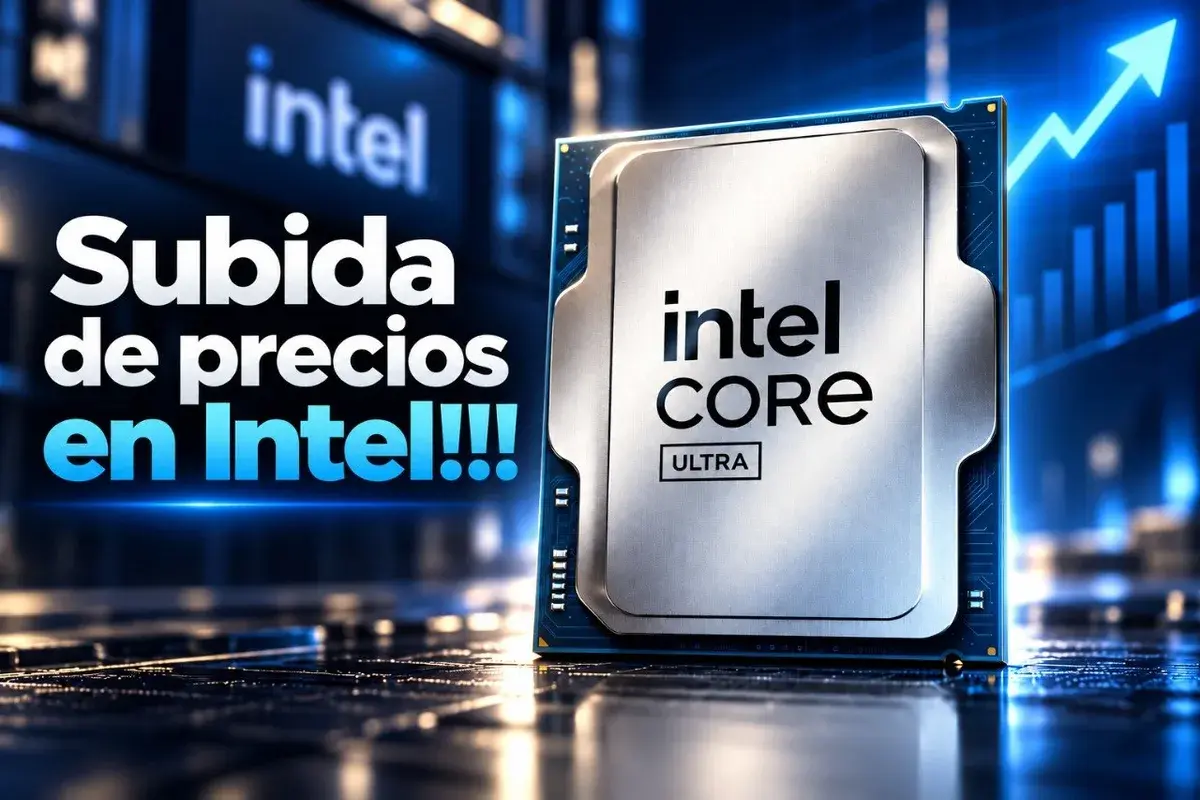
The hardware market is experiencing a perfect storm. The RAM and storage crisis, driven by the rise of artificial intelligence, has sent production costs for every component soaring. Manufacturers, far from absorbing this increase, are passing it on to the end consumer. And Intel is no exception . The Santa Clara-based company has already implemented several price hikes throughout 2026, and all signs point to another one coming in October.
According to supply chain sources cited by DigiTimes, Intel plans to increase the price of its PC processors by an additional 10% starting October 5th. This adjustment comes on top of those already implemented at the end of 2025 and during the first quarter of 2026, when the Core Ultra 7 270K Plus and Core Ultra 5 250K Plus saw price increases. The company justifies these changes by citing rising supply chain costs and high demand, but there is also a clear strategy behind them: to improve profitability.
Price increases in October: the impact on your wallet
The new 10% price increase is not an isolated move. Intel had already raised the prices of its PC CPUs several times since the end of 2025. In July, for example, increases ranged from several tens of euros for consumer products to over €1.041 (including VAT) for some server components. Now, with the October price hike, the company is looking to further squeeze more profit from its current product line.
The available information doesn't specify which processor families will be affected, nor whether the price increase will apply equally to desktop and laptop models. It's also unclear whether the next-generation Core Ultra processors, expected in 2027, will be affected by this revision. What does seem certain is that the increase will be widespread, as has been the case in the past.
This pricing policy isn't unique to Intel. AMD has also raised the cost of its processors in recent months, and the trend suggests that PCs will be more expensive over the next two years. Global PC shipments are estimated to fall from 260 million units in 2026 to 250 million in 2027, a drop that reflects the impact of prices on demand.

The profitability strategy: goodbye to Small Core
Beyond the price increase, Intel is undergoing a profound internal reorganization. CEO Lip-Bu Tan has made it clear that the priority is improving gross margin, even if it means losing market share. In this context, the company has decided to discontinue its Small Core product line, which includes low-margin chips used in industrial PCs, embedded systems, and IoT devices.
The discontinuation of these products will not affect the E-cores of conventional Core processors, but it will leave a gap in the market that Qualcomm and MediaTek could exploit to expand their presence in the industrial PC and IoT sectors. Intel, for its part, prefers to focus its resources on server processors, which offer much higher margins.
This decision also has implications for production. Intel is prioritizing the manufacture of its server CPUs in its own factories, while consumer products are outsourced to TSMC. This could reduce the production capacity available for PC processors, putting additional pressure on the highly anticipated Intel 18A and Intel 14A processes .

AI as a backdrop
The increased demand for CPUs for artificial intelligence is one of the factors behind this price spiral. Unlike data centers loaded with NVIDIA GPUs, conventional CPUs are not designed for training models, but rather for inference and data processing tasks. Agentic AI, which can autonomously execute complex tasks, has brought Intel processors back into the spotlight.
Furthermore, the most advanced processors are manufactured on the 3-nanometer node, a technology also used for GPUs and other AI accelerators. This creates a production bottleneck, as only TSMC and Samsung can manufacture on a large scale using this node. Intel, which relies on TSMC for its consumer products, is limited by its partner's capacity.
Analysts predict the memory crisis will extend beyond 2030, meaning component prices will remain volatile for years to come. Meanwhile, Intel is trying to weather this storm with a clear strategy: make more money on every sale, even if it sells fewer units. The October price increase is just one more step in that direction.
In short, Intel faces a turbulent autumn with a 10% price increase on its processors, the discontinuation of its Small Core range, and a firm commitment to profitability. Consumers will feel the impact on their wallets, and PC manufacturers will have to decide whether to pass the increase on to the final price or reduce their profit margins. The only certainty is that hardware, at least for now, isn't going to get any cheaper.