
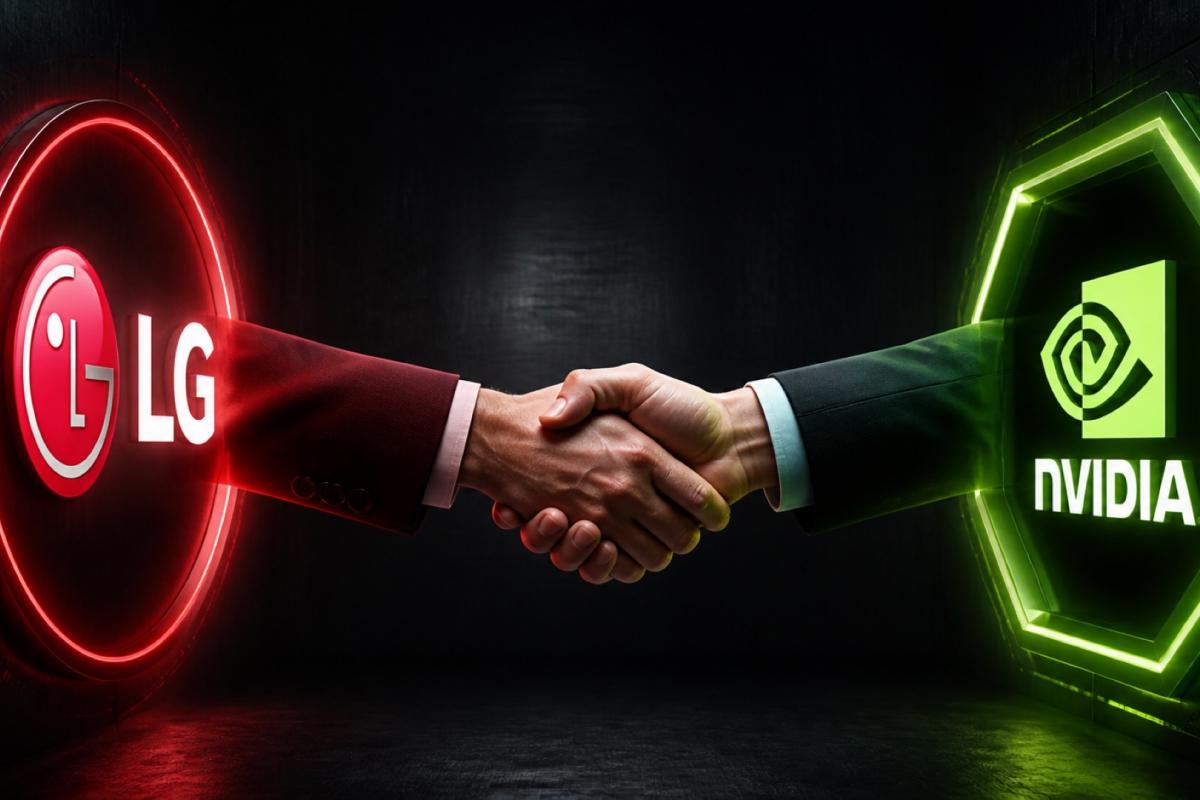
South Korean technology company LG and US giant Nvidia have formalized their strategic collaboration with the signing of a memorandum of understanding covering robotics, artificial intelligence factories, and mobility. The agreement, sealed on August 13 at Nvidia's headquarters in Santa Clara, California, was attended by the top executives of both companies: Koo Kwang-mo, president of LG Corp, and Jensen Huang, CEO of Nvidia. This pact comes just two months after an initial meeting in Seoul, demonstrating the speed with which the alliance has been forged.
The goal is to accelerate the development of physical AI —machines capable of perceiving, reasoning, and acting in the real world. To achieve this, LG will contribute its expertise in manufacturing, consumer electronics, and components, while Nvidia will provide its computing platforms and AI models. The first visible outcome will be a bipedal humanoid robot, to be unveiled in the first quarter of 2027, but the collaboration extends far beyond this: it includes the construction of large-scale AI factories and the development of software-defined vehicles.

A humanoid robot with Nvidia technology
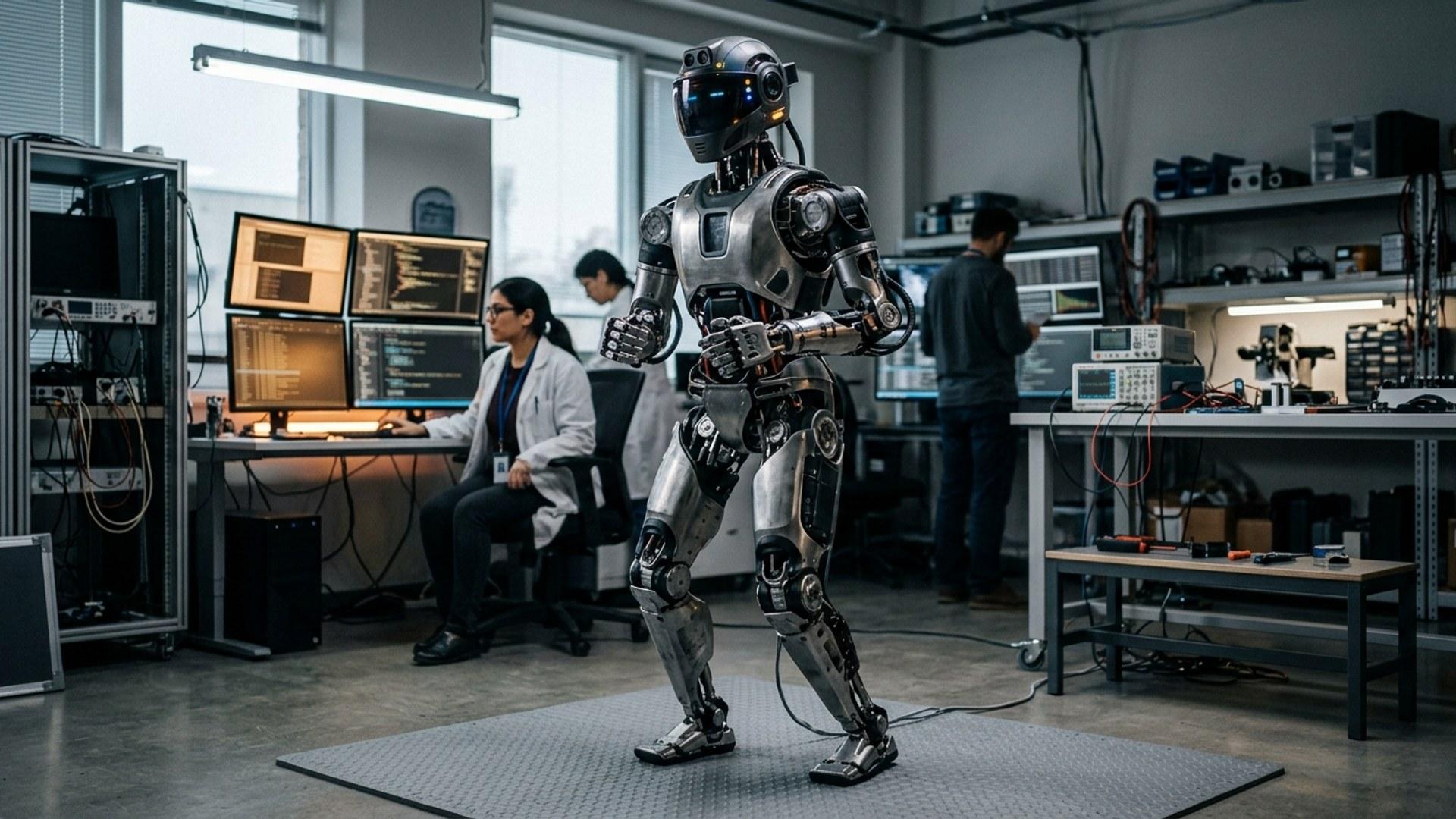
LG's humanoid robot will be bipedal and equipped with Nvidia's Jetson Thor chip for onboard computing, reasoning, and control. It will be built on the open-source Isaac GR00T foundation model, which provides advanced perception and planning capabilities, and will feature the Halos for Robotics safety system. For hardware, LG will integrate actuators from LG Electronics, sensors from LG Innotek, and batteries from LG Energy Solution, leveraging internal synergies within the South Korean conglomerate.
The company is also developing its own Robot Foundation Model (RFM), which will be powered by data collected through LG CNS's PhysicalWorks platform. This dual approach, combining Nvidia's open model with in-house development, aims to differentiate itself in an increasingly competitive humanoid robot market . The humanoid's public unveiling is planned for the first quarter of 2027, although the pilot line in Changwon is already producing early components.

Wheeled robots for the Tennessee factory
Before developing a humanoid robot, LG will test its technology in a real-world environment. The company will deploy its CLOiD wheeled robot on the washing machine production line at its Tennessee plant before the end of 2026. This proof-of-concept trial will validate the robot's perception, navigation, and basic manipulation capabilities in an operational industrial setting. If the results are satisfactory, the robotic technology will be rolled out to factories and then expanded to other production facilities, as well as homes and commercial spaces.
The choice of Tennessee is no coincidence: it's home to one of LG's most modern factories in North America and will serve as a real-world testing ground for Nvidia's software. The data collected during this validation will be used to improve the algorithms and the robots' behavior, creating a continuous feedback loop. This intermediate step is crucial for mitigating risks before launching the much more complex bipedal humanoid.
AI Factories: LG's plan for 2027 and 2028
The second pillar of the agreement is the construction of artificial intelligence factories. LG plans to build a reference site based on the Nvidia Vera Rubin platform during the first half of 2027. Subsequently, in the first half of 2028, it will construct an 80-megawatt facility in Cheonan, South Chungcheong Province, South Korea. For this latter project, the company will use prefabricated construction methods that will reduce construction time by more than 20%.

These facilities will not only house the computing systems needed to train AI models, but will also be offered as turnkey solutions to major technology clients. LG will combine Nvidia's DSX architecture with its capabilities in cooling, power, and design, creating a comprehensive package that it hopes to market globally. The Cheonan factory will focus on advancing physical AI and robot foundation models.
Future mobility: AI-defined vehicles
The third area of collaboration is mobility. LG will develop a high-performance computing platform for AI-defined vehicles, built on Nvidia DRIVE Hyperion. This platform will integrate LG's infotainment and automotive software capabilities with Nvidia's autonomous driving technologies. The goal is to offer automakers next-generation solutions that combine autonomous driving features with in-cabin AI services.
This move expands LG's automotive electronics business, which until now has focused primarily on components, into the realm of autonomous driving . The company expects this diversification to allow it to capture new growth opportunities in the future mobility market, leveraging the same technological architecture that powers its robots.

The announcement did not go unnoticed in the markets. LG's shares rose by more than 6% on Friday after the news broke, reflecting investor optimism about the new business lines. The two companies will also operate a joint working group , comprised of technical and commercial experts, which will be responsible for coordinating research, development, field testing, and commercialization across all three areas of the agreement.
The alliance between LG and Nvidia represents a significant step towards the realization of physical AI. With a humanoid robot on the horizon, large-scale AI factories, and autonomous vehicles under development, both companies are positioning themselves to lead a market that promises to transform both industry and everyday life. It remains to be seen how these plans will materialize in the coming years, but the roadmap has certainly been laid.
