

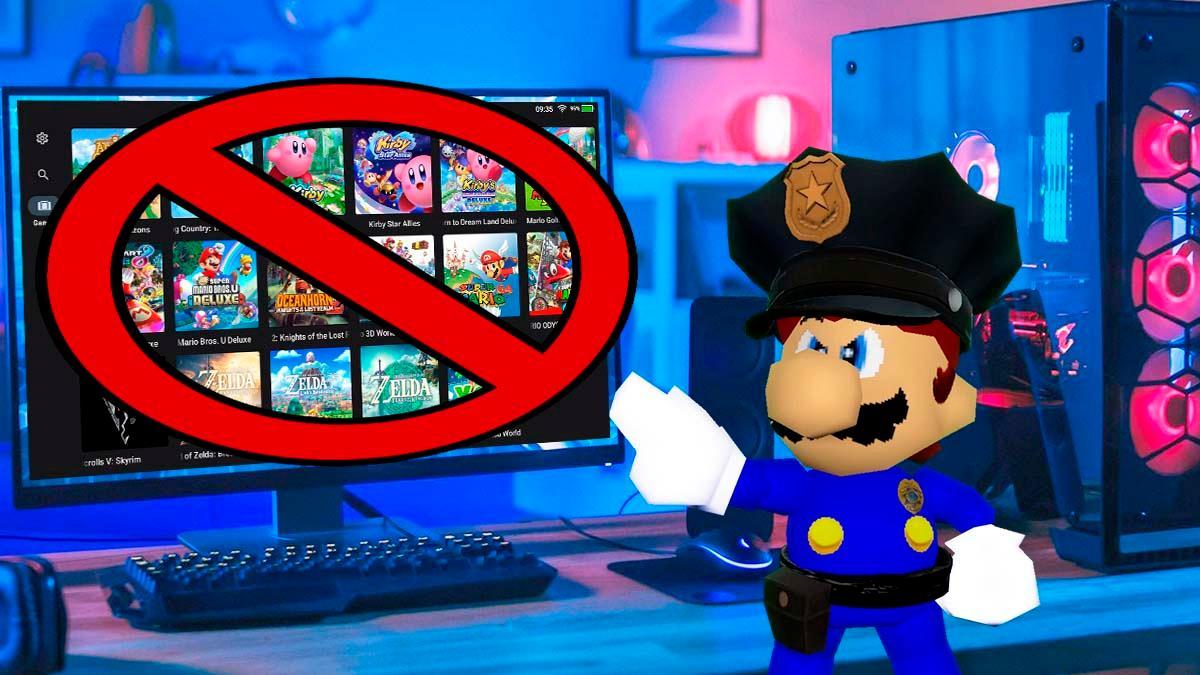
Nintendo has once again dealt a significant blow to the emulation community. The Japanese company has succeeded in getting GitHub to remove 401 code repositories linked to Nintendo Switch emulators, after sending seven takedown requests for copyright infringement (DMCA) in a single day. This operation, carried out in less than 24 hours, makes it clear that the multinational has no intention of letting its guard down in its ongoing crusade against piracy of its titles.
This isn't a new move. The Kyoto-based company had already taken down more than 8.500 Yuzu repositories in May 2024, and in February of this year, it again requested the removal of the remaining files for that emulator and twelve other projects. With this new offensive, Nintendo reaffirms a strategy that has become an open war against any tool that allows its games to be played outside the official ecosystem.
New wave of DMCA complaints
The latest action has had a devastating effect. A total of 401 repositories have been removed from GitHub, with the Suyu emulator, one of the best-known successors to Yuzu, playing a major role. In fact, 311 of those projects were forks of Suyu, representing the largest block on the network for this emulator since it began to gain popularity after the closure of Yuzu.

The spotlight has also fallen on other alternatives. Skyline, the Android emulator, and MonoNX, a project written in C#, have been affected by the same claims, as have numerous variants based on the original Yuzu code. Any user attempting to access these links now encounters a message warning of the content's removal and a direct link to the petition filed by Nintendo.
Nintendo's legal justification
Nintendo's argument rests on a solid technical and legal foundation. According to its filing, Switch emulators illegally circumvent technological protection measures to run unauthorized copies of games. The company points out that Switch titles are encrypted using proprietary cryptographic keys, called prod.keys , and that these programs necessarily require unauthorized copies of these keys to decrypt the ROM files upon execution.
This distribution, it adds, constitutes illegal trafficking under the DMCA. Nintendo hasn't limited itself to reporting the individual actions of each developer, but has instead taken advantage of a particular feature of GitHub: the so-called fork network rule. A single report against the root of a project is enough to automatically take down all its branches or forks, a mechanism that has maximized the impact of these seven warnings.
Background: the Yuzu case and judicial pressure
This latest blow cannot be understood without considering the Yuzu case, the emulator that nearly made a splash but ultimately ended with a financial settlement and the project's demise. Nintendo claimed at the time that Zelda: Tears of the Kingdom had been downloaded over a million times before its official release, and that Yuzu "facilitated piracy on a colossal scale." Tropic Haze, the company that developed the tool, eventually agreed to pay Nintendo $2,4 million in compensation.

Since then, Nintendo hasn't stopped taking action. Back in February of this year, it managed to remove 218 repositories related to Yuzu and other projects, and now it's surpassing that number with this new wave. Although some of the original developers have disappeared, forks and new versions keep appearing , turning this battle into a constant game of cat and mouse. Nintendo seems determined to continue until the end, as long as emulators with unauthorized copies of its encryption systems keep appearing.
The mass removal of 401 repositories makes it clear that the Japanese company will not tolerate any further steps regarding the distribution of tools that allow Switch games to be run illegally. Although the emulation community is trying to reorganize, it is finding increasingly less space on platforms like GitHub. With the memory of Yuzu still fresh and an ever-stronger legal arsenal, Nintendo has once again demonstrated that its anti-piracy policy makes no exceptions and that it will remain vigilant against any new threat to its ecosystem.