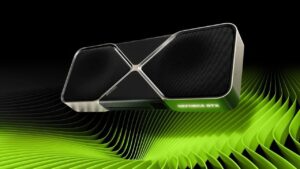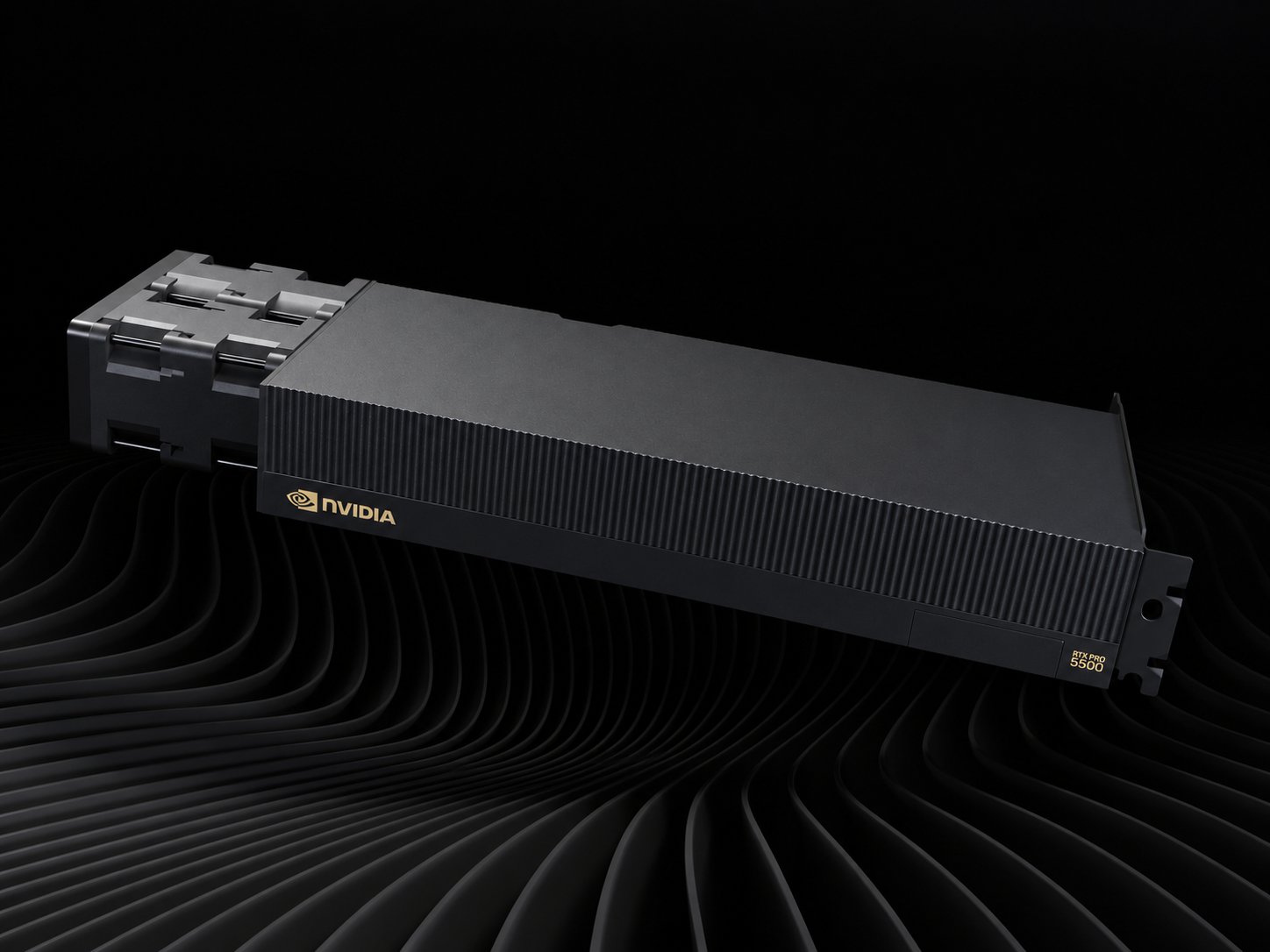
NVIDIA has quietly expanded its Blackwell professional GPU lineup with a new model called the RTX Pro 5500, which slots between the RTX Pro 5000 and the flagship RTX Pro 6000. However, in terms of memory and power consumption, it's much closer to the high-end than the mid-range model, making it a very attractive option for demanding workloads.
Although the company hasn't set a specific release date, the card is already listed as "coming soon" on some manufacturers' product pages. The specifications published by PNY reveal very powerful hardware, designed for rack-mounted workstations and artificial intelligence applications, where memory capacity and raw performance are critical.
An intermediate step with high-end specifications
The RTX Pro 5500 uses a 750 mm² Blackwell GPU, most likely a cut-down version of the GB202. This chip integrates 92.2 billion transistors and 21,760 CUDA cores , a figure that exactly matches that of the desktop GeForce RTX 5090. To give you an idea, the RTX Pro 6000 has 24,064 CUDA cores, while the RTX Pro 5000 has 14,080. Therefore, this new card is clearly positioned at the top of the range, despite its name.
The computing power is combined with 84 GB of error-correcting (ECC) GDDR7 memory , allowing it to handle very large datasets without fear of corruption. PNY indicates a bandwidth of 1,398 GB/s, a figure quite close to that offered by the RTX Pro 6000. Furthermore, the card supports PCIe 5.0 x16 and features four DisplayPort 2.1b outputs, as well as three ninth-generation NVENC encoders and three sixth-generation NVDEC decoders.
Memory and bandwidth: the bus dilemma
The memory section is generating some controversy because the official specifications appear to contain an error. PNY mentions a 416-bit memory interface, but that configuration is inherently incompatible with 84 GB of capacity . A 416-bit interface corresponds to thirteen 32-bit channels, making it difficult to achieve that amount of memory. If fourteen 6 GB modules were used, we would obtain exactly 84 GB with a 448-bit bus. This bus, operating at around 25 Gbps, would provide approximately 1,400 GB/s, which almost exactly matches the official figure. Therefore, it is very likely that the 416-bit figure is a typographical error and that the actual bus is 448 bits.
The memory is also configurable using MIG technology, which allows the GPU to be divided into two isolated 42GB instances , very useful for virtualized environments or for running multiple AI tasks in parallel. This flexibility is one of the hallmarks of NVIDIA's professional graphics cards designed for data centers.
Connectivity and energy consumption
The maximum declared power consumption is 600W, a figure that demands a robust cooling system and a high-capacity power supply. It's very likely that the card uses the 12VHPWR connector, the same one that has been the subject of some safety issues in the past. Although NVIDIA has tried to improve its design, it's still a point to watch out for, especially under extreme load conditions. The RTX Pro 5500 is designed for rack deployments , not for conventional desktop computers. Its 4,4 x 11,1-inch size and dual slots with active air cooling make it more suitable for servers or professional workstations.
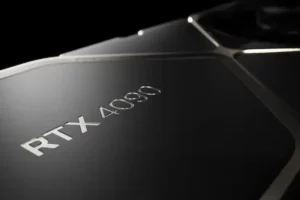
Nvidia claims it will also release a liquid-cooled variant, though it hasn't provided further details. As for the price, there's no official figure, but considering the card's positioning and the cost of its higher-end counterparts, it's likely to be in the five-figure range, similar to the RTX Pro 6000 series. That said, the performance it offers justifies the investment for those who require maximum graphics processing power and memory capacity.
The arrival of the RTX Pro 5500 is good news for the European market, where demand for professional GPUs with large memory capacities is booming thanks to the growth of artificial intelligence and machine learning. Many companies are looking for alternatives that don't reach the price point of top-of-the-line cards but still offer impressive performance. With this new option, NVIDIA completes its Blackwell range for professionals, ensuring that every segment has a suitable choice.
In short, the RTX Pro 5500 stands out for its 84GB of memory, outstanding computing power, and rack-mountable design. Questions remain about the actual bus speed and price, but what's clear is that NVIDIA is making a strong push into the professional market with this new card.