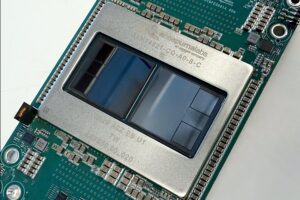
OpenAI has taken a significant step in its technological independence strategy with the presentation of the first results from its custom AI processor, dubbed Jalapeño. Developed in collaboration with Broadcom, this inference-focused chip has outperformed the Nvidia GB200 and GB300 accelerators in two key metrics: processing power per watt and response speed. The data, released at the Hot Chips conference and reported by outlets such as Bloomberg and The Verge, positions OpenAI in an unprecedented way in the AI hardware race.
This is no small announcement. Until now, OpenAI relied almost entirely on Nvidia processors to run its models, both in the training and inference phases—that is, when the system responds to user queries. With Jalapeño, the company aims to reduce its operating costs and gain control over its infrastructure, though without completely abandoning Nvidia. According to Richard Ho, OpenAI's head of hardware, the chip offers what he calls "the best of both worlds": high capacity to serve many clients simultaneously and low latency for interactive applications.

What is Jalapeño and how does it work?
Jalapeño is an application-specific integrated circuit (ASIC), designed from the ground up for a single task: running pre-trained language models. Unlike Nvidia's GPUs, which are general-purpose processors, this chip is optimized for the inference phase, where the system processes a request and generates a response. It is not intended for training models, a task that remains the domain of Nvidia's GPUs and which OpenAI will continue to use for that purpose.
The chip's design focuses on reducing bottlenecks that typically occur during inference, such as data movement between memory and compute units. According to the company, Jalapeño integrates a large compute section alongside six high-bandwidth memory (HBM) blocks, allowing data to be kept local and avoiding unnecessary transfers. Furthermore, the chip can activate the appropriate combination of resources for each processing phase, improving both the AI's performance and energy efficiency.

Benchmark results against Nvidia
The tests were conducted using SemiAnalysis' public InferenceX platform, which measures the performance of AI systems under real-world conditions. OpenAI compared Jalapeño to the best scores achieved by the Nvidia GB200 and GB300 superchips, which were the available benchmarks at the time of testing. The results showed that Jalapeño achieves between 1,5 and 1,9 times more AI work per watt, and end-to-end latency between 1,7 and 3,6 times lower. The models used in the test suite were GPT-OSS 120B, DeepSeek R1, and Kimi K3 , a mix ranging from open weights to frontier models.
These numbers are especially relevant because energy efficiency has become one of the industry's main challenges. AI data centers consume enormous amounts of electricity, and reducing consumption per unit of work can lead to significant savings. According to Richard Ho, Jalapeño operates at around 700 watts, a relatively low figure for an inference accelerator, and could reduce operating costs by around 50% compared to conventional GPUs, according to Broadcom CEO Hock Tan.

Collaboration with Broadcom and roadmap
The development of Jalapeño is the result of a strategic alliance between OpenAI and Broadcom, announced in October 2025. Broadcom contributes its expertise in silicon design, networking, and manufacturing, while OpenAI has used its own AI models to accelerate the design process. The chip went from initial design to tape-out, the final stage before manufacturing, in just nine months—a record time for an advanced semiconductor.
OpenAI is already working on a second generation of the processor and has a third under development. The company plans to deploy the first systems with Jalapeño in very small volumes by the end of 2026 and significantly expand its use during 2027. According to Bloomberg, the deployment will take place in data centers of Microsoft and other partners, and the scale is expected to reach 10 gigawatts of computing power by 2029. However, the results presented are preliminary and have not yet been validated in a large-scale production environment.
Implications for the market and users
The arrival of Jalapeño doesn't mean OpenAI is abandoning Nvidia. The company has insisted that Nvidia remains a key partner, especially for model training, and that the demand for computing power is so high that it needs multiple vendors. In fact, OpenAI also works with AMD and Cerebras, and its strategy involves building a heterogeneous infrastructure where each workload is assigned to the most efficient hardware.
For users and developers, this news has direct implications. If Jalapeño delivers on its promises, the cost per inference token could drop between 30% and 50% in the next 18 months, allowing startups and companies to offer more affordable AI services with lower latency. Furthermore, competition in the AI chip market is intensifying, which could translate into better prices and more options for end users.
Finally, it's worth noting that the tests didn't include a comparison with Nvidia's new Vera Rubin architecture, which has only recently begun shipping. Therefore, Jalapeño's advantage could diminish when Nvidia releases its next generation. Even so, OpenAI's progress demonstrates that the AI industry is entering a new phase, where custom hardware will play an increasingly important role. The race for efficiency and speed has only just begun.