In the field of automation and industrial electronics, efficient and safe management of electrical load switching is key to ensuring both the performance and durability of equipment. In this regard, the SSR-25DA solid-state relay has become an increasingly popular alternative to traditional electromechanical relays, thanks to its advanced features, reliability, and versatility of applications. If you've come here looking for detailed information, usage tips, advantages, and important considerations before installing an SSR-25DA, this article is for you.
Throughout this informative guide, you will discover exactly what an SSR-25DA solid-state relay is , how it works internally, its technical specifications according to leading manufacturers and distributors, its main applications in control and automation systems, and the key differences compared to traditional mechanical relays . All of this is accompanied by recommendations, safety warnings, and practical details derived from both user experience and official documentation.
What is a SSR-25DA solid state relay?
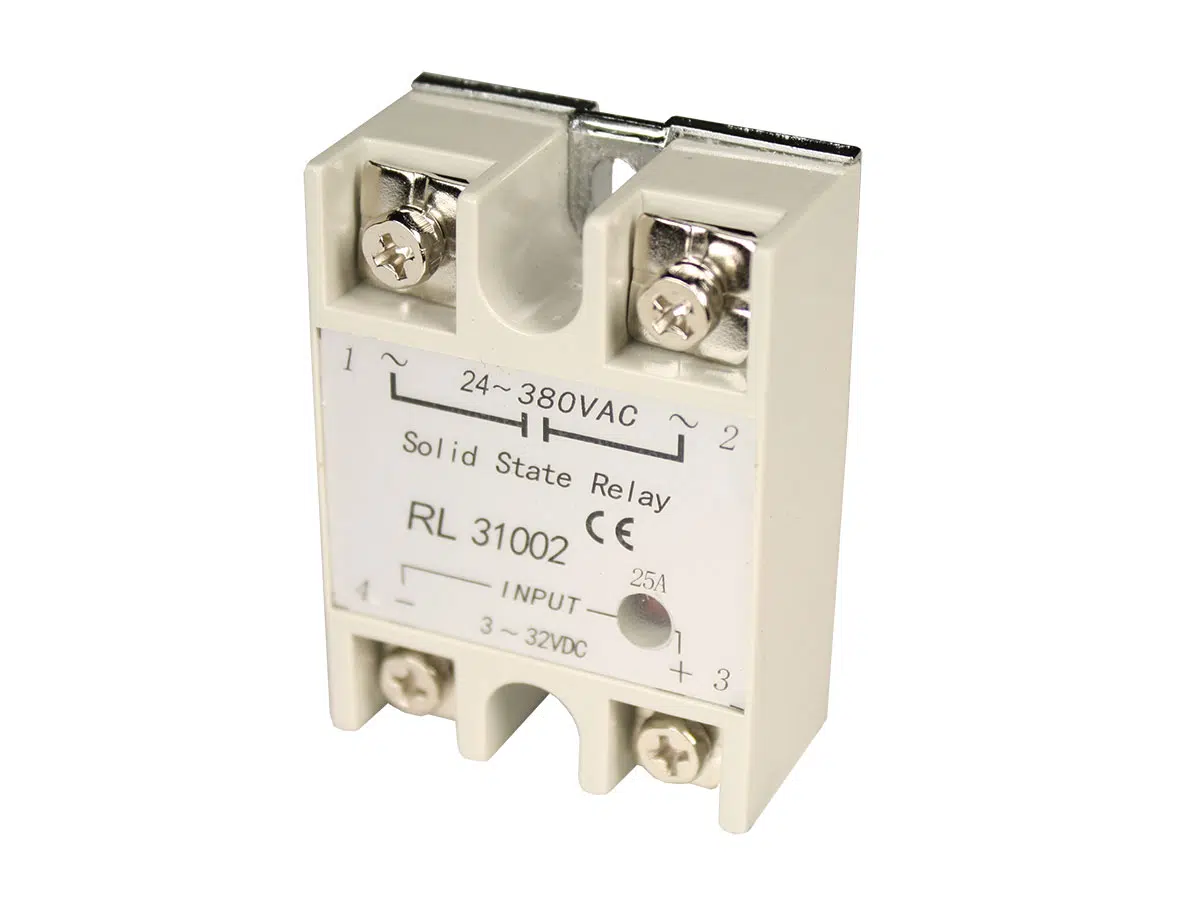
The SSR-25DA solid-state relay is an electronic device that enables the safe and efficient control of alternating current (AC) loads via a low-power direct current (DC) signal. Its designation, DA, refers to its ability to be activated by DC voltage at the input and control AC loads . This device belongs to the SSR (Solid State Relay) family and is notable for supporting up to 25 amps of output current and a working voltage range that typically varies between 24 and 380-480V AC, depending on the model and manufacturer.
By not integrating internal moving components, the SSR-25DA employs semiconductor technology – such as triacs, optocouplers, and trigger circuits – which translates into higher switching speed, reliability, and a longer lifespan , as there is no physical wear on the contacts.
The SSR-25DA is widely used in automatic control systems, home automation, industrial automation, 3D printers, PID temperature control, and applications where durability and quiet operation are essential.
Main technical characteristics of the SSR-25DA

The most common characteristics and technical specifications of the SSR-25DA solid-state relay, based on data sheets from manufacturers and distributors, are as follows:
- Maximum output current: 25A AC (some models allow up to 40A with suitable heatsink).
- Input voltage: 3 to 32V DC (ideal for control by microcontrollers such as Arduino, PLCs, Raspberry Pi, ESP8266, etc.)
- Output voltage: 24 to 380/480V AC (depending on model and manufacturer).
- Input tripping current: 6-35 mA (approximately 7,5 mA at 12V DC).
- Switching method: zero crossing (reduces interference and improves electromagnetic compatibility).
- Integrated RC protection circuit to reduce surges and interference.
- Response time: ON <10ms, OFF <10ms.
- Insulation resistance: >50MΩ/500V DC.
- Typical dimensions: around 62-63mm x 45mm x 23-26mm.
- Weight: between 102 and 105 grams depending on the model.
- Transparent protective case which insulates terminals and prevents accidental contact.
- Connection by screws to facilitate joining with ring or spade connectors.
- LED Indicator which shows the status (ON/OFF) of the relay.
These parameters are useful references to determine if the SSR-25DA fits the needs of your installation, although each manufacturer may offer slight variations.
Advantages of the SSR-25DA over mechanical relays
Switching from a traditional mechanical relay to a solid-state relay like the SSR-25DA offers several technical and functional advantages, especially in projects where reliability or switching speed are critical. Key advantages include:
- No mechanical wear: The absence of moving contacts that open or close ensures a much longer lifespan, allowing hundreds of thousands of cycles without maintenance or failure.
- Silent switching: It operates completely silently, ideal for applications where noise is a problem (laboratories, home automation, robotics).
- Faster response speed: Switching in milliseconds is much faster compared to electromechanical relays.
- Low activation power: It can be controlled by very low intensity signals, facilitating its integration into various automation systems.
- Complete galvanic isolation: The input circuit is electrically isolated from the load, improving safety and protecting control devices.
- Less generation of electromagnetic interference: Models with zero-crossing switching significantly reduce noise in the electrical network.
- Greater reliability in hostile environments: They do not suffer wear from vibrations, dust or humidity, as long as they are properly mounted and protected.
These qualities make the SSR-25DA a suitable solution for frequent switching, heating control, motors, lighting and automation systems where the failure of a mechanical relay could cause unexpected shutdowns or damage.
Inner Workings: How does an SSR-25DA relay operate?
The SSR-25DA operates using a set of electronic components that ensure stable and safe operation. Switching begins by applying a DC voltage to the input (3-32V DC). This activates an internal LED that illuminates a phototransistor or optocoupler; this system allows the connection or disconnection command to be transferred without direct electrical contact, providing galvanic isolation.
The optocoupler responds to light by generating a signal that triggers a triac or thyristor in the power circuit. This allows current to flow in the connected load, synchronized with the control signal. Many models, including the SSR-25DA, employ zero-crossing switching to minimize transient spikes and reduce interference.
Thanks to this internal architecture, the operation is efficient and safe , as it prevents overvoltages or load failures from damaging the control system.
Main applications: Where is an SSR-25DA used?
The SSR-25DA is highly versatile and is used in a wide variety of installations where AC devices need to be switched on or off safely, quickly, and accurately. Its most common applications include:
- Industrial automation: Control of motors, heating resistors, solenoid valves or pumps, where high load requires reliability.
- Home automation and smart home: Management of lighting, air conditioning, heating panels, fans, and temperature control systems.
- PID control and temperature regulation: 3D printers, industrial ovens, electric water heaters or radiant heat systems.
- Machinery management: Switching resistive or inductive loads on and off in factory environments, with appropriate precautions.
- Electrical protection systems: Disconnection of sensitive circuits in dangerous or fault situations.
The SSR-25DA is also used in DIY and educational projects as a reliable solution for safely handling power line loads, always in compliance with safety recommendations.
Installation and mounting recommendations
To ensure proper functioning and safety of the SSR-25DA , it is essential to follow good practices such as:
- Always use a suitable heat sinkThe internal triac dissipates energy, and without a heatsink, the current supported decreases significantly and can cause failures due to overheating.
- Check voltage compatibility. Confirm that the DC input and AC output voltages are within the specified limits.
- Respect the polarity in the control signal connection.
- Secure the cables with suitable terminals, to avoid disconnections due to vibrations.
- Protect with the supplied cover to avoid accidental contact and improve safety.
- Pay attention to leakage current (≤10mA on many models), which can turn on sensitive loads in dim mode.
- Avoid high-power inductive loads unspecified, such as large motors or transformers without additional protection.
Furthermore, it is advisable to connect with the network disconnected and, in educational or professional settings, to have expert supervision to avoid risks.
What brands and models are available on the market?
The SSR-25DA is manufactured by well-known brands such as LUBO, Denor, and FQETR, as well as other manufacturers that offer compatible models. Although the dimensions, mounting, and electrical characteristics are similar, it is always advisable to check the datasheet to ensure it meets the specific current, voltage, and operating temperature requirements. For more information on the different types of solid-state relays, you can consult this comprehensive guide.
These brands' versions typically include a green LED status indicator, wiring screws, and in some cases, transparent protective covers that improve safety in exposed installations.
Additional data and safety warnings
Among the most important supplementary data from specialized distributors, the following stand out:
- Insulation resistance: around 50MΩ/500V DC, ensuring safety against unexpected discharges.
- Work temperature: between -20ºC and +80ºC, without exceeding these limits to avoid damage.
- Weight: between 102 and 105g, compact dimensions (approx. 6,2×4,5×2,4cm).
- Activation requirement: ON >2,4V DC at the input and trigger current of 6-35mA depending on the applied voltage.
- RC protection circuit: to limit voltage spikes and extend service life in demanding applications.
Use in mains voltage installations involves serious risks. It is essential to perform operations with the mains disconnected, use appropriate protection, and have qualified personnel present to avoid potentially fatal accidents.