
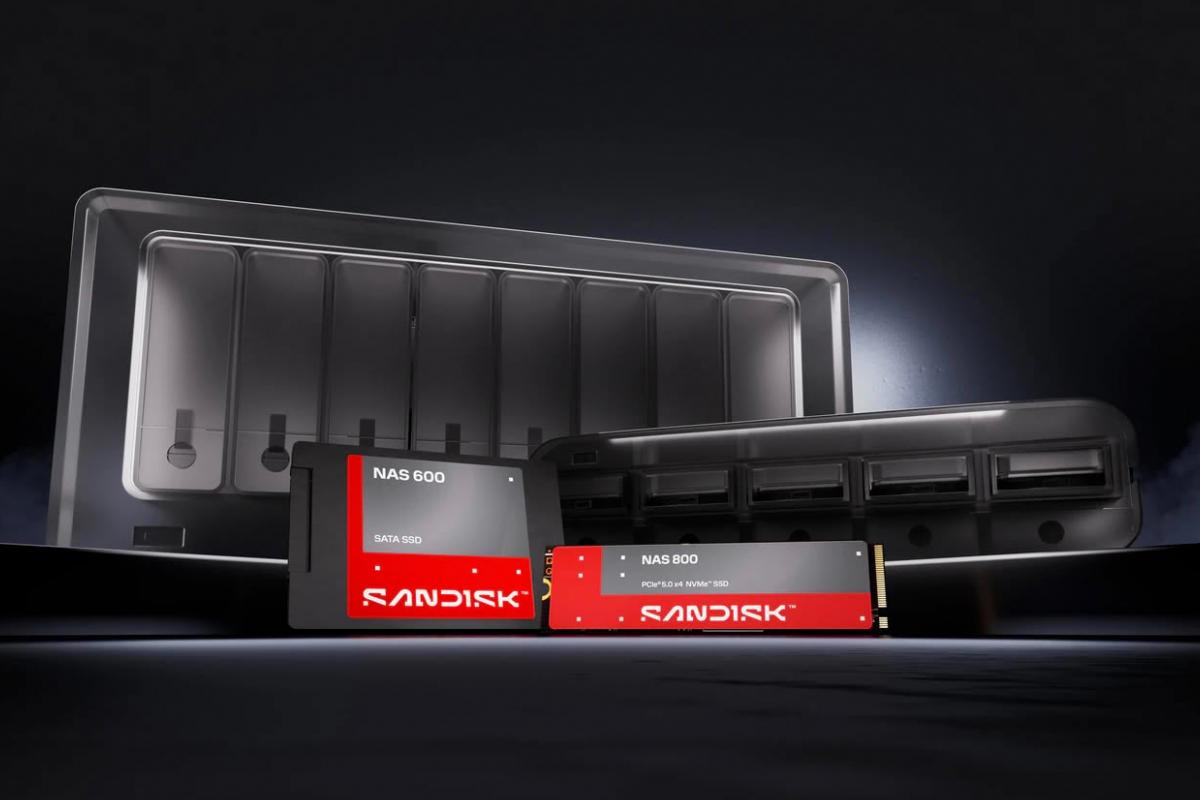
NAS systems have become commonplace in both small studios and offices that need to centralize and protect large volumes of data . In this context, SanDisk has decided to take a step forward with a new range of SSDs specifically designed for NAS, aiming to gradually replace traditional mechanical hard drives.
The company is introducing two distinct product lines, the SANDISK NAS 600 SATA and the SANDISK NAS 800 NVMe, designed to cover everything from simple upgrades of existing equipment to all-flash deployments for mission-critical workloads. While this is a global launch, these products will also be available in the European market through traditional distributors and online retailers, where they will compete directly with established SSD solutions for NAS.

New SanDisk SSD range for NAS: focused on performance and reliability
SanDisk positions these drives within a new SSD portfolio geared towards modern NAS devices , where uses extend far beyond simple home backups. The goal is to offer solid-state drives capable of reliably handling continuous data flows and multi-user environments, a crucial feature for small and medium-sized businesses and creative studios that rely on their NAS around the clock.
The two models in this family are the SANDISK NAS 600 SATA SSD and the SANDISK NAS 800 NVMe SSD . The former is designed for those who want to upgrade their NAS by replacing an HDD or adding an SSD cache layer, while the latter is aimed at hybrid or all-flash configurations that require very high performance and exceptional durability.
Both models are specifically designed for use in RAID configurations and multi-bay systems , typical of advanced home NAS devices and small to medium-sized business rack chassis. According to SanDisk, the new drives have been tested with numerous NAS systems on the market to verify compatibility, especially with the M.2 2280 form factor of the NVMe model.
The company emphasizes that these NAS SSDs aim to guarantee consistent performance under heavy, multi-user workloads , a key aspect in collaborative scenarios, network video editing, or simultaneous database access. The high endurance declared in TBW (terabytes written) and MTTF (mean time to failure) figures are specifically designed to meet this type of continuous use.
SanDisk NAS 600 SATA: Easy upgrade for NAS with hard drives
The SanDisk NAS 600 SATA is presented as the most affordable option for those who want to breathe new life into a NAS that still relies on mechanical hard drives . It is geared towards professional users, prosumers, and small businesses that need to improve performance without changing their chassis or redesigning their current infrastructure.
This model uses a 2,5-inch form factor with a 7mm thickness and a standard SATA interface. According to SanDisk, it can be installed in many of the 3,5-inch bays of NAS devices that support 2,5-inch SSDs, making it easy to replace existing HDDs or add SSDs in free slots to create a cache layer.
In terms of endurance, the 4TB variant of the NAS 600 SATA reaches up to 2.500 TBW and 2,25 million hours MTTF , placing it at the high end of the typical range for an SSD designed for intensive network use. These figures are geared towards supporting constant read and write operations with multiple users connected simultaneously.
In terms of performance, SanDisk indicates sequential read speeds of up to 560 MB/s , figures typical of the SATA interface limit, but with the advantage of the reduced latency characteristic of solid-state drives. By eliminating mechanical parts, the NAS 600 also eliminates the noise and vibrations typical of hard drives , a welcome feature in offices, studios, or meeting rooms where the NAS is used by staff.
The manufacturer emphasizes that this unit is optimized for RAID configurations and multi-user work environments , maintaining stable performance even when working with large files shared by multiple team members. The NAS 600 SATA will be offered in capacities ranging from 500 GB to 4 TB, aiming to cover everything from minor performance upgrades to complete storage volume replacements.
SanDisk NAS 800 NVMe: PCIe 5.0 for hybrid and all-flash NAS
One step up is the SANDISK NAS 800 NVMe SSD , designed for businesses and advanced users who need to get the most out of hybrid or fully SSD-based NAS systems. Here, the focus shifts to massive performance and extreme durability, with figures closer to those of data center environments than a traditional home NAS.
The NAS 800 drive uses the PCIe 5.0 interface in M.2 2280 form factor, so it can function as primary storage, mid-tier storage, or accelerator cache within a NAS designed for this type of slot. SanDisk has verified its compatibility with several leading NAS systems on the market, which is relevant for those planning to build an all-flash NAS with multiple NVMe modules.
One of the strengths of this model is its endurance. In the 7,68 TB version, the NAS 800 reaches up to 14 PBW (petabytes written), a figure far exceeding what is typically associated with general-purpose SSDs. This durability makes it especially suitable for business-critical workloads, where the NAS is used as the central data system.
Performance is also at very high levels: for the 3,84 TB variant, SanDisk announces up to 2,3 million IOPS in random reads and 2 million in random writes , while the 1,92 TB version can reach sequential speeds of up to 14.900 MB/s in reads and 13.200 MB/s in writes. These figures point directly to uses such as databases, virtualization, content creation projects with simultaneous access, or workloads related to agentic artificial intelligence.
Internally, the NAS 800 is built on SanDisk TLC 3D NAND memory and will be offered in capacities from 960 GB to 7,68 TB. The combination of high performance, durability, and support for multi-user environments makes it a suitable option for mid-sized business NAS devices, but also for advanced users looking to build a high-end home server.
A NAS that evolves: from simple backup to private cloud and AI data
SanDisk positions the launch of these SSDs within a clear shift in how NAS systems are used. According to the company, many users have moved from viewing the NAS as a simple backup storage device to using it as the core of a "private cloud" where they centralize teamwork, complex projects, and sensitive data.
Anil Moolchandani, vice president of product management at SanDisk, explains that prosumers, creative professionals, and small businesses today manage much larger datasets, collaborate across teams, and need infrastructures that operate continuously, 24/7. Based on this premise, the NAS 600 SATA and NAS 800 NVMe SSDs have been designed to maintain stable performance even under constant system load.
The company also links this move to the growing importance of private cloud integration and local control of artificial intelligence data . Increasingly, companies and research firms are choosing to keep the data repositories that feed AI models and tools under their own roof, for reasons of privacy, cost, and regulatory compliance, especially in the European Union.
In this scenario, having a NAS with reliable and resilient solid-state storage becomes almost mandatory. Both the NAS 600 and NAS 800 are positioned as key components for building infrastructures that coexist with traditional file services, virtual machines, containers, databases, and AI platforms that continuously read and write data.
Furthermore, the focus on scalability allows a single NAS chassis to start with a combination of HDDs and some SATA SSDs as cache , later evolving towards all-flash configurations with high-capacity NVMe drives, something especially interesting for small European businesses that prefer to expand their infrastructure in phases.
Global availability and price reference for Europe
Both the SanDisk NAS 600 SATA and the SanDisk NAS 800 NVMe will be available starting in September through the official SanDisk website and a network of select distributors and online stores worldwide. This includes the European market, where they are expected to be distributed through the usual professional and advanced consumer hardware channels.
SanDisk has announced suggested retail prices in US dollars for the international launch. The NAS 600 SATA will start at $179,99 for the 500GB version , while the NAS 800 NVMe will start at $309,99 for the 960GB capacity . These are indicative prices that place these drives in the mid-to-high price range for NAS-specific SSDs.
Using the current exchange rate, these amounts are approximately equivalent to €157 for the basic NAS 600 model and around €270 for the entry-level NAS 800. However, the brand has not yet confirmed official prices specific to Europe, so the final price in Spain will depend on factors such as VAT, import duties, and each retailer's profit margin.
Beyond the initial cost, SanDisk emphasizes that the combination of increased productivity, reduced downtime, and extended lifespan can help lower the total cost of ownership of the NAS in the medium and long term. By minimizing bottlenecks and replacing noisy HDDs that are more prone to mechanical wear, these SSDs aim to appeal to those who value reliability over immediate savings.
For creative studios, professional offices, or SMEs working from Spain and the rest of Europe, the arrival of this range means having specific SSD options for NAS within the catalog of a leading brand, with models adapted to both progressive upgrades and more ambitious deployments entirely based on solid-state storage.
Together, the new SANDISK NAS 600 SATA and SANDISK NAS 800 NVMe aim to solidify the role of the SSD as the foundation of the modern NAS , moving beyond the "backup box" profile to become the heart of private clouds, intensive collaboration environments, and data and artificial intelligence platforms that require sustained performance, high durability, and more direct control over information.