SiFive 's new lineup of IPs is making a strong entrance, aiming to cover everything from IoT and robotics to the heart of data centers . The company is introducing the second generation of its Intelligence family with five key components: X160 Gen 2, X180 Gen 2, X280 Gen 2, X390 Gen 2, and XM Gen 2 , all based on the RISC-V architecture and focused on modern AI workloads.
It's no coincidence that this update was unveiled at a leading forum like the AI Infra Summit : the market is pushing towards more configurable, scalable, and efficient solutions, and SiFive is responding by integrating scalar, vector, and matrix engines under a single strategy. Furthermore, the company aims to reduce design time and costs with tightly coupled IP blocks and new, optimized coprocessor interfaces to accelerate development.
What the second generation of SiFive Intelligence brings
In this release, SiFive refines its formula by combining flexibility and performance per watt. The Intelligence Gen 2 family consolidates a heterogeneous computing approach that integrates powerful scalar cores with RVV 1.0 vectors and, in the case of XM, a proprietary matrix engine , all with a memory strategy designed to maximize bandwidth and reduce bottlenecks.
The company maintains its modular design philosophy and adds two accelerator coupling methods: the Vector Coprocessor Interface Extension ( VCIX ) and the Scalar Coprocessor Interface ( SSCI ). These interfaces allow accelerators to directly access CPU registers , simplifying software, reducing latency, and improving data efficiency when integrating external coprocessors or specialized engines.
Against the backdrop of forecasts that, according to Deloitte , anticipate a 20% growth in AI workloads across all technology sectors and up to 78% in edge computing , SiFive's move makes perfect sense. The goal is to offer ready-to-license components that allow OEMs and cloud providers to build modular, future-proof AI platforms .
In addition to hardware, the company is taking a significant step in the software ecosystem: to accelerate time-to-market, SiFive is releasing its SiFive Kernel Library as open source . This initiative complements the design of the VCIX/SSCI interfaces and aims for faster and less expensive AI stack development .
X160 and X180 Gen 2: Efficiency for the Edge and IoT
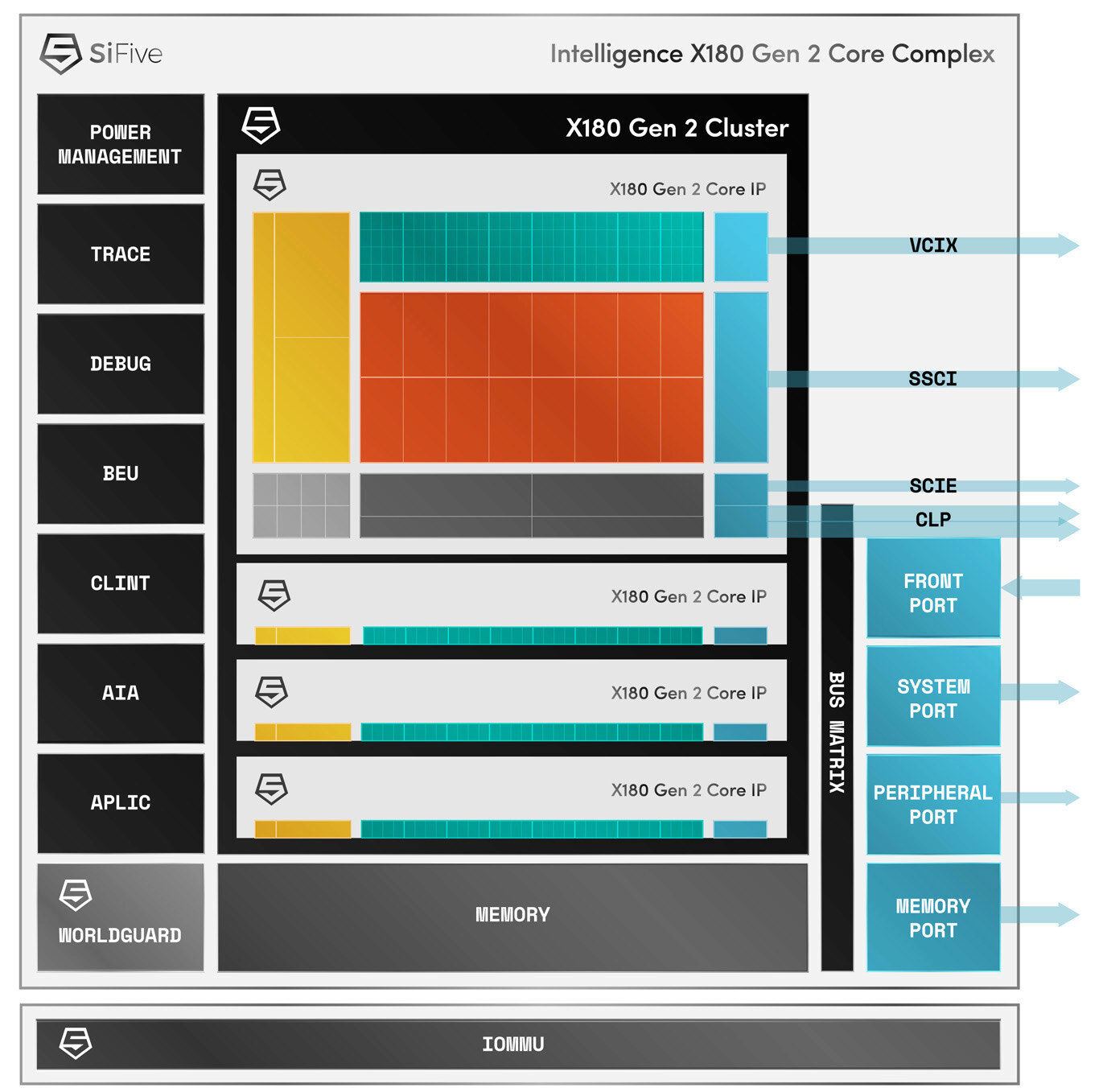
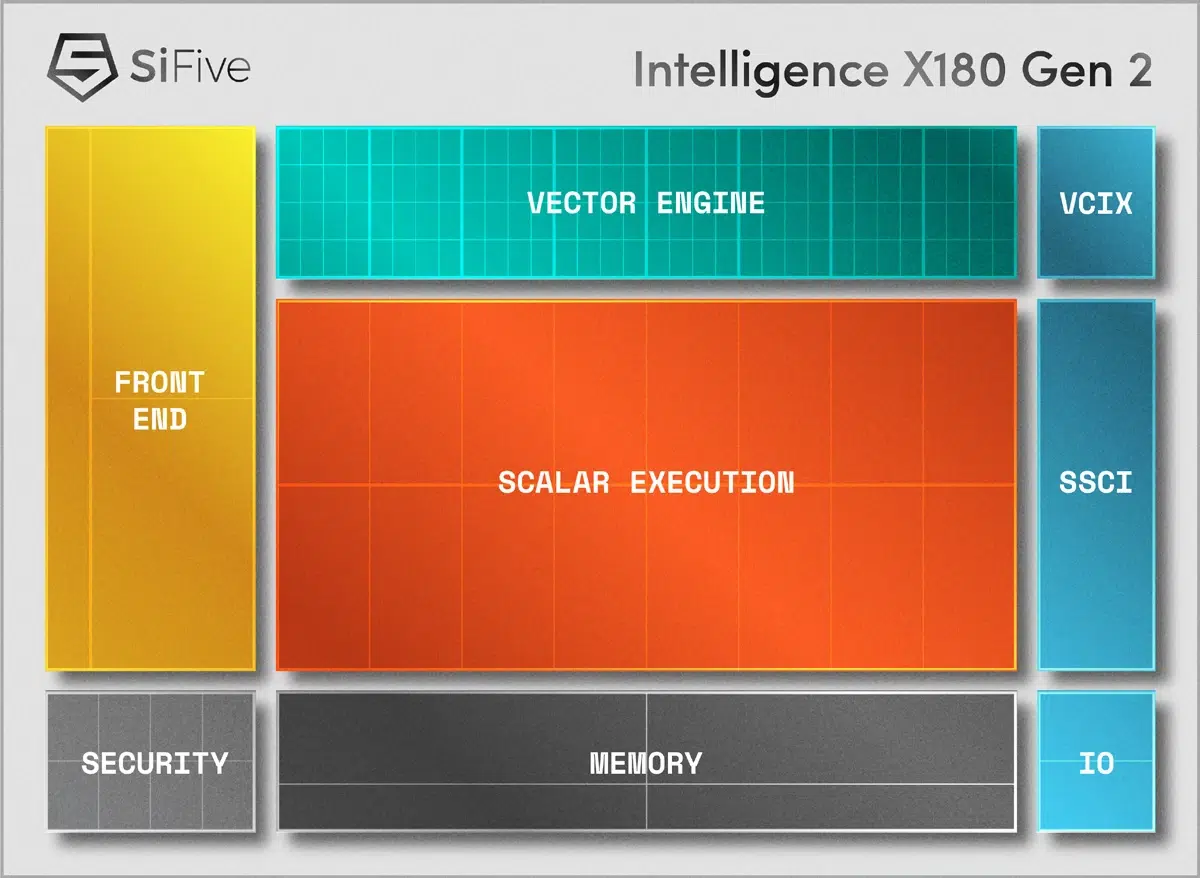
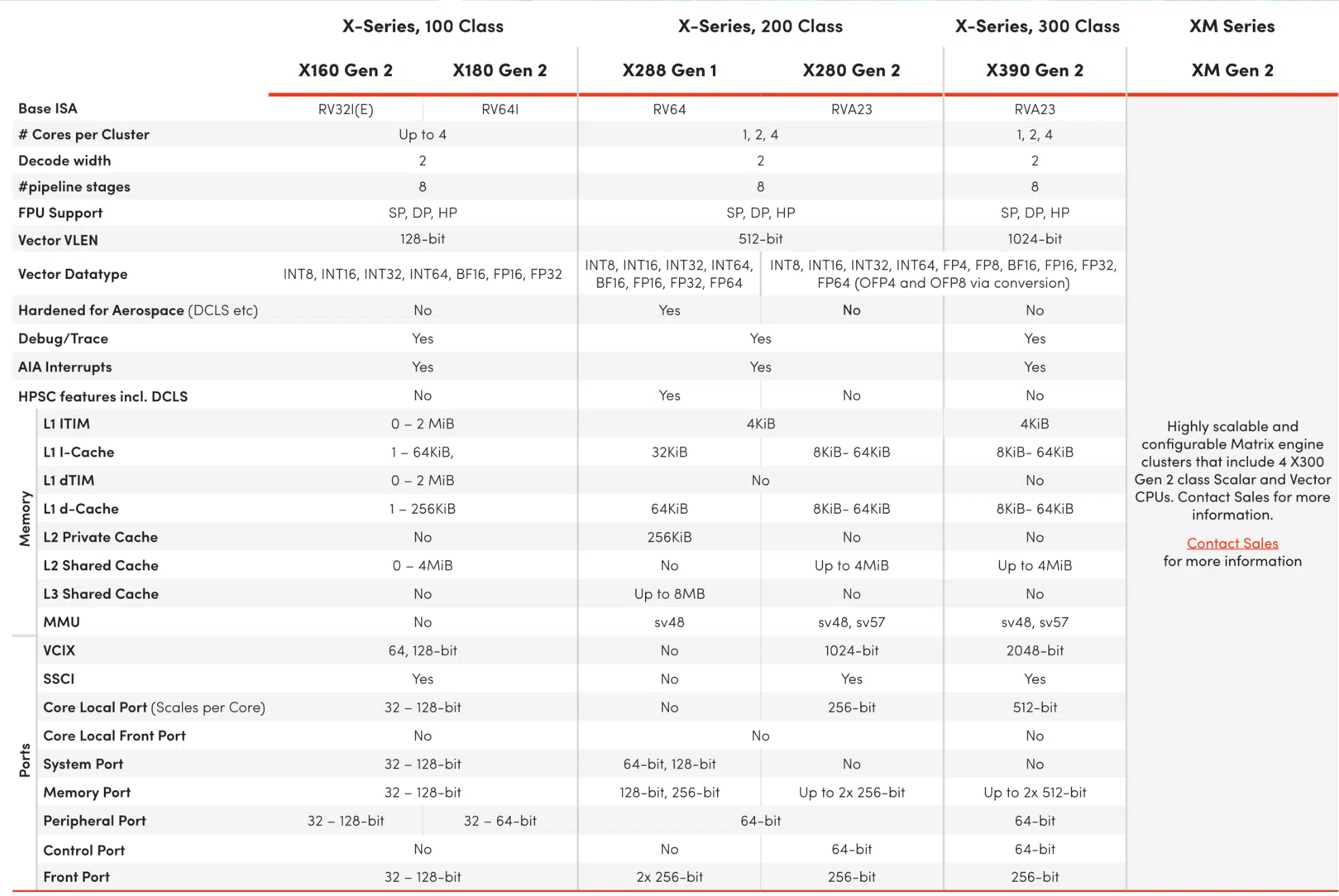
The new X160 Gen 2 (32-bit) and X180 Gen 2 (64-bit) are designed for power- and space-constrained scenarios such as IoT devices, drones , and autonomous robotics . They share support for 128-bit vector registers and a 64-bit data path, enabling them to efficiently execute popular AI numeric formats such as INT8 and BF16.
In terms of scalability, both can be grouped into clusters of up to four cores , achieving a very attractive balance between performance and power consumption. This approach allows for tailoring power to each use case without sacrificing the energy efficiency demanded by edge computing.
The fact that they integrate 128-bit vectors into this "lightweight" range highlights SiFive's intention: to bring truly useful AI computing to sensors, controllers, and robots that operate on batteries or tight thermal budgets, without penalizing cost or silicon surface area.
For applications that need to process machine vision, signal classification, or intelligent control , these cores offer just the right set of vector capabilities with a generous data path (64 bits) and support for reduced-precision types that make a difference in inference.
X280 Gen 2: Mature, edge-optimized vectorization
The X280 series already boasted a first generation with very good adoption in AI/ML, and the X280 Gen 2 revision raises the bar for edge computing with an 8-stage , dual-emitting, in-order , superscalar microarchitecture. This multi-core core is fine-tuned for AI/ML computing at the edge with extensive vector extensions designed for RVV 1.0 and SiFive Intelligence Extensions.
Specifically, the X280 Gen 2 offers vector processing with 512-bit VLEN and 256-bit DLEN, a configuration that effectively parallelizes typical vision, audio, and lightweight modeling operations. This vector bandwidth, along with SiFive's specific extensions, accelerates critical kernels that determine the performance of real-world applications.
Another key change is the simplification of the memory hierarchy: the L3 cache layer is eliminated in favor of a shared L2 cache of up to 1 MB per cluster. With this decision, SiFive aims to reduce latency and complexity, opting for a larger and more flexible L2 cache that particularly benefits inference workloads with medium-sized working sets.
At the ISA level, the new batch adopts RVA23 , which introduces native support for emerging AI formats such as BF16 , MXFP8 , and MXFP4 . The latter was recently chosen by OpenAI for the distribution of open-weight models, which underscores the importance of offering compact data types with good fidelity for large-scale inference.
With its multi-core capabilities and edge-oriented design, the X280 Gen 2 is well-suited for mobile, infrastructure , and automotive applications—fields where its first generation has already proven successful. For those needing to combine low latency with a lean power consumption profile, it provides a very solid foundation for embedded AI applications .
X390 Gen 2: When squeezing every vector matters
For scenarios that demand more vector muscle, the X390 Gen 2 makes a notable leap compared to the original X280: with a single core it already provides a 4× improvement in vector computing thanks to doubling the vector length and adding two vector ALUs working in parallel.
Architecturally, it is also an 8-stage , dual-emission, in-order, superscalar design , but here it incorporates two vector units with 1024-bit VLEN and 512-bit DLEN. The result is a platform that significantly accelerates vector-width -intensive operations , opening the door to more demanding models and kernels.
The X390 Gen 2 is scalable to coherent quad-core complexes and can optionally incorporate the VCIX interface for close coupling of customer-designed AI accelerators or other coprocessors. This close coupling reduces communication overhead and facilitates the integration of external engines without unnecessary software overhead.
In quad-core configurations, SiFive claims to achieve up to 1 TB/s of effective bandwidth, a figure that positions the X390 Gen 2 as an ideal candidate for both acting as an Accelerator Control Unit (ACU) and as a standalone AI engine. This versatility allows for the construction of everything from hybrid acceleration stacks to pure AI pipelines on RISC-V.
It is no coincidence that the X280 and X390 designs have found a place in projects of large technology companies: they have already been seen in applications of companies like Google in their TPUs , where the symbiosis between control, pre/post-processing and hard acceleration is key to production performance.
XM Gen 2: The matrix block that scales to the data center
The XM Gen 2 series represents the "big block" for light training workloads and large-scale inference: it integrates four X390 Gen 2 cores alongside a matrix compute engine developed by SiFive. This combination enables highly memory-efficient mixed scalar-vector-matrix processing.
Each XM Gen 2 cluster can deliver up to 64 TFLOPS at FP8 at 2 GHz, and the design is intended to be stacked in multi-cluster configurations that collectively exceed 4 PFLOPS . This modular approach makes it easy to build custom accelerators for data centers with different consumption and performance profiles.
SiFive also emphasizes that XM Gen 2 is heavily tuned for LLMs and maintains the company's tradition of high performance per watt. The tight integration of the three compute domains (scalar, vector, and array) allows for highly efficient memory bandwidth utilization and minimizes redundant data copies and moves.
For teams that need a foundation on which to build custom accelerators, XM Gen 2 acts as a ready-to-license blueprint : the X390 Gen 2 blocks provide powerful control and vectoring, while the matrix engine scales throughput where MAC density is needed.
VCIX and SSCI interfaces: accelerate without friction
The arrival of VCIX (Vector Coprocessor Interface Extension) and SSCI (Scalar Coprocessor Interface) is one of the defining features of this generation. Both interfaces allow accelerators and coprocessors to directly access CPU registers , reducing the intermediate software stack, lowering latencies, and improving overall memory subsystem utilization.
In practice, this translates to less "glue" time and more useful computing time: teams can couple vector or specialized accelerators without reinventing the wheel, with stable protocols and an optimized data path. Combined with the open-source SiFive Kernel Library , the friction in reaching functional prototypes drops significantly.
For workloads with preprocessing, scheduling, and postprocessing phases (e.g., vision and inference pipelines ), this direct connection to registers greatly simplifies orchestration. RISC-V cores can precisely manage the workflow while delegating the heavy lifting to coprocessors that operate with minimal overhead.
Adoption of RVA23 and support for emerging formats
SiFive aligns its IP with the RVA23 specification , key to the future of AI-oriented RISC-V software. This step enables out-of-the-box support for data types such as BF16 , MXFP8 , and MXFP4 , which is especially valuable as the market moves toward mixed and dynamic precision .
MXFP4 support is not a whim: it was chosen by OpenAI for the distribution of open-weight models, so having direct acceleration to this format reduces conversions and bottlenecks in modern deployments. In inference at scale, every cycle and every byte counts.
Support for RVV 1.0 on X280 and the expansion of VLEN/DLEN on X390 ensure that libraries, compilers, and frameworks can easily leverage the hardware. This accelerates adoption in ecosystems where software validation and maintenance cycles are typically the most expensive part.
Performance, memory and practical scalability
A key advantage of the Intelligence Gen 2 family is its bandwidth management and data handling. The cache reconfiguration in the X280 Gen 2 (goodbye L3, hello to a shared L2 cache of up to 1 MB) and the combination of dual vector ALUs in the X390 Gen 2 enable sustained high throughput without premature bottlenecks.
The figure of up to 1 TB/s in four X390 Gen 2 configurations perfectly illustrates the design's ambition: having many FLOPS is not enough if they are not fed efficiently. In XM Gen 2, vector-array integration and multi-cluster topology reinforce this idea by minimizing hops and intermediate copies.
For engineering teams, this translates into solutions that scale "cleanly": you can start with small clusters for POCs and grow to deployments with multiple clusters without having to rethink the entire data architecture and consistency.
Use cases: from sensor to data center
At the edge, X160/X180 Gen 2 enables the application of AI in smart sensors , drone flight control, and mobile robots, where power budgets and cost per unit are critical. Support for INT8 and BF16, along with 128-bit vector registers, accelerates convolutions , filters, and vision kernels with high efficiency.
One step up, X280 Gen 2 fits into gateways and embedded systems that require higher vector density, whether for real-time analytics, data preprocessing in 5G/6G networks, or advanced automotive functions. Its RVV 1.0 focus and shared L2 cache pave the way for low-latency inference pipelines.
In the high-performance segment, the X390 Gen 2 lends itself to acting as the brain of external accelerators (ACUs) or directly as a standalone vector engine, with the advantage of a clear path for adding coprocessors via VCIX . This facilitates the creation of hybrid solutions where control and heavy computing coexist more efficiently.
Finally, XM Gen 2 is the perfect solution for large-scale workloads where TFLOPS per watt and scalability are paramount. Being highly optimized for LLMs, it is particularly attractive for inference on large models and for certain phases of light training or fine-tuning in data centers.
Availability and roadmap
SiFive has confirmed that all of these IPs are now available for licensing, allowing partners to begin integration immediately. As for commercial products, the first chips based on these IPs are expected in the second quarter of 2026 , a reasonable timeframe for complex designs requiring extensive certifications and validation.
This timeframe aligns with the anticipated growing demand for edge and data center , and gives teams time to mature their software stacks by leveraging the SiFive Kernel Library and the standardization of interfaces proposed by the brand.
Summary of specifications and key features
To put each piece in its place, it's helpful to remember the family's most distinctive features. The X160/X180 Gen 2 focuses on low power consumption with moderate vectoring; the X280 Gen 2 strengthens the edge with RVV 1.0 and shared L2; the X390 Gen 2 significantly enhances vector width and parallelism ; and the XM Gen 2 adds its own matrix engine designed for LLMs and multi-cluster scaling.
- X160/X180 Gen 2: 32/64-bit, 128-bit vector registers, 64-bit data path, INT8 and BF16 support, clusters of 4, IoT/robotics focus with efficiency maximum.
- X280 There are 2: 8-stage, dual-issue, in-order, superscalar; VLEN 512/DLEN 256; RVV 1.0 + SiFive Intelligence Extensions; hierarchy with Shared L2 up to 1 MB per cluster.
- X390 There are 2: 8-stage, dual-issue, in-order, superscalar; dual vector ALU; VLEN 1024/DLEN 512; scalable to 4 coherent cores; Optional VCIX; up to 1 TB/s in 4-core configuration.
- XM Gen 2: 4 × X390 Gen 2 + SiFive matrix engine; up to 64 TFLOPS FP8 at 2 GHz per cluster; scalable above 4 PFLOPS in multi-cluster; highly tuned for LLMs and high performance per watt.
Why it matters now: software, standards, and ecosystem
Hardware announcements are only truly relevant when accompanied by robust software and standards. The adoption of RVA23, explicit support for formats like MXFP8/MXFP4/BF16, and the release of the SiFive Kernel Library all bolster the proposal, allowing libraries and frameworks to leverage it seamlessly.
The focus on clear interfaces (VCIX and SSCI) also reduces the "risk factor" for those planning to integrate their own accelerators . In an era where differentiation relies on specific kernels and proprietary models, having a clean path to registers and low-latency data routes makes all the difference.
Added to its previous traction in sectors such as automotive , infrastructure and mobile, and having already entered the ecosystem of giants like Google , SiFive sends the signal that RISC-V is no longer just an alternative, but a mature platform for production AI workloads.
All of this comes at a time when providers are seeking technological autonomy, sustainable costs, and licensing flexibility . Intelligence Gen 2's modular approach aligns perfectly with this desire to build exactly what is needed, no more and no less, and to scale as the business demands.
Although each use case will have its own block diagram, the design consistency between X160/X180, X280, X390, and XM allows for combining components without surprises and with a clear path to optimize performance/power consumption . This consistency opens the door to shorter development cycles and less rework.
Taken as a whole, the Intelligence Gen 2 family effectively covers the entire spectrum: from sensors requiring basic AI to racks demanding scalable PFLOPS, including gateways and controllers that orchestrate external accelerators . This move aligns with the industry trend toward heterogeneous and composable architectures.
Anyone looking to build a modern AI platform will find here building blocks that combine mature vectorization , robust matrix computing, and a software ecosystem that isn't starting from scratch. Add to that the momentum of emerging standards and the projected growth at the edge, and the pieces fit together perfectly.
SiFive offers RISC-V hardware for AI that feels practical and well-designed: configurable where it needs to be, efficient where it matters, and with an increasingly robust bridge to software. With licenses already available and initial silicon implementations planned for 2026, it's a promising proposition for building tomorrow 's platforms today.
Table of Contents
- 1 What the second generation of SiFive Intelligence brings
- 2 X160 and X180 Gen 2: Efficiency for the Edge and IoT
- 3 X280 Gen 2: Mature, edge-optimized vectorization
- 4 X390 Gen 2: When squeezing every vector matters
- 5 XM Gen 2: The matrix block that scales to the data center
- 6 VCIX and SSCI interfaces: accelerate without friction
- 7 Adoption of RVA23 and support for emerging formats
- 8 Performance, memory and practical scalability
- 9 Use cases: from sensor to data center
- 10 Availability and roadmap
- 11 Summary of specifications and key features
- 12 Why it matters now: software, standards, and ecosystem