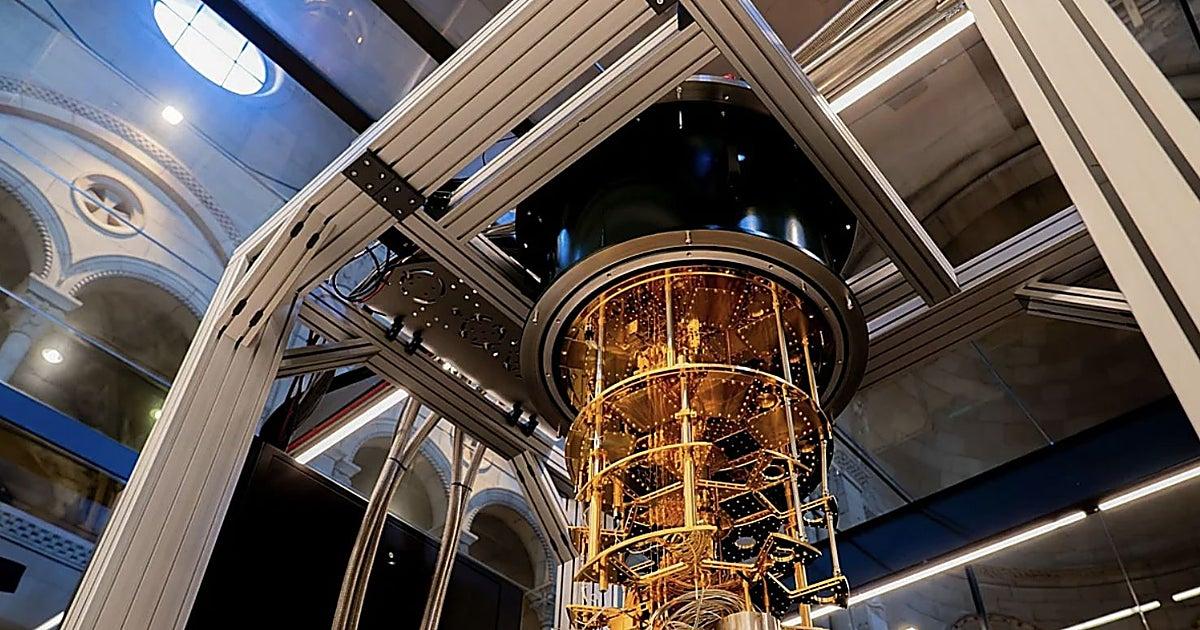
We've been hearing for some time that quantum computing is the future, but the truth is that tomorrow is starting to look very much like the present. It's no longer just about complex theories about particles being in two places at once, but a real technological race for digital sovereignty in which Spain is playing its cards quite successfully. Integrating these new machines into our existing supercomputing infrastructure is the great challenge of this decade, and the most recent advances indicate that we are breaking out of the purely experimental phase.
In our country, the movement is frenetic. Centers like the Barcelona Supercomputing Center (BSC) and the Galician Supercomputing Center (Cesga) are not standing idly by and are already working to integrate quantum processors with their traditional supercomputers . This combination, known as hybrid computing, seeks to leverage the best of both worlds: the robustness of classical computing and the disruptive speed of quantum computing to solve problems that would take a normal computer centuries, such as drug design or the optimization of energy networks.
The milestone of 98 qubits and trapped ion technology
One of the most recent bombshell announcements in this field has been the unveiling of Helios, a processor that uses a trapped-ion technique to manage 98 qubits. Unlike other giants, this system suspends barium atoms in a vacuum using electromagnetic fields. What's truly astonishing about this breakthrough, led by Quantinuum with the participation of international experts, is that it has achieved over 99% fidelity in logical operations , something crucial because these machines are extremely sensitive to any noise or temperature change.
Spanish researcher Carlos Sabín, from the Autonomous University of Madrid, has emphasized that this level of precision puts trapped-ion technology on par with, or even surpasses, the superconducting circuits so heavily promoted by Google and IBM . The key to Helios lies in its dynamic architecture, where ions physically move across the chip, functioning similarly to how data moves in a mobile phone, enabling a flexibility that was previously unimaginable.

Artificial intelligence and materials of the future
But it's not all about pure hardware. Artificial intelligence has become quantum physics' best friend. Researchers at the University of Washington have shown that AI can be used to predict the behavior of large atomic structures without having to spend millions on computing power. This is vital for designing quantum materials that exhibit exotic properties such as room-temperature superconductivity, something that would completely change the way we transport electricity.
This synergy between the two technologies is what multinationals like HPE are trying to standardize. The idea is to create an ecosystem where companies don't have to choose between a classical or a quantum supercomputer, but can instead use hybrid workflows that combine both depending on the needs of each situation. In Spain, the alliance between companies like FSAS and Telefónica to develop artificial intelligence factories in Barcelona is a clear example of how the groundwork is being laid for this massive integration.
Dissemination and the role of society
We cannot forget that all this technical development has a direct impact on society. Figures like Juan Ignacio Cirac insist that it is essential for scientific literacy to reach the general public so that we understand that quantum mechanics is not magic, but a tool that will transform cybersecurity through ultra-secure cryptography . It's not just a matter for laboratories; it's about preparing our culture for a paradigm shift in how we process information.
Even in such pressing issues as energy, quantum computing has much to offer. Although these systems require extremely cold environments, the energy balance will be positive once they can solve problems insurmountable for traditional computing in a matter of seconds. We are witnessing the transition from academic curiosity to industrial implementation, with Spain positioning itself as a strategic hub in Southern Europe for the development of these technologies, which will gradually cease to seem like science fiction and become part of our everyday technological lives.
The current landscape reveals a discipline maturing at breakneck speed thanks to collaboration between public institutions and the private sector. The arrival of machines with nearly a hundred high-precision qubits, coupled with the capacity of Spanish supercomputing centers to host these new architectures, paints a picture where European technological sovereignty seems more attainable than ever. As error rates decrease and quantum emulation is refined, the ability to simulate nature at the atomic scale will open doors we are only beginning to imagine.
Table of Contents