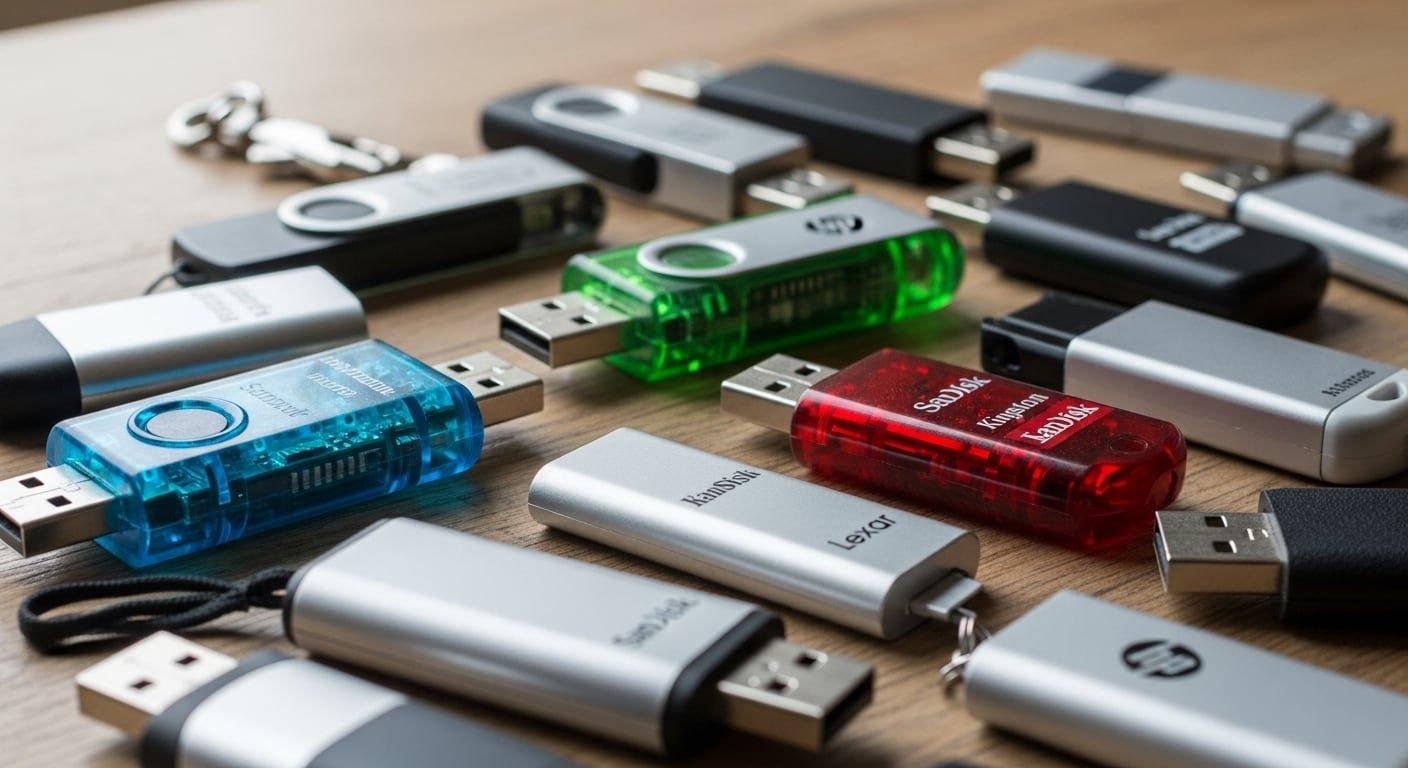
For years, carrying a USB drive on your keychain or in your backpack was practically mandatory for anyone who worked with computers. Today, however, USB drives have gone from being essential to playing a clearly secondary role in the daily digital lives of most users in Spain and the rest of Europe.
The combination of new habits, ever-increasing storage capacity needs, and changes in the connectivity of computers, tablets, and mobile phones has gradually dethroned the classic USB flash drive. Faced with faster solutions that offer more storage and are better integrated into modern devices , the USB drive no longer fits as well as a tool for continuous use, but rather as a resource for specific, occasional tasks.
In recent years, moving documents between computers, collaborating remotely, or making basic backups no longer necessarily involves plugging in a USB drive. It's much more common to use an external SSD, a portable hard drive, SD cards, or even cloud storage services . This shift is noticeable in both home and professional environments, from offices to educational institutions.

It's not just a trend or a matter of convenience. The inherent technical limitations of many USB drives—in capacity, actual speed, and compatibility with current ports —place them behind alternatives that better meet today's demands: working with 4K video, large photo libraries, virtual machines, or complete backups.
Furthermore, the massive transition to USB-C as the port standard in laptops, tablets, and even monitors has highlighted a significant mismatch: while most flash drives remain tied to the veteran USB-A , new equipment cuts or directly eliminates these connectors, forcing users to rely on adapters that reduce speed and immediacy.
Why USB flash drives are falling behind
Looking at it with some perspective, the decline of the USB flash drive isn't a sudden accident, but rather the result of several accumulated factors. For one thing, the storage needs of many users have grown much faster than the typical capacity of a conventional USB drive . For those who work with high-resolution video projects, RAW photos, demanding games, or virtual machines, 32, 64, or even 128 GB is clearly insufficient.
Added to this is the actual performance. Although the casing may display USB 3.0 or USB 3.2 logos, most cheap flash drives use discrete memory and controllers , with write speeds far below those offered by external SSDs. The result is obvious: when copying large folders or voluminous projects, the bottleneck is usually the USB drive itself.
The difference in read and write speeds is especially noticeable in professional and educational environments in Spain, where work involves video materials, large presentations, and design files. The same project that copies in seconds to an SSD can take several minutes on an inexpensive USB drive , which ultimately impacts workflow.
The other major issue lies in the physical aspect. In recent years, the European tech industry has established USB-C as the standard port for ultralight laptops, tablets, and mobile phones. Meanwhile, the majority of USB flash drives still use the traditional USB-A connector —the familiar large rectangle—which is gradually disappearing from new devices.
It's true that there are flash drives with dual connectors (USB-A and USB-C) or even microUSB designed for older phones, but these hybrid models usually sacrifice performance to maintain an attractive price . Adding external adapters doesn't help either: you lose some of the convenience and simplicity that originally made flash drives so practical.
Given this situation, USB flash drives are relegated to occasional use. They remain a quick solution when you need to move a few files between isolated computers , but they cease to be the logical choice when you're looking for a primary portable storage drive for daily work.
Modern alternatives that replace the USB drive
While USB flash drives stagnated, other solutions quietly gained ground, becoming the new de facto standard. In Europe, and especially in markets like Spain, the combination of external SSDs, traditional hard drives, memory cards, and the cloud covers virtually every use case.
On one hand, there are external SSDs connected via USB-C or Thunderbolt . These drives offer read and write speeds far superior to those of a USB flash drive, with capacities that typically start at 500 GB and can easily reach several terabytes. For those who edit video, manage very large photo libraries, or perform complete system backups, this option has become the most logical.
In Spain, it's becoming increasingly common to see these external SSDs in the backpacks of photographers, content creators, communication students, and remote professionals. The ability to open and edit projects directly from the external drive, with virtually no noticeable difference from internal storage , is one of their biggest advantages.
Those who prioritize price per gigabyte over speed opt for the classic external hard drive (HDD) . Although slower and more susceptible to shocks than an SSD, it offers several terabytes at a reasonable cost, making it a popular choice for archiving, regular backups, and large multimedia libraries. In European homes, it's common to dedicate an HDD to storing family photos, movies, or important documents.
In the field of photography and video, SD and microSD cards have become increasingly important. They offer ever-increasing capacities and, in their mid-range and high-end models, competitive speeds. Their small size allows for carrying several cards in a small space, something highly valued by amateurs and professionals alike. However, this advantage has a downside: they are easier to lose and more susceptible to physical damage , so it's advisable to handle them with care.
The fourth major player is cloud storage . Services like Google Drive, OneDrive, Dropbox, iCloud, and European business options allow you to access files from different devices, share folders instantly, and keep documents up-to-date without moving anything physical. For remote work, online training, and team collaboration, this option has become essential.
The downside is clear: it requires a stable internet connection and, in many cases, a paid subscription if you need a significant amount of storage space . Even so, the balance between convenience and cost means that, for many users, uploading a file to the cloud makes more sense than passing it around on a USB drive.
What role will USB drives play in 2026 and beyond?
With all these changes, it might seem that the USB drive is doomed to disappear completely, but the situation is more nuanced. In reality, the flash drive is transforming into a niche tool, useful in very specific scenarios where other solutions don't fit as well.
One such use is the creation of bootable drives or the installation of operating systems . In technical services and IT departments of companies and educational institutions across Europe, it remains common practice to prepare a USB drive with the installer for Windows, Linux, or another operating system to boot computers and perform maintenance tasks.
It also remains important for updating the firmware of routers, televisions, game consoles, and other devices that require simple and reliable physical support. In these contexts, its simplicity is a major advantage: they connect, the update runs, and they disconnect without any further complications.
Another area where USB drives remain relevant is in environments without internet access or with very limited connectivity . In some rural areas or isolated industrial facilities, using the cloud or online services is not an option, so a USB drive continues to be a practical way to move files from one computer to another.
Beyond these specific cases, their appeal diminishes. For daily workflows, where capacity, speed, and compatibility with modern equipment are essential, other solutions are clearly more sensible . USB flash drives are no longer the first choice for saving an important project or a complete backup.
In today's ecosystem, dominated by USB-C, mass storage, and the omnipresence of the cloud, USB flash drives are no longer the universal standard they were for much of the 2000s and early 2010s. They remain available when something very simple and straightforward is needed, but they have ceded the spotlight to alternatives that better meet today's demands.
A hybrid storage ecosystem for users in Spain and Europe
In practice, European users haven't simply replaced one device with another, but rather have moved towards combining different solutions depending on the type of data and the context of use . In Spain, this hybrid approach is evident in both home and professional settings.
For ongoing projects and tasks that demand speed, external SSDs have become the go-to tool . They allow for smooth editing, moving, and backing up data without noticeable performance penalties. Many lightweight laptops with limited internal storage rely on these types of drives to expand their effective capacity.
In addition, external HDDs serve as long-term storage . They're used for old photos, documents that you want to keep but don't access daily, video collections, and regular backups. Their lower cost per terabyte compared to SSDs keeps them relevant for users who want to store a lot of data without breaking the bank.
SD and microSD cards primarily serve the needs of photography, video, and mobile devices . Their use has become widespread in cameras, drones, handheld game consoles, and some laptops with SD card slots, where they function as a small storage boost, always with the caveat that it's advisable to back up their contents regularly.
The cloud, for its part, has become established as a workspace, not just a backup. Sharing documents with colleagues, sending materials to clients, submitting academic work, or collaborating in real time is now routinely done through links to online services, completely eliminating the need for physical storage devices.
Within this complex web, the USB flash drive occupies a more discreet place. It remains practical for taking a few files to a presentation, for use on an older computer, or as a quick fix in a pinch , but it is rarely chosen as the primary data storage or transport solution.
Everything points to this trend consolidating in the coming years: USB drives will not disappear overnight, but will become increasingly limited to specific functions , while SSDs, HDDs, cards and the cloud continue to evolve in capacity, security and speed.
Viewed with some calm, what is happening is not so much the sudden death of the USB drive as a change of stage: USB drives are going from being the default tool to becoming a specific resource within a much broader storage ecosystem , in which each solution has its place depending on the type of file, the budget and the way in which information is worked on and shared.
Table of Contents