Generative Artificial Intelligence has ceased to be a mere promise and has become a machine that devours resources at an astonishing rate. This exponential growth of Large Language Models (LLMs) has caused traditional data centers to fall short, as power density per rack has scaled to levels where air conditioning simply cannot keep up with cooling the equipment.
In this scenario, we've gone from viewing thermal management as a secondary technical detail to considering it the determining factor in how much AI we can run and at what price. The transition to liquid cooling solutions is no longer an experiment for a select few, but an imperative for any infrastructure that wants to keep pace with the next generation of hardware.

The concept of "Jacuzzi": Hot water to cool chips
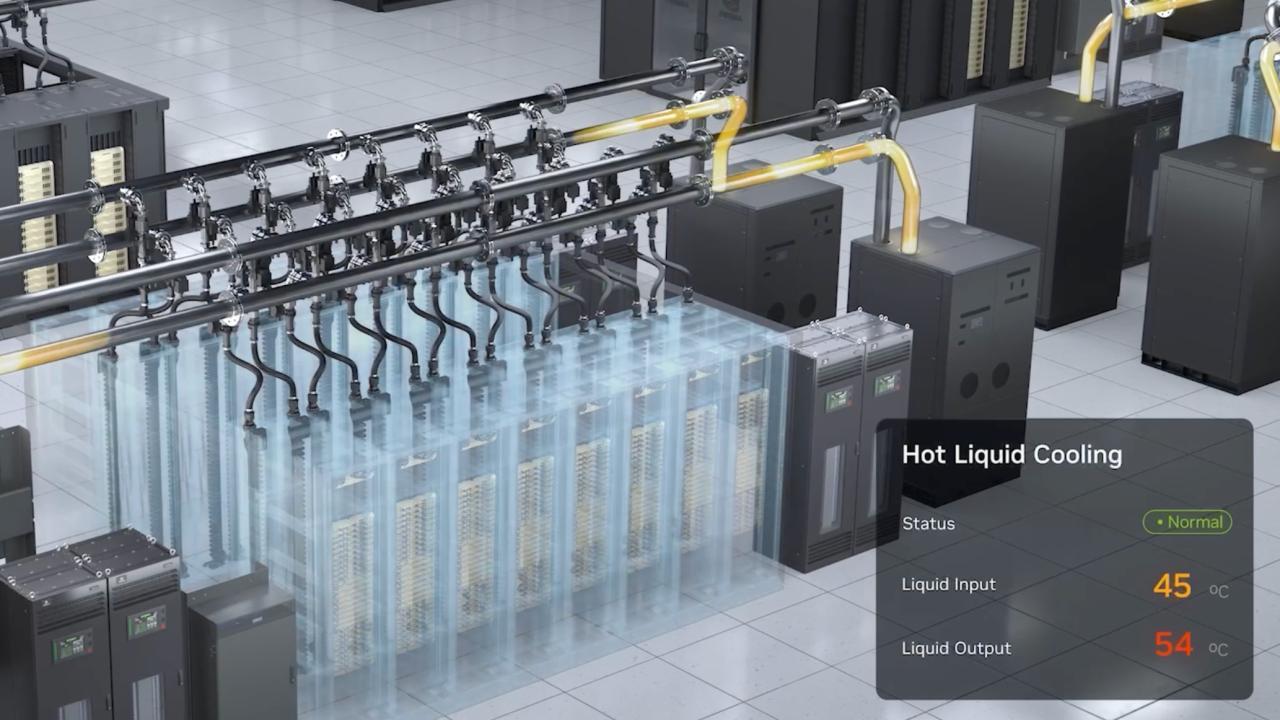
It's almost surreal to think that to cool the most advanced technology on the planet we're using water at temperatures reminiscent of a relaxing bath. Nvidia has broken the mold by proposing a system where the coolant enters at around 45°C (113°F) , a figure that in conventional computing would be considered alarming, but here is the key to success.
The magic lies in basic physics: AI chips generate so much heat that a fluid composed of 75% water and 25% propylene glycol can absorb that thermal load effortlessly. The liquid enters hot, absorbs the heat from the processor, and exits the circuit at around 55°C, allowing the silicon's performance to remain unaffected and undegraded.
This strategy is brilliant because, starting from such a high initial temperature, the temperature difference with the outside air is large enough for the system to operate passively in most temperate climates. Thus, the heat is expelled via giant external radiators, eliminating the need for noisy fans that typically raise noise levels above 85 decibels.
Goodbye to wasting water and energy
One of the strongest points of this architecture, especially in Nvidia's new Rubin generation, is that the water circuit only needs to be filled once during the entire lifespan of the system. This represents a complete paradigm shift, as it allows for the retirement of evaporative cooling towers, which are veritable water guzzlers.
According to Nvidia representatives, this approach can cut water consumption in data centers by almost 100% on-site. By using dry coolers and closed-loop systems, reliance on mechanical chillers is minimized, making the direct water impact virtually nonexistent for most of the year.
However, it's not all good news. Even if internal data center energy consumption plummets, there's a colossal indirect impact . Generating the electricity needed to power these GPU farms still relies heavily on natural gas and coal, industries that require vast amounts of water to operate, meaning the problem has shifted from the server room to the power plant.
The engineering behind performance: CDUs and cold plates
To prevent this system from becoming a disaster, simply pouring hot water on the chips isn't enough. It requires precise coordination between electrical distribution and thermal management. This is where intelligent CDUs (Coolant Distribution Units) come into play , acting as the system's brain, coordinating the flow and pressure of the liquid to ensure everything runs smoothly.

- Advanced cold plates: They use high-precision internal microstructures to capture between 80% and 90% of the heat directly from the chip.
- Direct-to-Chip Systems: This technology is up to 3.000 times more effective than air at transporting thermal energy.
- In-Rack Manifolds: Stainless steel collectors that ensure the coolant reaches each GPU efficiently.
When these technologies are properly integrated, something very interesting happens economically. The energy budget that was previously wasted on coolers can now be redirected to power more GPUs . According to Eaton data, this can translate into an increase of up to 33% in computing power output per connection to the electrical grid, making cooling a cost-effective tool.
Towards the "AI Factory": A paradigm shift
We're no longer talking about generic data centers, but rather true AI factories . The reference architecture, such as the Nvidia DSX platform, proposes a design where computing, networking, and power are fused into a single entity. In this ecosystem, liquid cooling is the norm, not the exception, enabling power densities exceeding 50 kW per rack—something completely impossible with air conditioning.
The industry is moving towards a model where performance and reliability depend on the ability to move heat away from the chip as quickly as possible. Companies like Schneider Electric are driving free cooling solutions and oil-free centrifugal chillers that optimize energy use, demonstrating that sustainability and raw power can go hand in hand if the system is designed from the ground up.
Implementing these architectures allows data center operators to save between 20% and 40% on energy costs. While the path to a fully green AI is long, the fact that the thermal hardware revolution and high-temperature liquid cooling are becoming the standard indicates that we are moving towards a much denser , more efficient infrastructure that is less dependent on local water resources.
The widespread adoption of liquid cooling systems using 45°C hot water is redefining data center architecture, eliminating fans and drastically reducing water requirements through closed-loop systems. While external energy challenges persist, optimizing cold plates and implementing smart CDUs can increase computing capacity by up to 33%, transforming thermal management into a strategic pillar for the economic and operational viability of artificial intelligence at an industrial scale.

Table of Contents