Heat management in data centers has gone from a simple technical detail to a critical obstacle for the deployment of artificial intelligence. With the advent of massively multifaceted languages and generative AI, we've encountered a stark reality: some racks exceed 50 kW of power density, rendering traditional air conditioning practically useless. This hasn't been a smooth transition, but rather an abrupt leap towards direct-to-chip liquid cooling , which is no longer an experiment for a select few, but the standard for anyone wanting to compete in this sector.
In this scenario, an idea emerges that, at first, sounds crazy: hot water cooling . Basically, it involves using water at temperatures reminiscent of a jacuzzi, between 40 and 45 °C, to cool the most powerful processors on the planet. It's not just about changing the liquid in the pipes, but also redesigning the electrical architecture and distribution systems so that efficiency isn't measured solely in PUE, but in how much real computing power we can extract from each watt connected to the electrical grid.
The hot water cooling paradigm
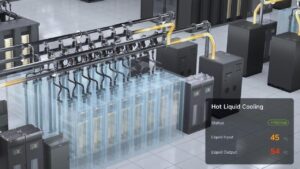
At first glance, pouring hot water into a server seems like a recipe for disaster, but the physics is clear. AI chips generate such a massive amount of heat that a fluid composed of 75% water and 25% propylene glycol can absorb that thermal load without breaking a sweat, even entering at 45°C. The liquid absorbs the heat and exits the circuit at around 55°C, maintaining the integrity of the silicon and ensuring that the processor's performance is not degraded at all.
The brilliance of this system, powered by architectures like Nvidia's Rubin, lies in the fact that, starting from such a high temperature, the temperature difference with the outside air is large enough for the system to operate passively in temperate climates . This allows for the retirement of noisy fans, which typically exceed 85 decibels, and their replacement with giant external radiators that expel heat much more efficiently and quietly.
Another key point is the environmental impact. By operating with closed-loop systems that only need to be filled once during the plant's lifetime, evaporative cooling towers, which are veritable water guzzlers, are eliminated. Nvidia maintains that this allows them to cut water consumption almost 100% within the data center, although challenges remain outside its walls, as power generation (gas or coal) still demands enormous quantities of water for every kWh produced.
Precision Engineering: Cold Plates and CDUs
To prevent this deployment from ending in a technological disaster, meticulous coordination is essential. This is where cold plates with internal microstructures come in , capable of capturing 80% to 90% of the heat directly from the chip. Not all cold plates are created equal; a high-precision one makes the difference between a reliable system and one that compromises the hardware's lifespan due to poor heat transfer.
The brains behind all of this are the intelligent CDUs (Coolant Distribution Units) . These units coordinate fluid pressure and flow, managing capacities ranging from 105 kW to 2,3 MW. When these CDUs are integrated with the electrical architecture, something fascinating happens at the business level: the energy budget that was previously wasted on cooling air can now be redirected to power more GPUs.
According to Eaton data, this optimization can lead to an increase of up to 33% in computing output per grid connection. In short, thermal control has ceased to be an operating expense and has become a tool for direct economic profitability , allowing savings of between 20% and 40% in overall energy costs.
Sustainability and the challenge of water consumption
Despite advancements, AI is a resource-intensive machine. Training models like GPT-3 has evaporated hundreds of thousands of liters of fresh water . To measure this impact, the industry uses Water Usage Effectiveness (WUE), which calculates the liters consumed per kWh of IT energy. While traditional evaporative cooling has a high WUE, closed-loop designs can approach the ideal value of 0.0 L/kWh.
Tech giants have already stepped up their game with ambitious commitments for 2030. Microsoft, for example, is implementing zero-evaporation designs that could reduce water usage by more than 125 million liters per facility annually. Meanwhile, Google and Meta are pursuing water positivity , aiming to return more water to nature than they consume, especially in water-stressed areas like Arizona and Oregon.
There are also more radical alternatives such as immersion cooling , where servers are submerged in dielectric fluids that do not damage the electronics. Whether through single-phase or two-phase immersion (where the fluid boils at extremely low temperatures), the goal is to completely eliminate dependence on water and reduce energy consumption by up to 82% in certain specific cases.
Towards the era of AI factories
We can no longer speak of generic data centers, but rather of true AI factories . In this ecosystem, computing, networking, and power merge into a single entity. The reference architecture, such as the Nvidia DSX platform, proposes that liquid cooling be the norm , not the exception, enabling power densities that would be impossible with traditional air conditioning.
Moving from an air-cooled to a liquid-cooled infrastructure is no easy feat; it involves operational risks and considerable integration complexity . However, when racks exceed 50 kW, this transition ceases to be optional and becomes an essential requirement for hardware survival . The combination of free cooling and oil-free centrifugal chillers demonstrates that it is possible to reconcile raw power with AI-powered data center infrastructure and environmental responsibility.
The widespread adoption of 45°C water as a coolant is redefining the viability of technological infrastructure. By optimizing heat flow from silicon to the electrical grid, the industry is enabling computing power to grow without water and energy consumption becoming an insurmountable barrier, allowing programming languages to continue expanding sustainably and cost-effectively.

Table of Contents