The robotics and automation ecosystem in Catalonia is experiencing a period of clear expansion and is beginning to consolidate itself as one of the technological drivers of the Catalan economy. In recent years, the business network linked to this activity has grown in size, diversity, and international ambition, underpinning a new era for the region's industry.
According to the latest report from Acció and data presented by the Catalan government, the sector has doubled in size over the last five years, reaching nearly €1.000 billion in revenue. This growth is complemented by more specialized companies, more skilled jobs, and an increasing presence of robotic solutions in both factories and services.
A robotics sector that is doubling and approaching 1.000 billion
The latest data places the robotics business volume in Catalonia at €974 million in 2024, double what it was five years ago. This growth reflects the progressive incorporation of automation and robotics technologies in Catalan industry and the response of local companies to the demand for advanced solutions.
In terms of employment, the report identifies 4.634 people working in robotics companies in the region, a figure that has been increasing as industrial projects, engineering services, and new technology-based initiatives become more established. The sector combines highly skilled technical profiles with positions related to the operation and maintenance of automated systems.
One of the most notable elements is the business structure: 87% of the companies are SMEs , while around 14,5% are specialized startups. This configuration reinforces the idea of an agile ecosystem, capable of rapid innovation, adapting to specific niches, and collaborating with large industries and technology corporations.
In addition to economic growth, the study highlights that approximately 44% of companies in the sector are exporters and that 30% have an annual turnover exceeding €10 million. These figures point to increasing maturity and a significant presence in international markets, particularly within Europe.
Diverse value chain: manufacturers, integrators and auxiliary industry
The Acció report details the composition of the robotics value chain in Catalonia . Approximately 18% of companies are dedicated to the manufacture of robots, from industrial arms to mobile platforms or collaborative solutions designed to interact with people.
The largest segment is comprised of systems integrators, representing 38% of the total. These are the companies that design, plan, and implement complete automated installations, combining robots, sensors, control software, and other industrial equipment to meet the specific needs of each client.
The remaining 44% corresponds to the so-called auxiliary industry , which includes suppliers of mechanical, electronic and machine vision components, industrial software developers, specialized consultancies and companies that supply enabling technologies linked to industry 4.0.
This distribution shows a reasonably balanced ecosystem, where manufacturers of proprietary technology coexist with integrators capable of adapting solutions to specific processes and a network of support companies that provide key services to the entire production chain.
Main applications: from automotive to the service sector
By area of use, the report confirms that 72% of companies in the sector offer robotics solutions applied to industry . A large portion of the projects are concentrated in the automotive, food, and packaging sectors, three areas where automation allows for increased productivity, improved product quality, and enhanced plant safety.
In the automotive industry, robotic cells are used for welding, assembly, component handling, and quality control , among other tasks. In the food industry, the focus is on packaging, palletizing, product sorting, and handling of delicate goods, always adhering to strict hygiene and traceability requirements.
Within the packaging sector, solutions focus on labeling, boxing, flexible packaging, and internal logistics , leveraging machine vision systems and control algorithms that enable rapid format changes and high precision. This versatility is key to adapting to the proliferation of product references and the demand for smaller, customized batches.
Beyond the manufacturing industry, the study highlights a notable increase in the use of robots in the service sector . Areas such as healthcare, audiovisual production, and logistics have been incorporating automated systems for years for support tasks, internal transport, inspection, and repetitive operations, thus freeing up staff time.
There is also an increase in robotic solutions designed for the safety, inspection, and maintenance of critical facilities, such as industrial plants, transport infrastructure, or hard-to-reach environments. In these cases, robots allow operations to take place in conditions that would be difficult or dangerous for human workers.
Foreign investment and international positioning
The sector's dynamism is not solely explained by domestic demand. During the period 2021-2025, Catalonia attracted 14 foreign investment projects in robotics , with an outlay of nearly 58 million euros and the creation of more than 600 associated jobs.
This investment flow has placed Catalonia as the sixth region in the world in terms of the number of foreign investment projects in robotics, the second in Europe and the first within the Spanish State, where it concentrates more than half of the registered initiatives (around 52% of the state projects).
The combination of a consolidated industrial fabric, specialized talent, leading research centers and a network of technology fairs and congresses makes Catalonia an attractive hub for international companies seeking competitive locations in Europe to develop advanced automation solutions.
From the Generalitat, the Minister of Business and Labor, Miquel Sàmper, has stressed that these figures demonstrate the strength of the network of industrial SMEs in the territory and the role of robotics and Industry 4.0 in strengthening the competitiveness of the productive fabric in the European context.
Advanced Factories: a showcase of Catalan robotics
One of the sector's major platforms for showcasing innovations is Advanced Factories , the international trade fair dedicated to automation, robotics, and Industry 4.0, held at Fira Gran Via in Barcelona. Now in its tenth year, the event has established itself as a key gathering in Southern Europe.
This year's Advanced Factories brings together more than 750 exhibitors and 420 international experts , with an expected attendance of over 33.000 trade visitors. The estimated economic impact is around €91 million, including both direct and indirect spending, reinforcing the trade fair's role as a driver of business and innovation.
The trade show serves as a meeting point for robot manufacturers, systems integrators, industrial software providers, technology SMEs, and large industrial companies seeking new solutions to modernize their plants. It also hosts conferences, live demonstrations, and networking spaces where collaborative projects are developed.
For the Catalan government, events like Advanced Factories are a key driver for accelerating the digital transformation of Catalan industry. The trade fair facilitates access for companies, especially smaller ones, to automation, artificial intelligence, and collaborative robotics technologies that are still uncommon in many processes.
Furthermore, the presence of technology centers, universities and innovation hubs makes it possible to showcase real-world application cases, share experiences and bring the latest international trends in advanced manufacturing, smart maintenance and industrial data management closer to the productive sector.
Eurecat: cognitive robotics, cobots and multi-technological solutions
Within this ecosystem, the Eurecat technology center plays a leading role in promoting advanced robotics and Industry 4.0 in Catalonia. From its various locations, it develops multi-technology solutions aimed at a more autonomous, competitive, and sustainable industry, with a clear commitment to strengthening European technological sovereignty.
Eurecat's approach involves combining cognitive and collaborative robotics, advanced manufacturing, industrial digitization, and printed electronics . This integration allows for the design of customized projects that not only automate specific tasks but also transform entire processes, optimize resources, and improve decision-making through intensive data analysis.
One of the most representative developments is an adaptable collaborative robotics system designed for sectors such as food, logistics, manufacturing, and recycling . These are the well-known cobots, robots designed to share space with human operators and work safely and flexibly in real-world production environments.
The proposed solution is based on a flexible and modular architecture, with integrated machine vision and artificial intelligence. It incorporates adaptable grippers to handle delicate objects, perform pick-and-place operations, and follow optimized trajectories with highly precise motion control, reducing errors and cycle times.
This system is being showcased at Advanced Factories through a demonstrator developed in collaboration with companies such as Codorníu, Gimatic, Omron, and Universal Robots , which have contributed key components, technology, and materials. The setup allows visitors to observe how advanced automation and human labor coexist in a realistic industrial environment.
Cognitive robotics, drones and mobile robots for inspection and logistics
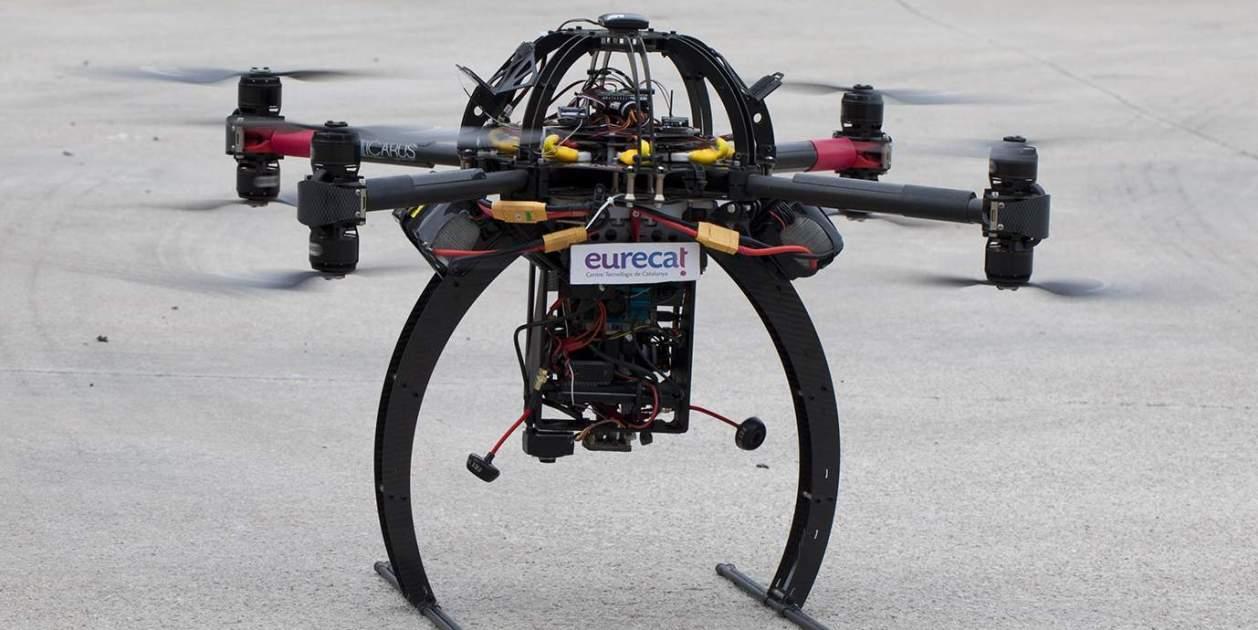
Eurecat also promotes cognitive robotics solutions capable of automating complex processes that previously required intensive human intervention. Among these technologies are drones with a high payload capacity of up to 35 kg, designed for logistics operations, maintenance tasks, and industrial assembly processes.
These systems can autonomously move objects in controlled environments , resulting in improved safety by freeing people from heavy or repetitive tasks, and increased operational efficiency. Coordination between drones, control systems, and data management platforms is key to their deployment.
Another of the center's lines of work focuses on intelligent mobile robots used in manufacturing, inspection, quality control, maintenance, and internal logistics. Within this category, quadrupedal systems equipped with advanced sensors for industrial inspections in complex environments and hard-to-reach spaces stand out.
In parallel, unmanned aerial platforms are being developed that can operate in critical infrastructure and environments with high safety and reliability requirements. These solutions are geared towards both industry and public services, providing valuable information on the condition of facilities and equipment.
Industrial digitization completes this approach: Eurecat works on real-time data collection and analysis technologies that allow monitoring of industrial plants, production equipment and machinery parks, with the aim of improving operational performance and detecting incidents before they become serious problems.
Projects with industrial companies: from Codorníu to Metalogenia and Carpel
Much of this technological capability is realized through collaborative projects with industrial companies seeking to improve their competitiveness. In the field of inspection and maintenance, Eurecat has worked with firms such as Codorníu, Metalogenia, Carpel, Rotimpress, and Pröll, among others.
At the Eurecat stand at Advanced Factories, for example, a production system is on display that handles Codorníu cava bottles . This demonstrator serves to illustrate the center's ability to design flexible and modular architectures for handling all kinds of industrial components and delicate objects while maintaining high levels of precision.
The solution incorporates advanced machine vision and intelligent algorithms that allow the robot to adapt to multiple types of objects and materials—from plastics and metals to food products and soft materials—without requiring complex reconfiguration. This facilitates reference changes and reduces downtime.
In the area of digitalization, the project developed with Metalogenia stands out , aimed at optimizing the operations of excavating machines working in mining operations and construction sites. The system captures real-time data on loading cycles, processes it, and generates key performance indicators visible in the cloud.
This information helps improve decision-making and machinery efficiency by identifying usage patterns, potential inefficiencies, and cost-saving opportunities. It's a clear example of how combining sensor technology, data analytics, and connectivity can transform the daily operations of traditionally traditional sectors.
In the field of advanced materials and embedded electronics, Eurecat collaborates with companies such as Pröll and Carpel in the development of plastronic solutions for automotive and aeronautical applications, opening the door to new designs of lighter, more functional and sustainable components.
Plastronics and printed electronics: new opportunities for robotics
Plastronics , the combination of electronics and plastic materials, is positioning itself as one of the technologies with the greatest potential to transform various industrial sectors. It allows for the integration of electronic functionalities directly into structural parts, reducing the number of components and providing new capabilities.
In the automotive sector, Eurecat, in collaboration with the German company Pröll, has developed a monolithic structural component that integrates intelligent lighting, capacitive sensors, a display, haptic elements, and microelectronics into a single plastic piece. This solution enhances user interaction and facilitates lighter and more versatile interior designs.
In the aeronautical sector, in collaboration with Carpel , the center has created a prototype cabin interior panel that is lighter and more sustainable than current models. The device integrates touch zones and interactive features, such as contact with the crew and access to passenger information and entertainment systems.
Printed electronics, closely linked to these developments, is emerging as a key technology for reducing weight, energy consumption, and emissions , while simultaneously improving the user experience and maintaining high safety standards. All of these factors are especially relevant in highly regulated sectors.
For robotics, these innovations mean the possibility of designing lighter, more efficient and adaptable robots and automated systems , with sensors and circuits integrated directly into the structures, opening the door to new architectures and applications.
Artificial intelligence and advanced industrial planning
Another key pillar of industrial transformation in Catalonia is the integration of artificial intelligence into resource planning and management . Eurecat develops intelligent platforms that analyze large volumes of data to optimize production, fine-tune internal logistics, and ensure process traceability.
These multi-criteria platforms are especially useful in sectors like food, where requirements for cost, quality, deadlines, food safety, and sustainability coexist . AI allows for the processing of all these variables simultaneously and proposes decision scenarios that help companies become more agile and competitive.
Robotics, connected to data-driven decision systems, is no longer just an element of mechanical automation but has become a component of a broader cyber-physical system. In this system, machines, sensors, and digital applications share information and coordinate in real time.
According to the center itself, all these capabilities are part of a commitment to building a more resilient, sustainable industry, prepared for current and future challenges. Continued participation in Advanced Factories and other European forums reinforces this strategy of technology transfer to the productive sector.
Overall, the robotics landscape in Catalonia reveals a fully mature ecosystem : a sector that has doubled its economic weight in five years, with 311 active companies, a strong presence of SMEs and startups, increasing foreign investment, and integration into industry thanks to the work of technology centers and spaces like Advanced Factories and DFactory. All of this places the region in a prominent position within the European map of automation and Industry 4.0, with room for further growth if the commitment to innovation, talent, and public-private collaboration is maintained.
Table of Contents
- 1 A robotics sector that is doubling and approaching 1.000 billion
- 2 Diverse value chain: manufacturers, integrators and auxiliary industry
- 3 Main applications: from automotive to the service sector
- 4 Foreign investment and international positioning
- 5 Advanced Factories: a showcase of Catalan robotics
- 6 Eurecat: cognitive robotics, cobots and multi-technological solutions
- 7 Cognitive robotics, drones and mobile robots for inspection and logistics
- 8 Projects with industrial companies: from Codorníu to Metalogenia and Carpel
- 9 Plastronics and printed electronics: new opportunities for robotics
- 10 Artificial intelligence and advanced industrial planning