If you're drawn to the blend of cyberpunk culture, electronic DIY, and Raspberry Pi , cyberdecks are a veritable wellspring of ideas. In just a few years, they've gone from a science fiction concept to fully customized, small laptops, created by makers worldwide with retro-futuristic aesthetics and highly specialized functions.
Although each project is unique, they all share a common core: a board like a Raspberry Pi, a screen, some kind of keyboard , and a very particular chassis, often 3D printed or mounted in recycled boxes. From there, the possibilities explode: from SDR radio and penetration testing equipment to development stations with dual screens or technological survival kits for a hypothetical internet outage.
What exactly is a cyberdeck with Raspberry Pi?
The term “cyberdeck” originated with William Gibson’s novel Neuromancer , which describes terminals hackers use to connect to cyberspace literally from their brains. In the real world, the maker community has adopted the concept to name those highly customized, homemade laptops that often use Raspberry Pi as their brains and draw on cyberpunk aesthetics and philosophy.
Unlike a conventional laptop, a cyberdeck is understood more as a modular, open, and repairable platform . It's common to see unusual screen sizes, compact mechanical keyboards, decorative LED indicators, radio frequency antennas, accessible connectors, and structures that make it easy to open the device for modifications whenever desired.
A distinctive feature is that many designs don't follow the classic "screen + foldable keyboard" model . There are cyberdecks in the form of portable consoles, others in waterproof cases, some carried in a shoulder bag, and still others mounted in laser-cut metal boxes or recycled laptop cases. The real limit is usually the creator's imagination and time.
Raspberry Pi has become the preferred platform because it allows you to have a complete Linux computer on a tiny board , with good software support, available GPIO pins for sensors and modules, and a huge ecosystem of accessories and communities. Compared to microcontroller-based solutions like Arduino, it offers enough power for a graphical desktop, web browsers, networking tools, SDR, or complete development environments.
In practice, a cyberdeck with Raspberry Pi can function as a mobile system administration station, pentesting lab , software-defined radio console, embedded development equipment, terminal for controlling robots, or simply as a technological toy for tinkering.
Retrofuturistic Cyberdeck SDR with Raspberry Pi 5
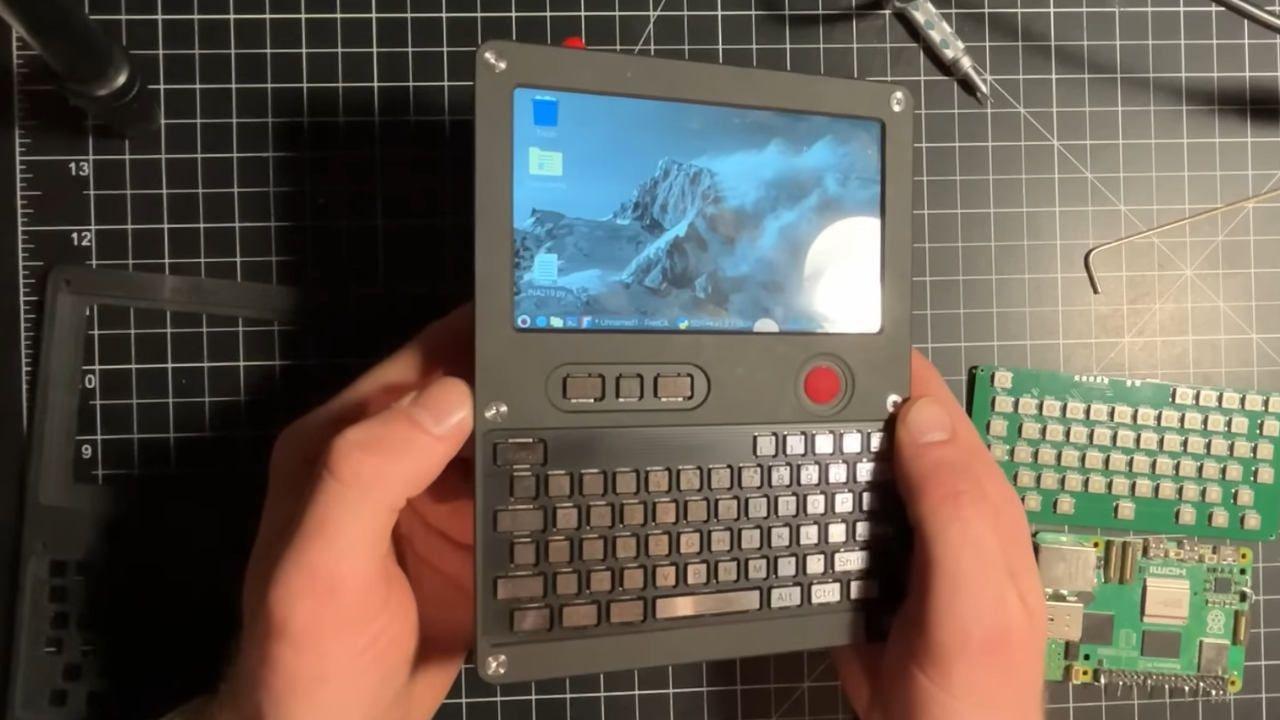
One of the most striking projects of recent times is Nicholas LaBonte's portable SDR Cyberdeck , which uses a Raspberry Pi 5 and boasts a distinctly retro-futuristic aesthetic. It's not just a pretty case: it's an all-in-one computer designed for software-defined radio and other technical tasks on the go.
The design combines dark plastics, vibrant red accents, and polished metal pieces , achieving an industrial console look reminiscent of a science fiction film, yet with an exceptionally refined finish. Visually, it departs from typical 3D-printed boxes, opting instead for more original materials.
Instead of sticking to plastic, LaBonte uses Richlite (a phenolic material) on the front and sapele wood on the back , creating a striking contrast. This is complemented by fine aluminum details and a large bronze heat sink, which is not only functional but also reinforces the professional-grade look of the device.
The device integrates a DSI-connected Waveshare display with a resolution of 800×480 pixels , sufficient for lightweight interfaces and terminals, and is operated with a fully customized keyboard and a mouse joystick reused from a PSP 1000, giving it a classic handheld console feel.
The keyboard's electronics are based on a custom PCB with an ATmega32U4 microcontroller and QMK firmware, which also manages the joystick's analog input. The keys are etched onto Gravitech material, which mimics aluminum, and are activated by a matrix of carefully wired microswitches.
Beyond the input, this Cyberdeck includes a detachable SDR antenna , which can be attached or removed as needed. The Raspberry Pi 5, with its improved CPU and GPU, allows for smooth operation of software-defined radio applications, spectrum analysis, and networking tools on Linux.
One of the project's strengths is its battery life: it integrates an internal UPS that provides around 5 hours of use , making it truly portable. Thermal risk is mitigated by the bronze heatsink and careful heat management, ensuring that the Raspberry Pi and other components remain within safe operating ranges.
To gain internal space, the creator decided to desolder the dual USB ports of the Raspberry Pi 5 , freeing up room for the keyboard and SDR antenna. Looking ahead to future revisions, he plans to add a camera module, GPS chip, and 4G modem, which would require incorporating an additional USB hub to restore connectivity.
The best thing for those who want to replicate it is that LaBonte has published a very detailed construction guide , accompanied by a video demonstrating it. With time, patience, and some experience in welding and machining materials, it's possible to build your own version of this retrofuturistic cyberdeck.
Pi Slate: A compact, Raspberry Pi 5-based cyberdeck for mobile Linux
Another interesting example of a Raspberry Pi-based cyberdeck is the Pi Slate, an ultra-compact laptop focused on Linux and technical tasks. It's not intended to replace traditional laptops, but rather to offer a mobile work tool for system administration, ethical hacking, embedded development, and experimenting with open-source hardware.
The Pi Slate combines a 5-inch widescreen touchscreen with 1920x720 pixel resolution and an integrated keyboard in a body reminiscent of a modern handheld console. It's all built around a Raspberry Pi 5, taking advantage of the power boost provided by its 2,4 GHz Cortex-A76 CPU and VideoCore VII GPU.
The result is a very small but surprisingly capable machine for programming, managing servers, running automation scripts , connecting via SSH, or executing network tools. It's not designed for demanding gaming, but it's perfectly suited for lightweight desktop environments like XFCE or KDE Plasma, offering reasonable performance.
The Raspberry Pi 5 offers integrated connectivity: dual-band Wi-Fi, Bluetooth 5.0, USB 3.0, and microHDMI outputs . Some similar designs even add NVMe SSDs via PCIe adapters, taking advantage of the Pi 5's PCIe link to significantly increase speed compared to traditional microSD cards.
This performance improvement over previous generations makes a Pi 5-based Cyberdeck feel much less limited: the CPU can perform more than 150% better than the Pi 4 under certain workloads, and the GPU handles modern interfaces and 4K60 HEVC video playback better.
The Pi Slate's screen is one of its key differentiators. Its ultra-wide 1920x720 format offers significantly more visible text columns than an 800x480 or even a similarly sized 1280x720 display. It's a delight for terminals, code editors, htop, or technical dashboards.
The very high pixel density makes the text look sharp, which is key for those who work constantly with the terminal in Linux. However, it's necessary to adjust the interface scaling in the desktop environment so that icons and menus don't appear ridiculously small on a 5-inch screen.
In terms of uses, a cyberdeck like Pi Slate serves as a portable remote administration terminal, a lightweight cybersecurity node with Kali or Parrot OS, an IoT monitoring station using GPIO and sensors, or an embedded development kit to program ESP32, RP2040 or Arduino directly from the device itself.
Within the world of compact cyberdecks, Pi Slate positions itself alongside projects like Pilet, HackberryPi5 , and Carbon Computers' Pi Flux . Some prioritize battery life, while others experiment with square screen formats or recycled Blackberry keyboards. Pi Slate seeks a more usable balance between size, ergonomics, and resolution.
In such small form factors, cooling and power consumption challenges are significant. The Pi 5 can heat up to over 80°C under load and consume between 8 and 12 W, necessitating the integration of heatsinks, compact fans, and batteries between 5000 and 10000 mAh to achieve between 3 and 6 hours of actual battery life.
Beyond the hardware, what gives the project meaning is Linux. Being able to run full distributions like Raspberry Pi OS, Ubuntu, Kali, Manjaro ARM, or DietPi on a pocket-sized device remains very appealing to technical users. And the community regularly publishes open-source STL designs, schematics, and firmware, facilitating long-term repairs and modifications.
Differences between a cyberdeck and a conventional laptop
Given all of the above, the question arises: if a cyberdeck has a screen, keyboard, and battery, why not simply call it a laptop ? The answer lies in the design philosophy and intended use, rather than mere functionality.
A laptop is designed as a closed product: a thin box, difficult to open, with little room for reusing components or adding extras. In a cyberdeck, on the other hand, the internal parts are valued for being accessible, interchangeable, and easy to maintain . Opening it to change a motherboard, a keyboard, or add sensors is usually just a matter of a few screws.
Another important difference is creative freedom. A cyberdeck allows the use of unusual screen sizes, ortholinear keyboards, LED matrices, visible antennas , old panels from other devices, industrial connectors… Anything that breaks with the “smooth” and minimalist aesthetic of the commercial laptop comes into play.
It's also not uncommon to use recycled electronics and casings : old laptops, obsolete tablets, instrument cases, toolboxes, or even camera cases are repurposed as cyberdeck chassis. Besides saving money, this reinforces the repurposed technology aesthetic so closely associated with cyberpunk imagery.
Finally, many projects incorporate elements that would be unthinkable in a standard laptop: environmental sensors, radios, dedicated physical buttons , secondary displays, unusual power systems, modules for SDR, LoRa, GPS, or custom internal USB hubs.
The community surrounding these devices is very active. Spaces like Cyberdeck Cafe or the r/cyberDeck subreddit serve as showcases for builds, exchanges of ideas, and shared culture. It's not just hardware; it's also a way of understanding computing as something malleable and personal.
Cyberdeck Raspberry Pi Recovery Kit: Prepared for the “end of the world”
Among the more unusual types of Raspberry Pi-based cyberdecks is Jay Doscher's "Raspberry Pi Recovery Kit ." It's a mini PC specifically designed for emergency scenarios, intended to function as an autonomous network core when everything else fails, without relying on the internet or external infrastructure.
The device is built inside a water- and shock-resistant Pelican case , typically used for transporting cameras or delicate instruments. Inside, it houses a Raspberry Pi 4, an official 7-inch touchscreen, an internal battery, and various carefully organized network and control components.
The chosen keyboard is a compact Plaid 5z6p ortholinear model , which fits perfectly with the low-power and simple design philosophy. The Pi 4 acts as the heart of the system, while a 5-port Netgear Ethernet switch handles the wired connectivity.
One of the design's unique features is the use of a copper sheet as shielding against electromagnetic pulses (EMP) , adding an extra layer of robustness against extreme events that could damage electronic equipment. The idea is that this Cyberdeck can survive where other devices would fail.
The front panel features USB connectors, a barrel connector for power, and Ethernet ports, each with independent analog switches that allow them to be manually disconnected to save energy or isolate network segments.
Its purpose is to act as an independent network core , capable of handling DNS, DHCP, and web server services, similar to an advanced router. In the event of a complete wireless communications outage, it could maintain a functional local infrastructure.
Doscher details all the components and the assembly process on its website, including the 3D-printed parts needed to secure and join the internal modules . While the aesthetic remains distinctly Cyberdeck, here the practical and resilient approach is just as important as the visual design.
RPI DEV: Fully open source dual-screen modular cyberdeck
At the most advanced end of the spectrum, we find Sector07's RPI DEV project , a dual-screen, modular cyberdeck with a futuristic aesthetic reminiscent of devices from video games like Cyberpunk 2077. This design stands out for both its technical ambition and its radical open-source approach.
RPi DEV is designed as a portable development station for electronics and software , capable of functioning as a mobile lab, robot controller, or STEM education tool. It is fully 3D printable, with press-fit parts and tolerances achieved down to the millimeter.
The creator modeled each part of the chassis in CAD, printing multiple test pieces until achieving a robust yet easy-to-assemble and disassemble fit. The casing strikes a balance between sturdiness, ergonomics, and a distinctly retro-futuristic style, with angular lines and flat surfaces.
On the electronic side, the project incorporates several custom PCB boards designed in KiCad . These handle power distribution, connection to the physical buttons, linear slider, rotary encoder, and GPIO bus expansion via a 40-pin flexible flat cable (FPC).
The boards were manufactured by a specialized supplier and then soldered by hand by the author himself , who had to solve typical development problems: confused resistors, failures on the first power-up and long testing sessions until he got everything to start up properly.
In terms of interface, the Cyberdeck features two screens that can rotate from landscape to portrait , equipped with mechanical stops to prevent cable strain. This allows for adaptable setup depending on the type of work: one for console use and the other for documentation, for example.
The control panel includes a linear slider, a rotary encoder with push button and four programmable buttons , opening the door to a wide variety of uses: real-time parameter control, navigation through custom menus, script launching, etc.
In addition, the device offers an external GPIO port accessible from the outside , ideal for connecting shields, sensors or actuators without disassembling the equipment, and an auxiliary USB port perfect for plugging in additional WiFi modules, dongles or memory.
One of the most practical features is the Raspberry Pi's "quick eject" system , which allows you to remove it for reprogramming, updating, or reusing it in another project without having to disassemble the entire chassis—something highly valued when working with multiple configurations.
To demonstrate its potential, Sector07 conducted an experiment using I2C-connected sensors to measure light, temperature, and pH in a container. First, with water, it obtained neutral readings; then, upon adding hot coffee, the temperature rose, the light decreased due to the opacity of the liquid, and the pH dropped, indicating acidity.
This practical example demonstrates how Raspberry Pi DEV can serve as a tool for citizen science, education, or experimentation , going beyond being just a flashy toy. It's a real working environment, designed for serious projects with a strong visualization and physical control component.
The most interesting aspect is that the entire project has been released as open source on GitHub : 3D models (.step), KiCad files, bills of materials, GUI code, and basic documentation. Anyone can replicate, modify, or extend it, multiplying its impact on the community.
The creator himself is already working on other equally striking projects: a functional biomimetic robot, a thermal katana inspired by Cyberpunk 2077 with real nichrome resistance, and mechanical "mantis blades" with a pneumatic system and gesture control, capable of generating around 100 pounds of force in a quarter of a second.
Other types of cyberdecks with Raspberry Pi and creative approaches
Beyond these specific cases, the community has developed a whole range of Raspberry Pi-based cyberdecks , each with its own main function and style. Some examples illustrate the wide range of possibilities very well.
A practical example is Subir Bhaduri's "Raspberry Pi projector box ," designed as a low-cost computer for classrooms with limited resources. Instead of a built-in screen, it uses a projector, allowing a large group of students to share the same image and work together.
This design uses a Raspberry Pi 3B+ or 4B, taking advantage of its wireless capabilities to connect a mouse and keyboard via Wi-Fi . Everything is housed in a robust, portable, and relatively simple-to-manufacture laser-cut metal case. The project aims to be affordable, open-source, and easy to replicate.
There are also Cyberdecks with a shoulder strap and dual operating system , combining an i7 NUC with a Raspberry Pi to switch between systems with a physical button. These models integrate multiple displays (touchscreen, e-ink, LED matrix) and a compact mechanical keyboard, resulting in a boutique computer with a distinctive aesthetic and high performance.
Another popular idea is to recycle old laptops . The enthusiast known as Alta repurposed the chassis of an old notebook, installing a Raspberry Pi Zero, an iPad mini as a screen, and an Apple Magic Trackpad. Without the need for advanced 3D printing or significant expense, he created a fully functional cyberdeck with plenty of personality.
At the purely aesthetic end of the spectrum are projects like the Hosaka MK1, inspired by the novel Neuromancer . This device features a 7-inch touchscreen, audio and radio modules, and a 3D-printed chassis with a distinctly retro style that looks like it came from a corporate terminal of a megacorporation.
To discover even more examples and gather ideas, the best sources are the Cyberdeck Cafe community , with its extensive gallery of projects and cultural documentation, and the r/cyberDeck subreddit, where users share their builds, technical questions, and progress.
Taken together, these projects demonstrate that a cyberdeck can occupy a middle ground between desktop and laptop computers , but with such a distinctive design that it forms its own category. From survival machines without internet access to dual-screen graphics workstations, the common denominator is creative freedom and absolute control over the machine.
This entire ecosystem means that if you get the itch to build your own kind of cyberdeck with Raspberry Pi, you have plenty of references: designs focused on SDR, portable Linux, network resilience, embedded development, or technical education show that there's room for almost any idea you can think of, as long as you're willing to invest time, patience, and a good dose of enthusiasm for experimenting.
Table of Contents
- 1 What exactly is a cyberdeck with Raspberry Pi?
- 2 Retrofuturistic Cyberdeck SDR with Raspberry Pi 5
- 3 Pi Slate: A compact, Raspberry Pi 5-based cyberdeck for mobile Linux
- 4 Differences between a cyberdeck and a conventional laptop
- 5 Cyberdeck Raspberry Pi Recovery Kit: Prepared for the “end of the world”
- 6 RPI DEV: Fully open source dual-screen modular cyberdeck
- 7 Other types of cyberdecks with Raspberry Pi and creative approaches