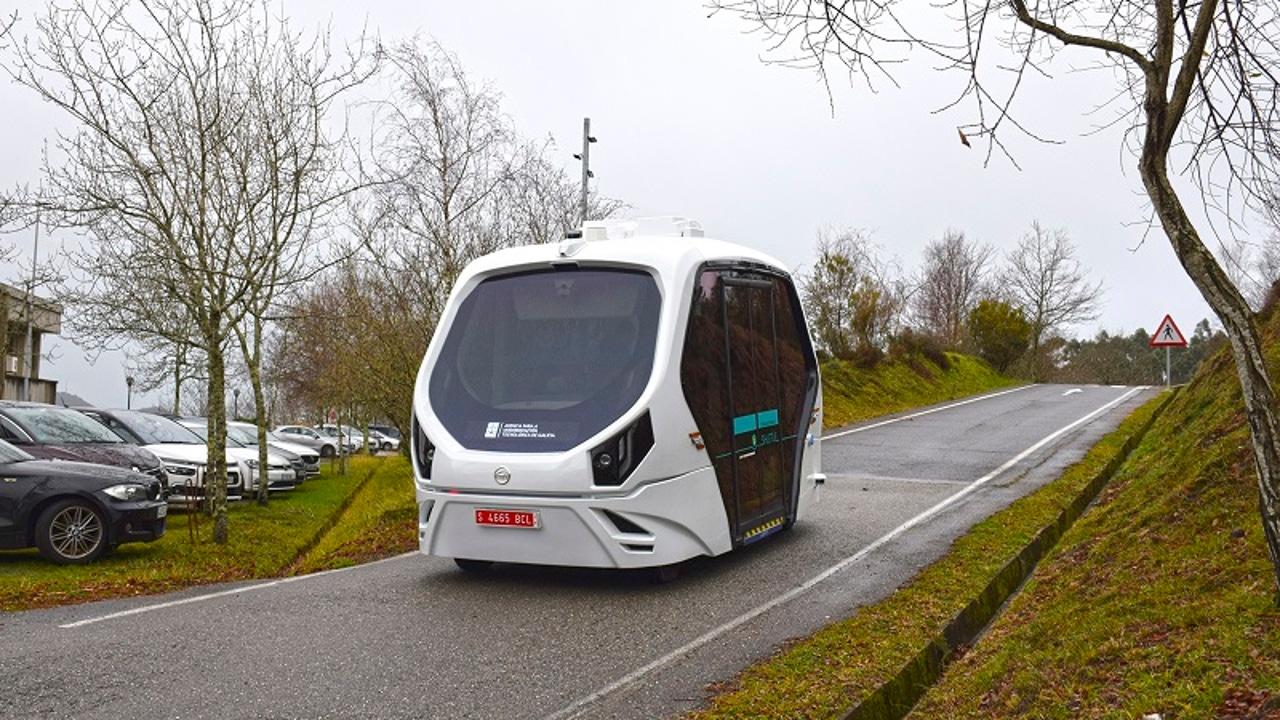
In the coming weeks, those traveling around the University of Vigo campus will encounter a vehicle without a visible steering wheel or a traditional driver, silently traversing the roads. This is not a one-off demonstration, but rather the first stable autonomous and connected vehicle service to operate on a university campus in Spain, designed for both daily transportation and technological experimentation.
This new mobility system comes in the form of an electric shuttle , with a capacity for eight passengers, which can be used by the entire university community to travel between buildings. At the same time, it will transform the Vigo campus into a real-world testing ground for advanced smart transportation solutions, 5G/6G connectivity, and cybersecurity , using traffic, pedestrians, and changing conditions as a testing environment.
A pioneering pilot project in Spain and a testing ground for smart mobility
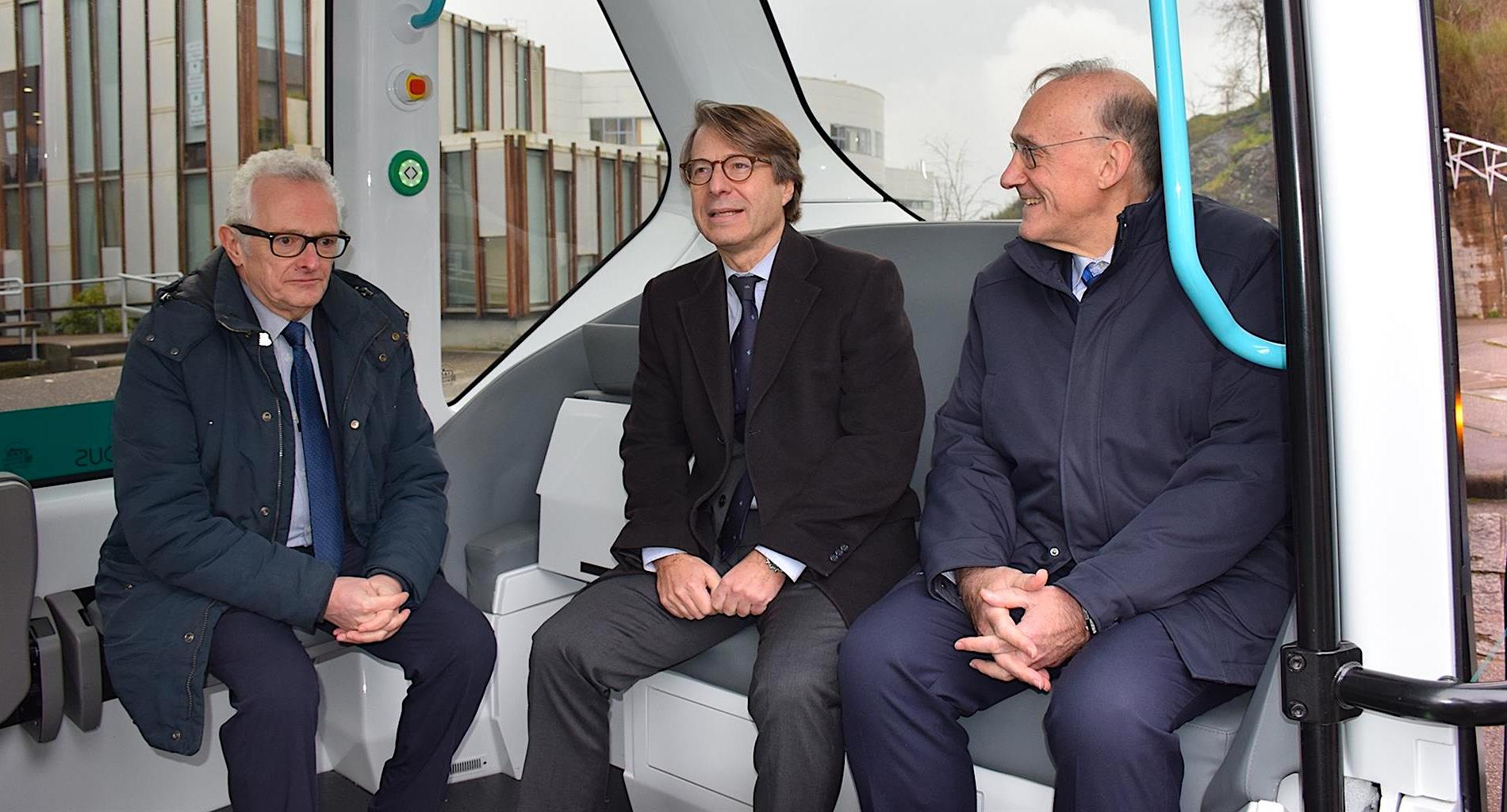
The initiative is part of a cybersecurity pilot project for connected vehicles using a 5G network , presented on campus at an official event. Those participating in the launch included the Rector of the University of Vigo, Manuel Reigosa; the Regional Minister of Finance and Public Administration of the Galician Government, Miguel Corgos; the Director of the Automotive Technology Center of Galicia (CTAG), Luis Moreno; and the Director of the Agency for Technological Modernization of Galicia (Amtega), Damián Rey, among other representatives.
The vehicle, designed and developed entirely in Galicia by CTAG, is equipped to transport up to eight passengers and operate autonomously on a defined route. Its function extends beyond serving as an internal shuttle: it will allow for the validation of automated driving technologies , vehicle-infrastructure communications, and cybersecurity protection mechanisms in an open environment, outside of a closed laboratory.
During the presentation, project leaders agreed that these types of tests place Galicia at the forefront of smart mobility internationally , paving the way for new developments in the field of connected and autonomous vehicles. The experience gained in Vigo will also serve as a benchmark for other urban and university environments, both in Spain and throughout Europe.
In the words of the rector, projects like this allow the University of Vigo to strengthen its role as a strategic environment for applied research and technology transfer , thanks to the continued collaboration with agents of the Galician innovation ecosystem.
Start-up, route and daily operation of the service
The shuttle is scheduled to begin regular service on February 2nd , following a symbolic launch with a short route between the School of Telecommunications Engineering and Erasmo Square. Authorities and technical staff participated in the inaugural trip and gave the experience a very positive assessment.
The service will operate, initially as a pilot program, until June . During those five months, the vehicle will travel along a fixed route of approximately 3 kilometers , designed to connect the busiest points on campus. Any member of the university community will be able to use it in their daily routine to connect buildings and faculties.
The route includes six planned stops : Rectorate/Library, Faculty of Economics, Citexvi, Experimental Sciences, Cintecx, and School of Telecommunications Engineering. This route covers both teaching areas and research and service areas, so that its potential use includes students, teaching and research staff, and administrative and service personnel.
During the trial period, detailed data will be collected on peak hours, waiting times, and occupancy levels , with the aim of adjusting the service frequency and, if necessary, making changes to the route or stops. The intention is to adapt the actual operation to the usage patterns observed among the university community.
Although the vehicle operates autonomously, the pilot program design includes the constant presence of a supervisor on board . This professional is responsible for monitoring the system's proper functioning, intervening in any incidents, and ensuring passenger safety while data is collected and the driving algorithms are refined.
Cybersecurity, 5G/6G and open lab on the Vigo campus
The connected autonomous vehicle project is part of the Territorial Networks for Technological Specialization (Retech) Program , a cooperative initiative that promotes the creation of advanced infrastructure and use cases in different regions. In the case of Vigo, the focus is on cybersecurity applied to connected mobility and next-generation communications.
Thanks to a specific agreement, the University of Vigo (UVigo), the Automotive Technology Center of Galicia (CTAG), Amtega, the Technological Institute of Galicia (ITG), and the Gradiant technology center are participating in this pilot project. These five entities are working in a coordinated manner on activities related to cybersecurity, vehicle connectivity, and intelligent transport.
Within the framework of this agreement, UVigo is building a specialized 5G/6G communications and cybersecurity laboratory , designed as an open experimentation space for third parties. The idea is that companies, research groups, and other organizations can test solutions and best practices in realistic environments, using both the campus and the autonomous vehicle as a testing platform.
This laboratory will rely on an experimental 5G and 6G connectivity network covering the entire campus , providing the shuttle with a direct, high-capacity connection. The vehicle will integrate various equipment and payloads to test multiple scenarios: from vehicle-to-infrastructure communications to remote monitoring, as well as detection and response systems for potential intrusion attempts.
Project managers emphasize that these tests will not compromise the safety of the service or its users in any way . The architecture is designed to allow the experiments to be run in a controlled manner, isolating the critical components that affect driving and braking, while simultaneously testing defense and resilience mechanisms against cyber threats.
Investment, institutional support and the Galician innovation ecosystem
The pilot project for the connected autonomous vehicle on the Vigo campus is one component of a broader strategy promoted by the Galician Regional Government (Xunta de Galicia) to develop a network of cybersecurity laboratories applied to transportation . Within this framework, an investment of nearly €8,5 million has been committed, of which approximately 75% comes from the regional administration through Amtega (the Galician Agency for Technological Modernization).
As the Galician Minister of Finance explained, this public support aims to promote digitalization and innovation in a key sector like the automotive industry , which accounts for a significant portion of Galicia's economy. The automotive industry and its value chain represent more than 15% of Galicia's GDP, generate annual revenue of nearly €13.000 billion, and account for more than 30% of the region's exports.
CTAG, for its part, contributes its accumulated experience in the development of automated vehicles and advanced assistance systems . The shuttle that will travel around the Vigo campus is a new use case for a platform that has already been tested in other controlled environments, and which now takes a further step by being integrated into the daily life of a university space.
The technology center emphasizes that cybersecurity is an essential pillar for the deployment of autonomous and connected driving . It's not just about vehicles making decisions safely, but also about ensuring that communications with infrastructure, cloud servers, and other vehicles are protected against unauthorized access and external attacks.
The institutions involved agree that the Vigo project demonstrates the capacity of the Galician ecosystem to lead strategic initiatives in smart mobility, 5G and digital security , competing in areas where traditionally powers such as the United States, Germany, France or Japan have excelled.
DGT authorization and previous experience in open environments
One of the key milestones of this autonomous shuttle is that it is the first vehicle of its kind in Spain to receive the Spanish Directorate General of Traffic (DGT) certification for operation in open environments. This certification allows it to operate outside of completely enclosed circuits, respecting traffic regulations and sharing the road with other users.
Thanks to this authorization, the vehicle has already undergone an initial pilot test in Madrid's Casa de Campo park , in a shorter deployment than the one now planned for Vigo. That initial trial served to measure the system's performance in an urban park environment, with the presence of pedestrians, bicycles, and other service vehicles.
The move to the Vigo university campus represents, according to technical managers, an intermediate step between controlled trials and a fully integrated service within the city . The university area offers a combination of internal traffic, shared roads, pedestrian crossings, and heavy traffic during certain times of day—elements that are very useful for refining autonomous driving models.
The CTAG technicians point out that this experience helps demonstrate that innovation in autonomous mobility is also being developed in Galicia , without being entirely dependent on major international hubs. The medium-term goal is for these types of solutions to evolve into broader public transport services, once the safety results and public acceptance are consolidated.
Retech and the four main lines of work at UVigo
The University of Vigo's participation in the Retech program is not limited to autonomous vehicles, but is organized around four main areas of technological action . All of these are related to data protection, advanced connectivity, and the application of new technologies to the industrial and transportation sectors.
One line of research focuses on integrating quantum key distribution (QKD) technologies into 5G and 6G infrastructures , aiming to secure communications against risks associated with future quantum computing. Another line of research works in the connected industry sector, seeking to guarantee secure, real-time operations on next-generation networks deployed in production environments.
The third line of research focuses on using artificial intelligence to optimize connectivity and strengthen the security of communications, both in mobile networks and distributed architectures. The fourth is directly linked to vehicular communication technologies , where the autonomous shuttle service on campus fits perfectly.
The Vigo campus is thus becoming a major testing ground for intelligent transport and cybersecurity , where use cases combining advanced networks, connected vehicles, AI algorithms, and cryptographic protection mechanisms can be deployed. The data collected during the vehicle's months of operation will serve both to improve the service itself and to further these lines of research.
With the entry into operation of the connected autonomous vehicle, the Vigo campus takes a qualitative leap and positions itself as a real environment where next-generation mobility is tested on the street, with everyday users and under changing conditions, consolidating Galicia as one of the European benchmarks in the intersection between automotive, telecommunications and cybersecurity.

Table of Contents
- 1 A pioneering pilot project in Spain and a testing ground for smart mobility
- 2 Start-up, route and daily operation of the service
- 3 Cybersecurity, 5G/6G and open lab on the Vigo campus
- 4 Investment, institutional support and the Galician innovation ecosystem
- 5 DGT authorization and previous experience in open environments
- 6 Retech and the four main lines of work at UVigo