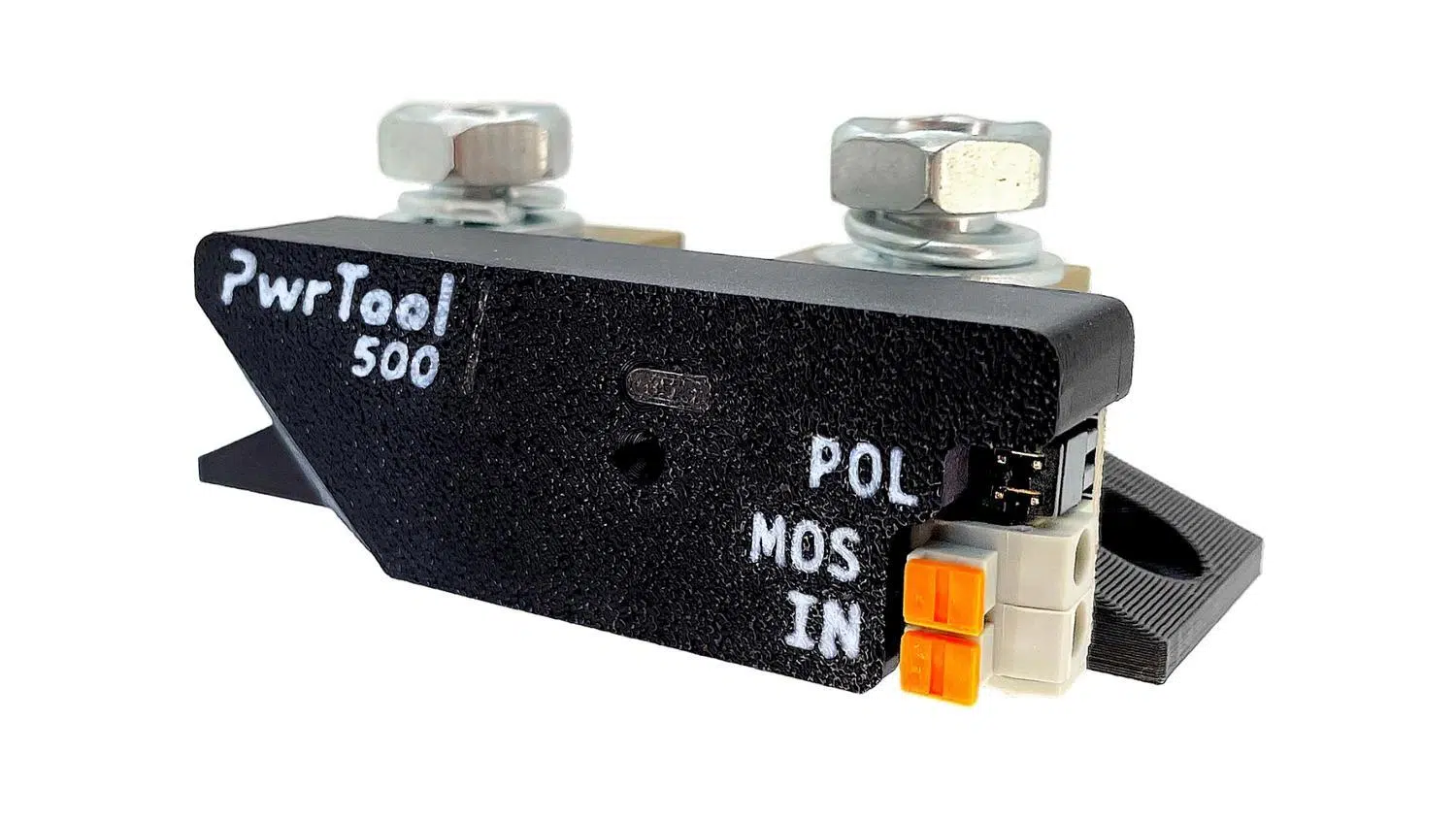
If you're looking to fully understand a truly open smart shunt, the Voidbox PwrTool 500 is a promising option for the self-consumption and off-grid systems market. It natively integrates Home Assistant and allows for direct customization with ESPHome or proprietary firmware, a rarity in this type of hardware. In terms of specifications, it works with 6–60 V DC systems and supports peak currents of up to 500 A with a continuous 300 A shunt , offering detailed telemetry to visualize and even automate energy flow, generation, storage, and consumption.
This device positions itself as a bridge between battery monitoring and load orchestration, with a clear focus on open data and freedom from closed ecosystem constraints. With accessible sensors, available GPIO pins, and transparent firmware , it caters to both those who want a ready-to-use dashboard in Home Assistant and those who need to leverage its capabilities with advanced integrations, high-current relays, and resistive load control to manage excess solar energy.
What is PwrTool 500 and who is it for?
Essentially, PwrTool 500 is an open-source, intelligent shunt that monitors critical variables such as voltage, current, and power in systems from 12 to 48 V nominal, while maintaining true compatibility with a wide range of lithium, LiFePO4, and lead-acid batteries. Its strength lies in offering visibility and control from Home Assistant without external gateways , reducing adoption friction and leaving the door open for expansion via ESPHome.
The device is designed for owners of off-grid solar installations, caravans, boats, makers, and professionals who demand more than just a single charge status reading. By offering a comprehensive approach to telemetry and control, it enables automation based on voltage, current, power, and environmental data, moving from simply measuring to acting—for example, to protect batteries or intelligently utilize surplus energy.
Smart shunt truly open
Many market shunts encapsulate data in opaque apps and protocols, making integration difficult. PwrTool 500 breaks with this dynamic: both the hardware and software are open, with direct access to sensors, firmware, and expansion pins. This means you can adapt the equipment to very specific requirements without vendor lock-in and without having to decipher undocumented protocols.
This philosophy simplifies life for those who wish to audit, extend, or maintain their power systems long-term. Furthermore, documentation, schematics, PCBs, and BOMs are publicly available, enhancing transparency and accelerating community-based problem-solving.
Applications in isolated and DC systems
The shunt is versatile enough to be placed at various points in the DC system, covering uses ranging from battery status monitoring to load shedding. With its open architecture, it's easy to combine it with other modules to separate consumption and generation, or to add monitoring where it's lacking in modern hybrid controllers and inverters.
- Battery monitoring: State-of-charge tracking with high-precision coulomb counting, useful for realistic range estimates.
- Load segregation: use of multiple shunts to differentiate between consumption and generation sources, providing diagnostic clarity.
- Expand existing systemsMany MPPT hybrids and large controllers lack monitored DC output; here the PwrTool 500 fill that void telemetry.
Monitor and automate with Home Assistant
Once connected to your Wi-Fi network, the device quickly appears in Home Assistant and displays a comprehensive set of metrics ready for your custom dashboards. From there, you can calibrate the current offset, monitor the system's critical point , and, most interestingly, trigger automations based on voltage, current, power, or even temperature and humidity thresholds.
For automatic protection, the system includes a 45W N-channel MOSFET that controls a high-current relay and disconnects loads during faults . This same control is useful for activating resistive loads, such as an electric water heater, to absorb excess solar energy when the batteries are already full, maximizing the system's energy efficiency.
Scalable hardware based on FLIP_C3
The heart of the PwrTool 500 is the FLIP_C3 board, a proprietary design featuring an ESP32-C3 microcontroller that provides Wi-Fi and BLE connectivity, as well as pin expansion for UART, I2C, SPI, PWM, and more. This base is designed for integration into 12 to 48 V DC ecosystems and includes a 5 V, 2 A buck converter tolerant to 60 VDC, simplifying power supply in demanding environments.
- ESP32‑C3 with Wi‑Fi and BLE, ideal for telemetry and wireless control in home and professional environments.
- 5 V / 2 A buck converter (10 W) with 60 V DC tolerance, robust to bus variations.
- Expandable GPIOs with support for UART, I2C, SPI, PWM, among other common protocols.
- USB Type-C for direct and convenient firmware flashing and recovery.
- WS2812 output leveled, capable of powering and controlling strips of more than 100 addressable LEDs.
- Configurable BOOT button, integrated status LED and Reset button for maintenance.
Furthermore, the design features Stemma QT and Qwiic connectors for I2C expansion, duplicated on the main board to facilitate solderless connection of multiple peripherals. All of this allows for modular and organized scalability of the system with sensors, relays, and displays .
ESPHome: Accessible development step by step
Each PwrTool 500 unit ships with custom ESPHome firmware. Adopting this firmware in ESPHome Builder provides a well-maintained configuration base, designed for seamless extension. ESPHome's YAML approach makes learning easy and well-documented , democratizing smart device development.
The ESPHome community offers a wealth of copy-and-paste examples for sensors, motors, lights, and more, including its own repository of modular configurations to help you get started quickly. You can also import data from your power system via UART and other protocols, integrating controllers and inverters you already have installed.
ESPHome is updated monthly according to the Home Assistant roadmap and a vast database of open-source contributions. This cycle ensures a steady stream of bug fixes and new features , reducing the risk of being stuck with outdated or abandoned versions.
The team behind the project invites suggestions for improvements to the default configuration. With the dataset provided by the shunt, there's room to create more advanced templates and logic , benefiting the entire community through continuous iterations.
Key specifications and capabilities
Power monitoring
- System voltage: 6–60V DC, compatible with lithium, LiFePO4 and lead acid batteries.
- Current: 500 A peak and 300 A continuous through the shunt, sized for demanding installations.
- precise measurement: INA238 with preamplifier and 16-bit ADC, plus on-chip thermal sensor oriented to the shunt.
- Polarity: Jumper selection for hot or cold side, delivered as standard in cold side mode.
- 45W N-channel MOSFET for PWM control of LED lighting or control of powerful loads using a relay or contactor.
FLIP_C3 controller board
- ESP32‑C3 with Wi‑Fi and Bluetooth Low Energy connectivity.
- Buck 5 V / 2 A with a total power of 10 W.
- Expandable GPIOs with UART, I2C, SPI, PWM and other standard interfaces.
- USB Type-C for flashing and recovery.
- WS2812 output leveled, suitable for more than 100 addressable LEDs.
- Configurable BOOT button, plus status LEDs and Reset button on board.
Additional hardware
- Two Stemma QT/Qwiic ports for solderless I2C expansion.
- Integrated SHTC3 sensor for ambient temperature and humidity.
Flexible polarity and mounting
Most shunt-based monitors operate only on the cold side, that is, the return or negative terminal of the battery bank. In designs with physical constraints or safety features, this can complicate wiring. The PwrTool 500 incorporates a jumper-selectable hot-side mode , adding flexibility for advanced or unusual configurations. It comes from the factory in cold-side mode, but switching between modes is quick and well-documented.
This flexibility allows it to be adapted to electrical panels where the ground bar is not ideal for shunting, or when measurements on the positive rail are required for diagnostic or load protection purposes . Regardless of the orientation chosen, the INA238's accuracy and offset compensation help ensure consistent readings over time.
Comparison against popular alternatives
In the 500 A range, there are established options like Victron SmartShunt, Thornwave PowerMon, and offerings from REDARC. In contrast, PwrTool 500 stands out as the only fully open solution in both hardware and software, with native Wi-Fi integration with Home Assistant, and a design that favors expansion over a closed ecosystem. Furthermore, it comes with a competitive price of $149 USD.
Note on polarity : The shunt is called the hot side when it is located on the positive side of the bank, and the cold side when it is installed on the return or ground. The industry standard is usually cold side, but the option to use hot side avoids conflicts in certain installations. The equipment is supplied in cold side configuration and can be changed to hot side using a jumper.
Documentation and community support
The hardware files, including schematics, board layout, and bill of materials, are available as open source on the project wiki. YAML configurations for ESPHome are also offered and maintained on GitHub, with a focus on reusable modules and clear templates to accelerate deployment.
Because ESPHome is maintained by the Home Assistant team and a large community, new features and bug fixes are released regularly. This provides a solid foundation for secure updates and continuous improvements without relying on closed vendors or discontinued software.
Manufacturing, logistics and risk plan
The design of the PwrTool 500 is complete and tested, ready for production. Final assembly and packaging will take place in Joshua Tree, California, with the option to partner with Elecrow as a contract manufacturer if demand exceeds projections. Elecrow has a proven track record in Crowd Supply campaigns, lending confidence to their processes and quality.
After validation and testing, each unit will be sent to Crowd Supply's logistics partner, Mouser Electronics, which will handle distribution to backers. You can consult the Crowd Supply guide for details on ordering, payment, and shipping , ensuring logistical transparency from day one.
Among the risks considered, the team points to fluctuations in import tariffs between the United States and China, which could impact margins, as well as the preparation of CE and UKCA certifications to expand the market to Europe and the United Kingdom. Component availability and global logistics remain factors to monitor, although the project works with established suppliers and maintains clear communication regarding timelines.
Events and ecosystem: FLIP_C3 and PwrTop 18
Voidbox Industries showcased the PwrTool 500 at events like Teardown, alongside prototypes based on the FLIP_C3 development board, a base designed for integrating hardware into 12–48V DC systems. They also presented the PwrTop 18, a simplified circuit for a USB-C power bank using an 18650 cell, developed in collaboration with Alpenglow Industries. These initiatives demonstrate a commitment to practical and open solutions within the DC power ecosystem.
Beyond the core product, the team fosters community feedback through demos, giveaways, and prototypes, aiming to gather genuine impressions from users and professionals. This cycle of listening and continuous improvement reinforces their open hardware approach and long-term support.
Price, stores and usual policies
The manufacturer positions PwrTool 500 at a competitive price of $149 USD. In the retail channel, it's common to find forms for reporting lower prices at other stores, which helps maintain competitiveness. These practices, along with clear shipping and return policies , typically improve the shopping experience and end-user confidence.
Similarly, e-commerce sites display cookie notices with mandatory functional options and statistical or personalized preferences. While unrelated to the device's technical performance, understanding these policies facilitates navigation and the purchasing process, and it's common to see categories such as strictly necessary cookies and user-controlled analytics .
In terms of availability, the manufacturing strategy and logistics alliance with Mouser facilitate orderly fulfillment, while open documentation and the ESPHome community provide a stable foundation for medium- and long-term support and updates .
With an approach that combines complete openness, direct integration with Home Assistant, robust specifications, and an expandable ecosystem on the ESP32-C3, the PwrTool 500 presents itself as an attractive option for DC monitoring and automation. Its ability to operate at 6–60 V, measure up to 500 A peak, select polarity, control high-current relays, and expand via I2C and GPIO, coupled with the project's transparency and the planned logistics, makes it a well-rounded package for those who want to go beyond a simple state-of-charge number and seek fine control, useful data, and the freedom to evolve their installation.
Table of Contents
- 1 What is PwrTool 500 and who is it for?
- 2 Smart shunt truly open
- 3 Applications in isolated and DC systems
- 4 Monitor and automate with Home Assistant
- 5 Scalable hardware based on FLIP_C3
- 6 ESPHome: Accessible development step by step
- 7 Key specifications and capabilities
- 8 Flexible polarity and mounting
- 9 Comparison against popular alternatives
- 10 Documentation and community support
- 11 Manufacturing, logistics and risk plan
- 12 Events and ecosystem: FLIP_C3 and PwrTop 18
- 13 Price, stores and usual policies