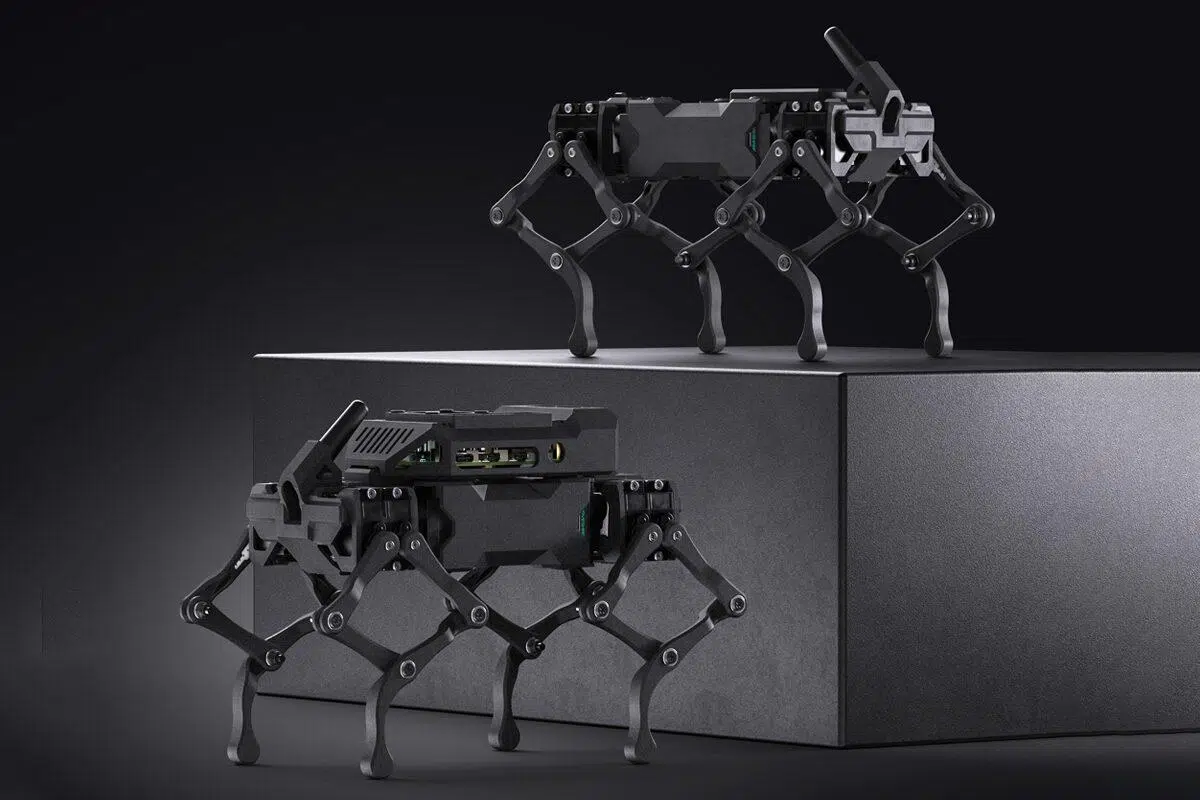
The world of educational quadrupeds continues to expand, and in this arena, the WAVEGO Pro 12-DOF has carved out its own niche thanks to its open approach, two-level control, and seamless computer vision integration. This robotic dog is designed for classrooms, makerspaces, and lab prototyping, offering a striking balance of robustness, price, and ease of use.
Beyond the headline about 12 degrees of freedom, what truly sets it apart is how it distributes the workload between a real-time ESP32 and a Raspberry Pi for high-level decision-making, with a cross-platform web interface that eliminates the need for apps, and OpenCV demos for features like facial recognition, color tracking, and motion detection. In the following sections, we delve into the hardware, software, and kit options, and compare it to alternatives such as Petoi Bittle, XGO-Mini2, PuppyPi, and PiDog.
What is WAVEGO and what does the Pro version offer?
WAVEGO is an open-source, dog-like quadruped platform with 12-DOF , built around a multi-link leg design to extract more effective torque from 2,3 kg·cm servos. Its base configuration includes a front-facing camera, a 9-axis IMU, RGB lighting, and a web app for browser control—all designed so you can take it out of the box and start using it right away without struggling with compilation environments.
The core of the system is divided in two: an ESP32 acts as a real-time sub-controller responsible for inverse kinematics and gait generation, while a Raspberry Pi can take on the role of host controller for vision and AI tasks. This separation shares the computational load and improves gait stability, reserving resources for the Pi for more demanding functions.
As for variations, there are "Basic" options and packages with upgrades. The basic model includes everything needed to assemble the bionic dog and make it walk, with the Raspberry Pi as an optional extra if you prefer to integrate it later. For those looking for the complete package, there are kits that include the 4GB Raspberry Pi 4, a 32GB microSD card, a USB-C power supply, and a CSI camera, as well as mounting brackets and cabling ready for integration.
The Pro edition reinforces this approach with an even more polished open-source web interface, compatibility with Raspberry Pi 4B and 5, ESP-NOW host-sub connectivity , and a 5MP wide-angle camera for integrated vision. It's important to note that the 5MP camera is only included in certain kits labeled RPI WAVEGO Pro ACCE or PI5 WAVEGO Pro KIT.
For the end user, this translates into a platform ready for education, AI demonstrations, and agile prototyping: open your browser, connect to the WiFi hotspot that the robot itself creates when it starts up, and start controlling, without installing applications or preparing toolchains.
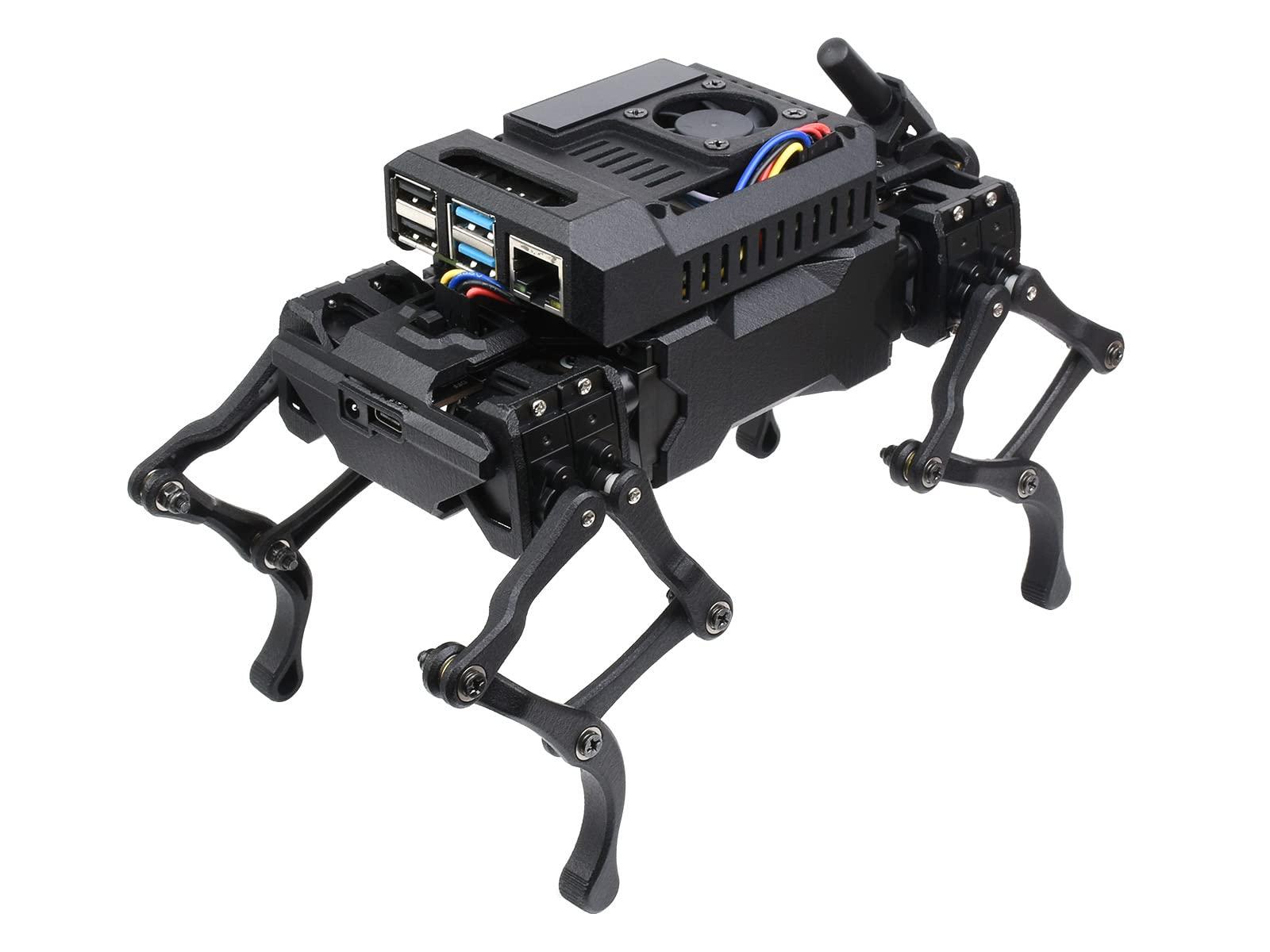
Mechanical design and hardware: 12-DOF, materials and electronics
The chassis combines 5052 aluminum alloy with PA12 nylon for an ultra-compact and lightweight structure that withstands desktop use without sacrificing rigidity and durability. Throughout the body, there are approximately 40 sets of bearings that smooth movement and distribute loads, resulting in noticeable fluidity of transitions and repeatability.
The overall leg design utilizes a multi-link system per leg. This mechanical kinematics, combined with the inverse resolution of the ESP32, allows for a higher effective servo torque of 2,3 kg·cm. In practice, this results in more precise steps and agile responses to changes in weight distribution or minor terrain irregularities.
To maintain stability, it integrates a 9-axis ICM20948 IMU that enables self-balancing posture. Thus, even on uneven surfaces, the system compensates for tilts to keep the front camera stable , improving tracking and visual recognition. This sensor is key for detecting falls, swaying, and micro-instabilities in real time.
In terms of vision, the Pro version includes a 5MP wide-angle camera, which is useful for the OpenCV demos (faces, colors, objects). Keep in mind that the camera may or may not be included, depending on the kit. It is included in the "RPI WAVEGO Pro ACCE" and "PI5 WAVEGO Pro KIT" bundles, while in other cases you will need to purchase it separately. This precision in your purchase prevents surprises and ensures that what you receive matches your intended use.
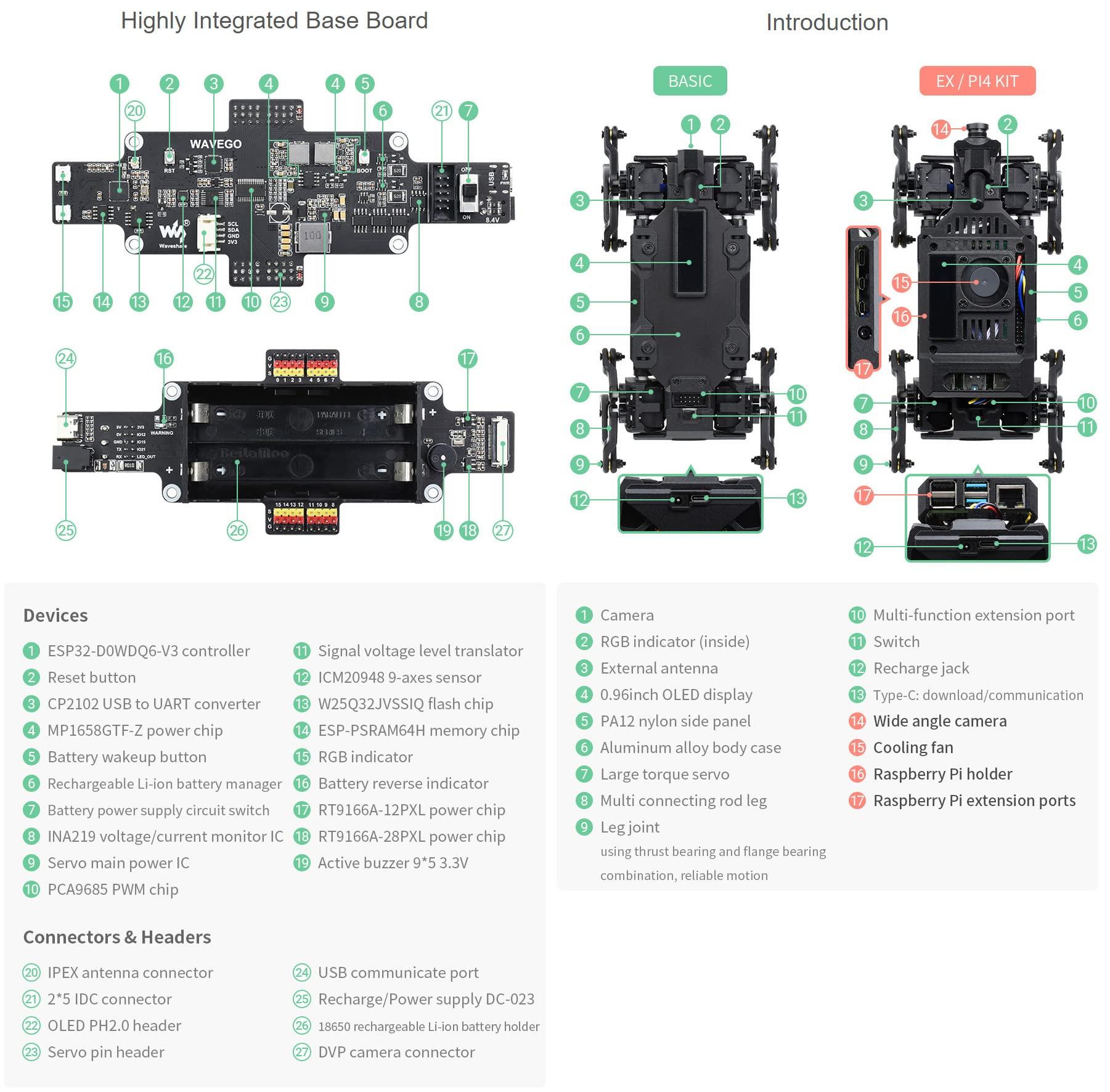
The control board comes with an interesting assortment of components designed for robustness and development: you'll find the main power IC for servos , the voltage level translator for signals (ensuring compatibility between logic domains), the ICM20948 9-axis sensor itself, the W25Q32JVSSIQ flash memory for firmware and data, external ESP-PSRAM64H memory to expand buffers and processing, battery reversal indicators to protect the user, and a 9×5 active 3,3V buzzer for acoustic warnings.
In terms of physical connectivity, the robot offers frequently used ports and headers for expansion and maintenance. It features a USB communication port for programming/diagnostics, a DC-023 charging and power connector, and a battery holder for rechargeable 18650 lithium cells. This last feature simplifies battery swapping and provides modular autonomy adapted to your class day or testing sessions.
- USB communications port: Quick link to subcontroller and console.
- DC‑023 Charging/Power Connector: Secure entry for charging or powering.
- 18650 battery holder: standard solution for rechargeable lithium batteries.
In addition, the chassis includes a multi-function expansion port for extra modules, an accessible power switch, a dedicated charging socket, USB-C for firmware download and communications, physical support for Raspberry Pi, expansion ports for the Pi itself, and a cooling fan for when you push it hard with vision or AI workloads.
- Multifunction extension port for accessories and sensors.
- Switch y recharging socket easy access.
- USB‑C for programming and direct communication.
- Raspberry Pi Stand and its expansion ports.
- Ventilador cooling for long sessions.
The manufacturer notes that "Resources & Services" may vary depending on the specific product in the catalog, so it's a good idea to consult the technical wiki before purchasing to confirm examples, documentation, and files actually supplied.
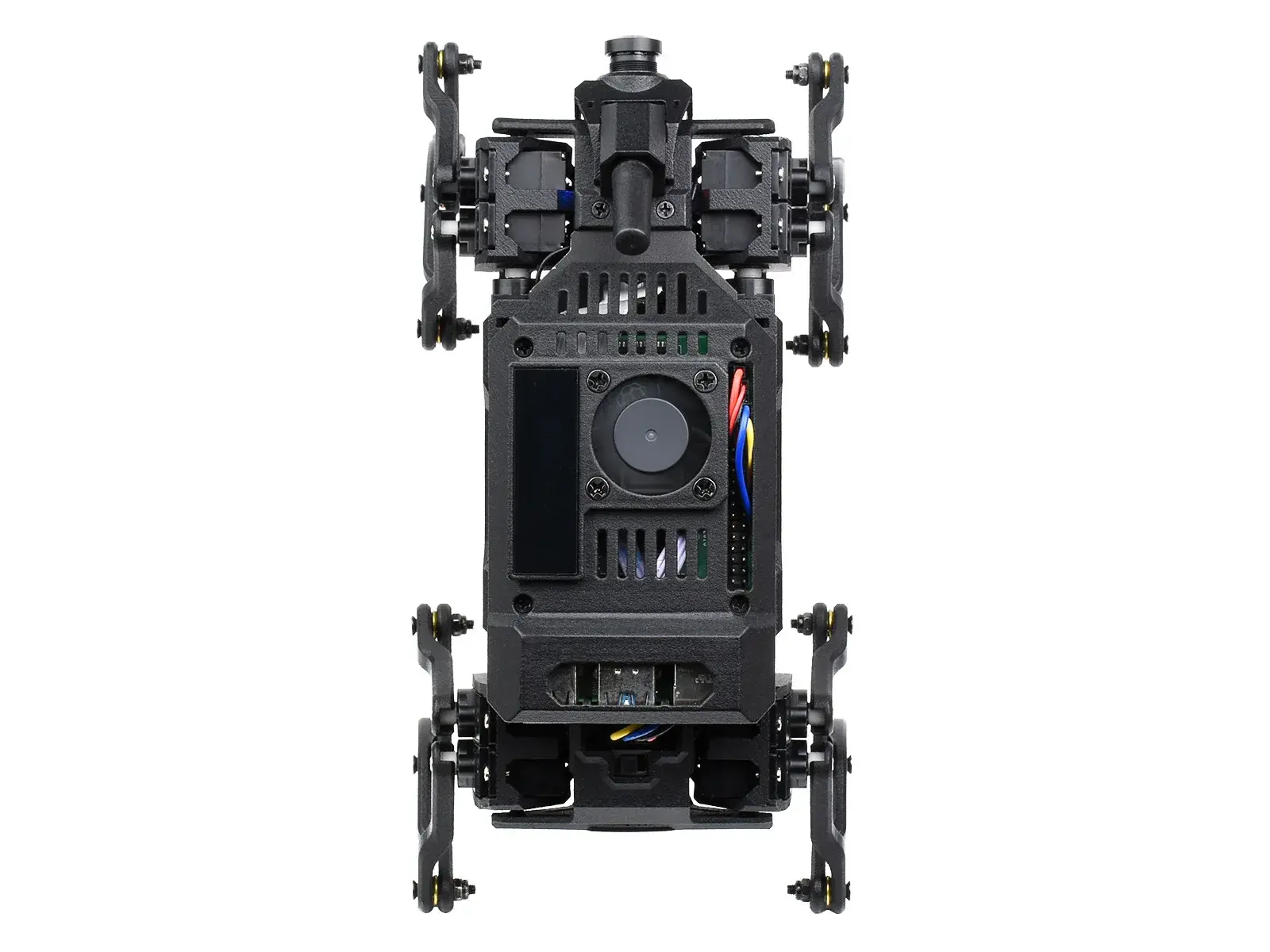
Control, software and onboard intelligence: ESP32 + Raspberry Pi, webapp and vision
The WAVEGO's greatest strength lies in its dual control architecture. The ESP32 runs a real-time system that handles the inverse kinematics of the legs and generates the gait. This ensures low latency and stable steps, while the Raspberry Pi (4B or 5) handles the high-level logic: OpenCV vision, AI algorithms, and complex decision-making.
Communication between the two worlds is via UART, allowing the subcontroller to handle much of the computational work while the Pi focuses on heavy lifting. The Pro version also emphasizes ESP-NOW connectivity in host-sub mode , which is very useful for multi-node scenarios or lightweight wireless control.
For day-to-day control, the robot launches a Wi-Fi hotspot upon startup. You connect from your mobile phone or computer, open your browser, and that's it: no apps or installations required . You access an open, cross-platform web interface with controls, status updates, and demos. This simplicity reduces the learning curve in the classroom and accelerates testing in the lab.
In the field of computer vision, the included examples cover facial recognition , motion detection, and color tracking. These cases demonstrate the camera→processing→action pipeline and serve as a basis for extensions such as object detection, color segmentation, reactive navigation, and marker interaction.
The platform is openly hackable: there's a dedicated expansion interface for secondary development, user documentation, and materials for extending functionality. Many kits also include a CSI camera, USB-C power supply, microSD card, and the necessary hardware for seamless integration with the Raspberry Pi.
WAVEGO Pro runs on a Raspberry Pi 4B and is compatible with a Raspberry Pi 5, which is ideal if you want to increase the workload: from more complex pattern recognition to SLAM for navigation. With a Pi 5 and the fan running, the robot performs well during extended, intensive processing sessions.
In terms of market performance, the system falls into a mid-range price bracket (around $450 USD according to some sources), positioning itself below more expensive robots like the XGO-Mini2 and above entry-level options such as the Petoi Bittle or PiDog. Its most notable features at this price point are the combination of dual controls, a universal web interface, and a robust chassis.
In terms of degrees of freedom, the WAVEGO Pro matches the XGO-Mini2 and PiDog and surpasses the Petoi Bittle and PuppyPi. Its standout feature is the aluminum + PA12 frame with bearings, which offers superior mechanical feel and durability compared to cheaper alternatives. One point to consider is the lack of official ROS support, something present in the PuppyPi and, to some extent, the XGO-Mini2, in case your roadmap requires ROS from day one.
Regarding battery life, the specifications consulted don't provide a definitive answer, so if you're planning long-duration or outdoor activities, you should consider high-quality 18650 batteries and have spare battery packs on hand. The advantage is that the system allows for quick battery swaps thanks to the battery holder, and the electronics include protections such as reverse polarity indicators.
Who is it for? Three profiles fit perfectly: educators who want to teach kinematic control, Python, and computer vision (consult mechatronics books ); makers and developers who need an open and modular platform; and researchers and prototypers looking for a quadruped to test deep learning models and autonomous behaviors without spending a fortune. Compatibility with the Pi 5 expands that ambition.
Looking at the ecosystem, many stores position the product with "Basic (assembled)" variants or bundles that include a 4GB Raspberry Pi 4, a 32GB microSD card, a USB-C power adapter, and a CSI camera. Some websites even have forms for reporting better prices , with required fields (marked with an asterisk) and options to indicate if the reference comes from a physical store, the province/state, etc. These commercial details don't affect usability, but they help find the right variant at the best price.
In line with the rest of the catalog, the manufacturer notes that available resources and services may vary by SKU, so it's always a good idea to check the product wiki to confirm exactly which examples, system images, and guides are included in the kit you choose.
As a point of context, the market for programmable quadrupeds for education, research, and experimentation is booming: platforms designed to walk, run, and maneuver with precision and stability, compatible with Raspberry Pi or micro:bit, offer AI, vision, and remote control packages. WAVEGO Pro fits into this landscape, bringing versatility and openness with a very accessible entry barrier.
All of the above makes the WAVEGO Pro 12-DOF a very well-rounded option: meticulous engineering (5052 aluminum + PA12, bearings), dual ESP32 + Raspberry Pi control with ESP-NOW host-sub, an open web interface without apps, ready-to-run OpenCV demos, and a range of kits from basic assembly to packages with a Pi 4/5 and camera. While not the cheapest or the most "pro," it competes effectively in its category thanks to its ease of use, expandability, and balance between hardware and software.
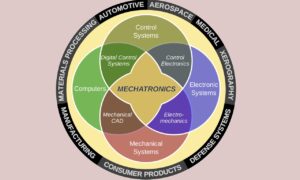
Table of Contents