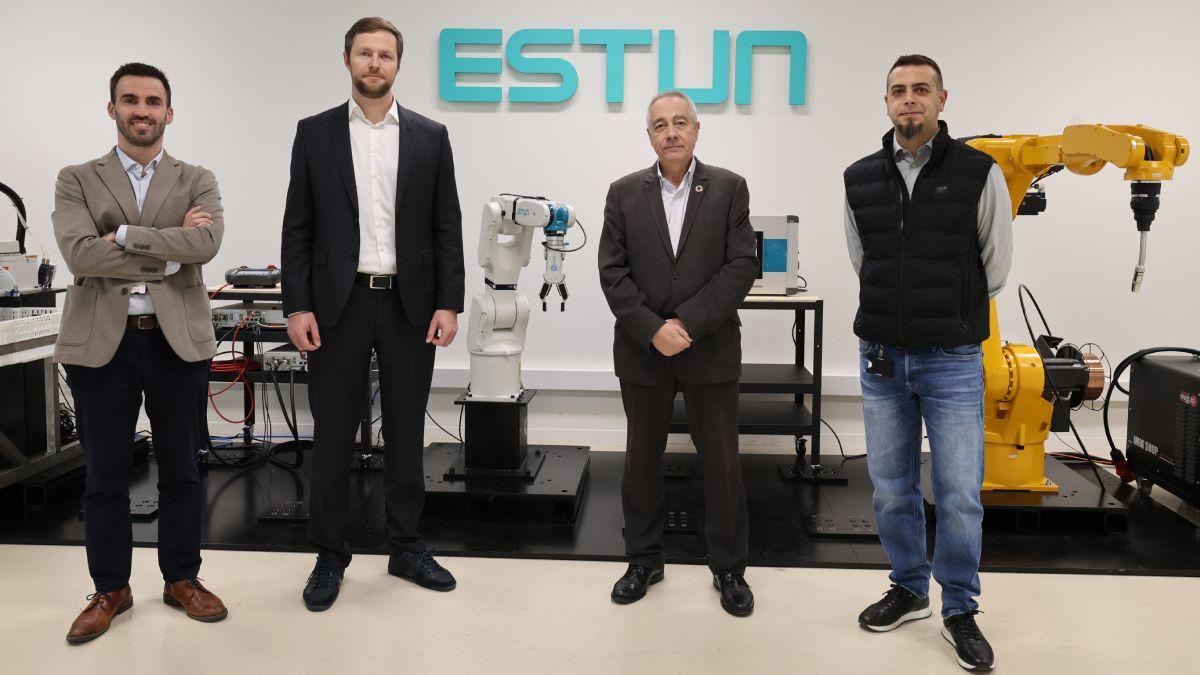
The Chinese industrial robotics company Estun has taken a significant step in its international expansion with the opening of new facilities at DFactory Barcelona , the Industry 4.0 hub promoted by the Barcelona Free Trade Zone Consortium (CZFB) . This move reinforces the company's commitment to the European market and positions it closer to its customers and technology partners on the Iberian Peninsula.
The arrival in this innovation ecosystem not only represents the arrival of a new technology company in Barcelona, but also consolidates Estun's strategy of offering scalable and reliable solutions for companies of all sizes, from industrial SMEs to large corporations.
Estun: Three decades of innovation in industrial robotics
Founded in 1993 in Nanjing, China , Estun has established itself as one of Asia's leading companies in robotics and industrial automation , with nearly 30 years of continuous innovation . The company has built a technological ecosystem that encompasses everything from robot design to the development of software and digital solutions for industry.
Currently, the company has a global workforce of approximately 5.000 people , distributed among development centers, factories, and sales offices across several continents. This structure allows it to tackle complex projects and offer close technical support in key industrial markets.
One of the keys to its growth has been sustained investment in research and development: around 10% of its annual revenue is allocated to R&D. This commitment has allowed it to evolve from basic automation solutions to advanced integrated systems capable of meeting the needs of very different sectors.
Their value proposition is structured around three main business areas : industrial robots , industrial automation, and digital solutions for industry. This comprehensive value chain approach allows customers to find all the hardware, software, and services they need to modernize their production processes from a single supplier.
Estun has also been recognized internationally: in 2020 it was included by Forbes as the only Chinese industrial robot company on the list of "China's Most Innovative Companies", a milestone that reinforces its technological profile in a highly competitive sector.
Technological capabilities and industrial footprint in Europe
The arrival in Barcelona is part of a broader strategy by which Estun seeks to gain a stronger foothold in the European market , considered a key area for the growth of advanced automation. The company already operates in the region through a production plant in Poland , with the capacity to manufacture up to 15.000 robots per year.
From this factory, Estun supplies a wide range of models that cover various automation needs: six-axis robots, SCARA robots, and collaborative robots , among others. The payload capacities of this equipment range from approximately 3 to 1.200 kilograms , allowing it to handle everything from light handling tasks to heavy-duty operations.
These robots are used in multiple sectors: welding, consumer goods, renewable energy, automotive, and aerospace , among others. The versatility of the portfolio makes it easy for each customer to find solutions tailored to their type of production, current level of automation, and potential for future growth.
In addition to hardware, the company develops its own motion control and key components , which is especially relevant given that many companies rely on third parties for these parts. By integrating design, manufacturing, and control, Estun aims to ensure stable performance and reduce supply chain risks.
This comprehensive approach also lays the foundation for next-generation robotics projects , such as increasingly autonomous production lines or even the development of solutions approaching humanoid robotics, where precise motion control and data management are fundamental.
Commitment to Spain and close support from DFactory Barcelona
The new headquarters at DFactory Barcelona will serve as a central hub for Estun's operations on the Iberian Peninsula. According to Dmitry Kapishnikov, CEO of Estun Iberia , the move to this hub reflects a "strong commitment to the European market" and to providing close technical and sales support to customers in Spain and the rest of Europe.
The executive emphasized that the company wants to strengthen its collaboration with local industry , both with established manufacturers and with companies taking their first steps in advanced automation. The intention is to work on joint R&D projects , share knowledge, and promote the adoption of technologies that improve the competitiveness of production plants.
Kapishnikov emphasizes that this physical presence will facilitate top-tier support , with a faster response to integration, commissioning, training, and maintenance needs. In a sector where production line downtime has a direct impact on costs, having a nearby supplier can be crucial.
The office at DFactory is also envisioned as a space to introduce industrial robotics to companies that haven't yet embraced automation, helping them evaluate use cases, calculate return on investment, and design customized projects. In this way, Estun aims to make advanced automation "accessible and reliable," not only for large industrial groups but also for SMEs.
At the same time, the company will use this base to strengthen alliances with technology partners and research centers, taking advantage of the concentration of talent and projects related to Industry 4.0 that already exists in Barcelona and its metropolitan area.
DFactory Barcelona, a leading hub in Industry 4.0
DFactory Barcelona has become one of the most important industrial innovation hubs in Southern Europe. Driven by the Barcelona Free Trade Zone Consortium (CZFB) , this space brings together companies, startups, and research centers specializing in key technologies for the digital transformation of industry.
Currently, the hub hosts more than 40 companies and organizations working in fields such as robotics, advanced sensors, 3D printing, cybersecurity, artificial intelligence, augmented reality, and nanotechnology. This mix of profiles creates an environment conducive to collaboration and the development of cross-sector projects.
Pere Navarro , the State's special delegate to the CZFB ( Barcelona Free Trade Zone Consortium), highlighted that Estun's addition "enriches the DFactory Barcelona ecosystem" and helps consolidate the commitment to digitalization and advanced automation in the production sector. The presence of a company specializing in industrial robotics thus joins other firms already operating in the complex.
For her part, the CEO of the CZFB, Blanca Sorigué , emphasized that Estun's arrival reinforces DFactory's commitment to creating a robust ecosystem capable of attracting companies that provide high-impact solutions for European industry. These types of implementations help position Barcelona on the map of advanced automation on an international scale.
The DFactory project is not stopping at its current configuration. A significant expansion of the facilities is planned , increasing from 17.000 to 60.000 square meters by the end of 2026. This expansion will allow for the incorporation of new companies, laboratories, and testing spaces, reinforcing its role as a strategic hub for Industry 4.0.
With the opening of its headquarters at DFactory Barcelona, Estun combines its expertise in robotics and industrial automation with an environment designed to accelerate the digital transformation of the manufacturing sector. The combination of a company with technological capabilities and its own manufacturing facilities, along with a hub that brings together dozens of innovative players, positions Barcelona and Spain as a whole to capitalize on the momentum of Industry 4.0 in Europe.
Table of Contents