
Temperature management in data centers has evolved from a simple engineering adjustment to a central factor determining how much AI power can actually be run. With the deployment of massive language models (LLMs) and generative AI, we've encountered racks exceeding 50 kW density, a figure that renders conventional air conditioning completely ineffective, simply useless against such a heat load.
This shift hasn't been a smooth ride, but rather a sharp leap towards direct-to-chip liquid cooling . What recently seemed like an experiment for a few enthusiasts is now the standard architecture for any company that wants to compete in the next generation of technological infrastructure, transforming how we think about the efficiency and economic viability of data centers.
The disruptive concept of hot water cooling
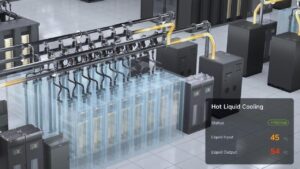
For those unfamiliar with the field, the idea of using water at temperatures similar to those of a jacuzzi to cool the most advanced hardware on the planet sounds completely surreal. However, physics doesn't lie: AI chips generate so much thermal energy that a fluid composed of 75% water and 25% propylene glycol can absorb the heat effortlessly. In this system, the liquid enters the circuit at around 40°C or 45°C and exits at around 55°C, maintaining the integrity of the silicon and preventing a performance drop.
What's truly brilliant about this technique is that, starting from such a high initial temperature, the temperature difference with the outside air is large enough for the system to operate passively in the vast majority of climates. This allows for the installation of massive external radiators and eliminates the need for noisy fans that typically raise noise levels above 85 decibels, making the operating environment much more pleasant and efficient.

Precision engineering: the heart of the system
To prevent this deployment from ending in operational disaster, precise coordination of the components is essential. This is where advanced cold plates with internal microstructures come in , capable of capturing 80% to 90% of the heat directly from the chip. Not all cold plates will do; a high-precision plate ensures system reliability even with hot water, while a substandard one could drastically reduce the hardware's lifespan.
The system is based on several fundamental technological pillars:
- Intelligent CDUs: These Refrigerant Distribution Units act as the brain, managing pressure and flow from 105 kW up to 2,3 MW.
- Rack manifolds: Stainless steel collectors that ensure the fluid reaches each GPU without leaks.
- Direct-to-Chip Systems: A technology that becomes 3.000 times more effective than air to transport thermal energy.
- RDHx (Rear Door Heat Exchangers): Rear door heat exchangers that remove heat using liquid-cooled air with capacities up to 75 kW.
When these components are integrated with the electrical architecture, a fascinating economic phenomenon occurs. The energy budget previously wasted on cooling air is now redirected to power more GPUs. According to Eaton data, this can increase computing output by up to 33% per power connection, making heat management a direct business tool.

The water challenge and sustainability
Despite advancements, AI is a resource-intensive machine at an astonishing rate. To measure this impact, the industry uses Water Usage Effectiveness (WUE) , which calculates the liters of water consumed per kilowatt-hour of IT energy. While traditional evaporative cooling has a very high WUE, closed-loop liquid cooling can approach the ideal value of 0.0 L/kWh.
Giants like Microsoft are implementing zero-evaporation designs to reduce water loss by more than 125 million liters per installation per year. Meanwhile, Google and Meta have committed to water positivity by 2030 , aiming to replenish more water than they consume. This move is vital, as the power density of GPU racks, which can reach 135 kW, puts local water resources at risk in critical areas like Arizona.
There are also more radical alternatives, such as immersion cooling . Whether through single-phase or phase-change cooling (where the fluid boils at low temperatures), the goal is to completely eliminate the use of water and reduce energy consumption by up to 82% in specific cases. In the case of Nvidia's Rubin architecture, the water circuit only needs to be filled once, allowing for the retirement of evaporative cooling towers, which are veritable water guzzlers.
Towards the era of AI factories
We can no longer talk about generic data centers; we are entering the era of true AI factories . In this ecosystem, computing, networking, and power are merging into a single entity. The Nvidia DSX platform is the perfect example, where liquid cooling is the norm, not the exception, enabling power densities that would be impossible with traditional air conditioning.
For those seeking reliability, companies like Schneider Electric offer free cooling solutions and oil-free centrifugal chillers that optimize heat flow from the chip to the power grid. While switching from air to liquid cooling involves operational risks and considerable integration complexity, when racks exceed 50 kW, liquid cooling ceases to be an option and becomes an essential requirement for hardware survival.
The widespread adoption of these advanced thermal systems is redefining infrastructure profitability, enabling energy savings of between 20% and 40% . By optimizing the ability to quickly move heat away from silicon, the industry is ensuring that the growth of language models is not hampered by the insurmountable barrier of energy consumption and water stress.

Table of Contents