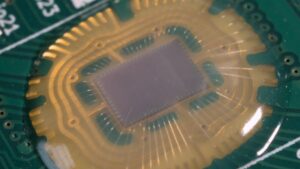
OpenAI and Broadcom have announced a long-term collaboration to co-develop and deploy AI accelerators and networking equipment that will add 10 gigawatts (GW) of data center capacity. This move positions both companies at the forefront of the race to secure computing power in a rapidly growing market.
The agreement stipulates that OpenAI will design the chips and accompanying systems , while Broadcom will handle their development and installation in its own and partner infrastructures. The plan anticipates beginning to assemble the first racks in the second half of 2026 and completing the rollout before the end of 2029, leveraging Broadcom's Ethernet technology and connectivity.
What the collaboration includes and who does what
The alliance encompasses the design of custom accelerators and network architecture , with OpenAI defining the specifications and Broadcom leading the development and operational deployment. The entire solution is built on Ethernet and Broadcom's connectivity portfolio, including optical and PCIe options, with the goal of facilitating open and scalable clusters.
The goal is to implement the knowledge gained from training and serving advanced models in hardware , thereby improving performance and energy efficiency. The racks will be installed in OpenAI data centers and partner facilities, allowing for rapid and coordinated capacity growth.
Meanwhile, OpenAI is making progress in its own semiconductors, primarily focused on the inference phase of its models, while Broadcom is contributing its expertise in switching, high-speed links, and optical solutions to reduce bottlenecks.
Project schedule, capacity and scope
The roadmap sets the start of the rollout in 2026 and its completion before 2030 , with a total capacity of 10 GW. To put this in perspective, one gigawatt is roughly equivalent to the typical capacity of a conventional nuclear power plant , and 10 GW is equivalent to the energy consumption of more than eight million US homes, which gives a sense of the challenge.
This scale increases the pressure on electrical grids and energy providers , as AI data centers concentrate intensive use of electricity and cooling. Companies are therefore adopting a phased deployment, coordinated with cloud providers and hosting partners to ensure supply and continuity.
Market impact and financial details
The companies have not disclosed the financial terms of the agreement, and OpenAI emphasizes that it does not include investment or equity components, unlike other deals in the sector. Various market estimates suggest that the startup could raise an additional $350.000 billion to $500.000 billion to support its infrastructure expansion.
The news had an immediate impact on the stock market: Broadcom shares jumped around 9%–10% after the agreement was announced, in line with investor appetite for everything related to AI infrastructure and with the positive tone the stock had already been showing.
How it fits with other OpenAI partners
The agreement with Broadcom adds to OpenAI's other alliances aimed at diversifying its ecosystem and securing computing power. In recent weeks, the company has placed orders equivalent to 10 GW with Nvidia and announced another agreement with AMD for 6 GW , in addition to a five-year, $300.000 billion data center contract with Oracle , according to press releases and industry reports.
By embracing Ethernet and open solutions, OpenAI reduces its reliance on proprietary architectures and gains leeway to optimize costs and availability. This approach, according to executives involved, allows them to "control the technological destiny" by fine-tuning everything from the chip to the service.
Declarations and technological ambition
Sam Altman, CEO of OpenAI, argues that collaborating with Broadcom is key to building the infrastructure required by the next wave of AI and delivering real benefits to businesses and citizens. He asserts that hardware customization allows for capturing efficiencies that are difficult to achieve with general-purpose processors.
For Hock Tan, president and CEO of Broadcom, the project marks a turning point in the construction of large-scale AI platforms . He frames the 10 GW as the spearhead of a new generation of accelerators and networks that will define the next decade of the industry.
Greg Brockman, co-founder and president of OpenAI, clarifies that this capacity leap is only the first step in a much broader effort , necessary to approach more ambitious AI goals. The company has been working with Broadcom for over a year and a half, refining the design and integration.
From Broadcom, Charlie Kawwas emphasizes that the alliance sets a new standard for open, scalable, and efficient clusters . At the same time, he notes that the adoption of critical infrastructure takes time: the sector will need to mature gradually, without expecting complete transformations in just five years.
The deal strengthens OpenAI's self-sufficiency and consolidates Broadcom as a central provider of networks and semiconductors in AI data centers, while opening a debate on costs, energy and financing that will accompany the industry for years to come.