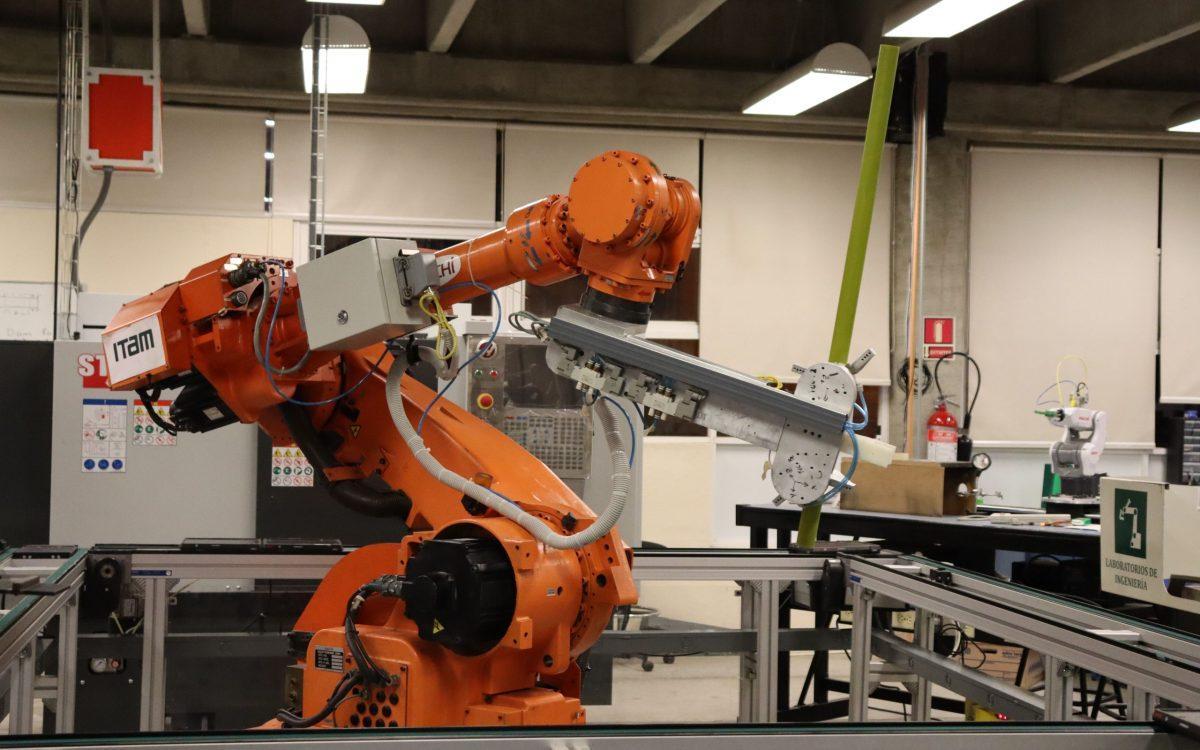
The most recognizable image of an automated factory remains an arm welding, placing boxes, or feeding a machine, but the industrial business has shifted to encompass everything surrounding the robot : process engineering, machine vision, programming software, autonomous vehicles, maintenance, and safety. This combination is what allows us to speak of industrial robotics as a complete system and not simply as an isolated machine.
In Spain and Europe, the focus is shifting towards projects that increase flexibility and reduce reliance on rigid scheduling . Companies are no longer just asking how much a robot costs, but how to integrate it into a production line with fluctuating batches, how to train staff, and what return on investment can be expected over its lifespan. This broader perspective explains the interest in cobots, simulation, and Physical AI.
From buying a robot to designing an automated cell
Automating an operation isn't simply a matter of bolting an arm to a table and pressing a power button. It requires studying the process, designing the cell, selecting industrial automation sensors and cameras, developing tooling, connecting the robot to existing machinery, adding safety systems, and training the operators. Integration can be as important, or even more so, than the equipment itself , which is why many SMEs need technical support before making a decision.
This effort explains why the total cost is not limited to the price of the robot. The investment includes engineering hours, vision systems, software, fencing, certification, and commissioning, so a simple cell and a complex installation can differ by hundreds of thousands of euros . For a medium-sized company, the challenge is calculating the savings, additional production, and defect reduction that will offset that investment.
Cobots with higher payload capacity and software that simplifies commissioning
One of the new developments in the sector aims to expand the scope of collaborative robots. ABB's PoWa family covers payloads from 7 to 30 kilograms and speeds of up to 7,2 meters per second, with models such as the CRB 1910, up to 13 kilograms, and the CRB 1920, up to 30 kilograms. This leap in capacity allows for palletizing, heavy machining, or handling large parts without necessarily having to upgrade to a closed-cell industrial robot. These applications will be showcased at Advanced Manufacturing Madrid, at IFEMA, on November 4th and 5th, in Hall 6.
In collaborative welding, the CRB 1910 is presented alongside the EasyTeach device, which allows for teaching welding points through manual guidance and interactive buttons. The idea is that the operator moves the arm to mark the trajectory, reducing programming time for short runs. Programming thus becomes part of the process that is also automated , not just the robot's physical movement.
For palletizing and depalletizing, the CRB 1920 is combined with 3D machine vision, allowing the system to identify objects of different shapes, sizes, and positions on the pallet and guide the robot in real time. The IRB 930 SCARA is also on display, with a payload capacity of up to 22 kg and cycle times of 0,38 and 0,39 seconds, representing a small percentage improvement that translates into more units per hour . In manufacturing, this kind of difference can justify the investment without changing the entire production line.
The digital layer is gaining importance in these proposals. RobotStudio allows for simulation and programming off-site, Automatic Path Planning generates trajectories with just a few clicks, OptiFact collects and analyzes production data, and AppStudio facilitates the creation of interfaces without code. Reducing setup time and engineering hours has become as important as improving the robot's lifecycle , especially when the company lacks its own integration team and seeks to optimize industrial production control.
Physical AI for complex processes in Getafe
In the field of composite materials, FIDAMC and Sopra Steria have signed a collaboration agreement to apply Physical AI to manufacturing processes. The initiative aims to develop robots capable of perceiving their environment, adapting to the characteristics of each part, and executing complex operations with greater efficiency, quality, and traceability. Training will initially take place in simulated environments before the systems are deployed in real industrial cells.
This combination is particularly relevant for aerospace, aeronautics, and defense, sectors where complex manual tasks remain difficult to automate with conventional robotics. Initial work will be carried out in FIDAMC's robotic cell in Getafe, and the results will then be shared with the European industrial ecosystem. The key lies in combining the operator's flexibility with the robot's precision and repeatability , without losing process knowledge.
This approach aligns with a broader trend: artificial intelligence is moving beyond simply being a software layer and is beginning to influence how robots interpret their environment. Cameras, sensors, and AI models allow machines to move beyond simply repeating coordinates and respond to changes in position, batches, or references. Physical AI aims to bring this decision-making capability to the physical world of the factory , although its adoption will depend on results, costs, and ease of integration.
What do companies look at before taking the plunge?
Industry surveys consistently point to several practical obstacles: cost, integration with existing systems, choosing the right solution, security, and regulatory red tape. Added to this is the shortage of qualified technology professionals and the difficulty of connecting plant technologies with information systems. The hurdle is not only financial ; it also involves knowledge, maintenance, and the ability to measure results.
For SMEs, the return on investment depends on the specific process. A project can recoup its costs in a few months if it automates a bottleneck, allows for more shifts, or reduces errors, but it may fall short if production is constantly changing or requires too much human intervention. Flexibility and workload are just as crucial as the robot's price , which is why it's important to analyze the workload curve, the actual cycle time, and the cost of the operator interfaces.
The market is also beginning to explore rental or service models to reduce initial investment, while Spanish mobile robotics expands its presence in logistics, materials transport, order picking, and inventory control. Automation is moving into operations previously reserved for large plants , with smaller solutions, accessible software, and systems that can work alongside humans.
Industrial robotics is no longer measured solely by the number of robotic arms installed. Integration, vision, simulation, higher-capacity cobots, and artificial intelligence applied to the physical environment are gaining importance. The immediate future lies in more flexible factories and companies capable of evaluating the total cost, training their teams, and choosing projects with a clear return on investment . This combination, rather than an isolated robot, is what is driving the business in Spain and Europe.
Table of Contents