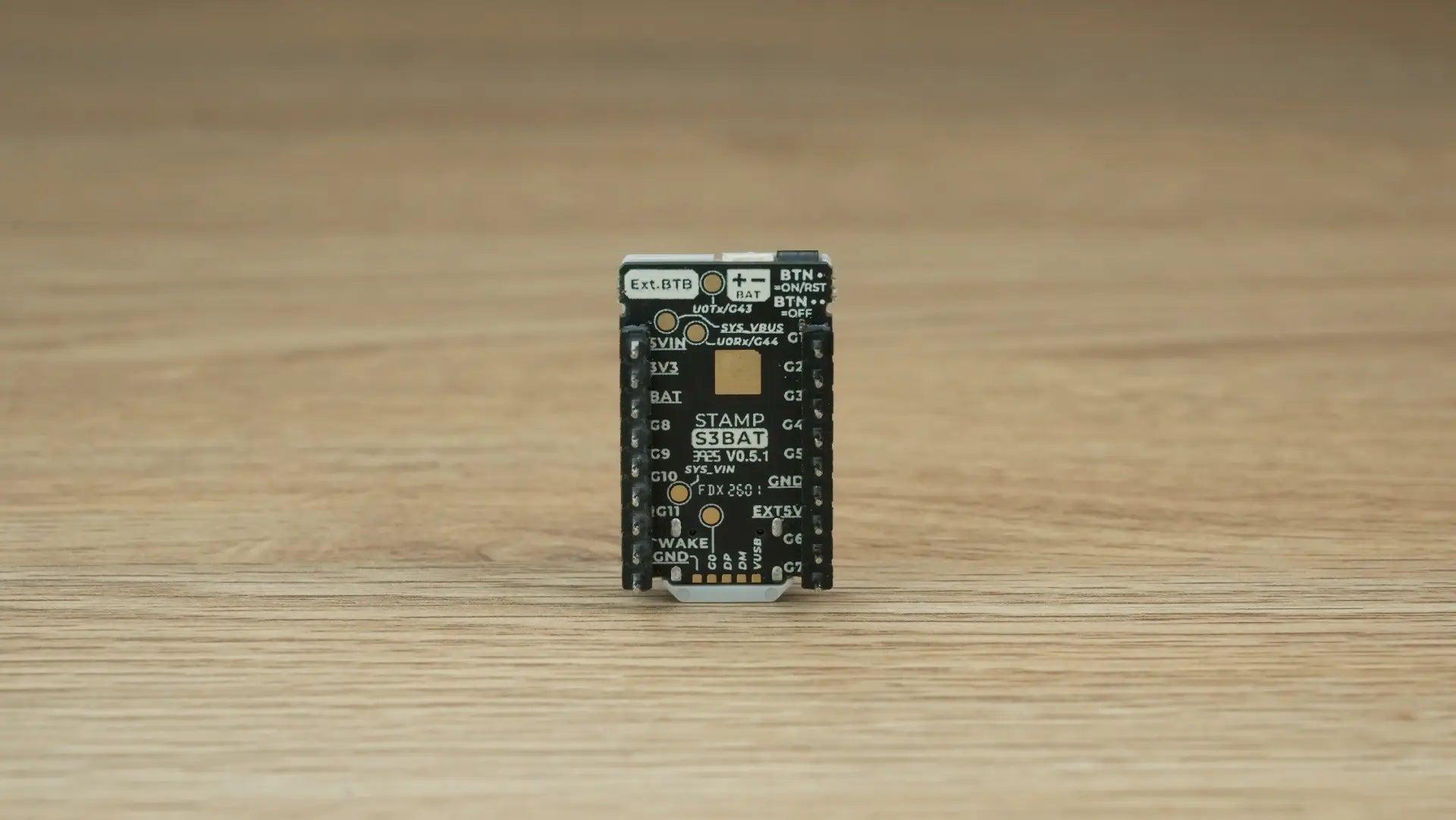
The M5StampS3 BAT module with ESP32-S3 and integrated battery has become one of the most attractive options for those looking to build compact, efficient IoT projects with advanced power management. It's not just "another ESP32": it combines a powerful platform with an intelligent power system, ample memory, and a form factor designed for direct integration into custom boards or commercial products.
Furthermore, this module fits within a whole ecosystem of M5Stack devices , such as the StampS3 or the unique Cardputer, also based on the ESP32-S3. Understanding what each one offers helps in choosing the right option for the project: from a minimal "brain" soldered onto a PCB, to a pocket-sized mini-computer with integrated keyboard, screen, and batteries, ready to experiment with WiFi, Bluetooth, or even perform penetration testing.
What is the M5StampS3 BAT and how does it differ?
The M5StampS3 BAT is an embedded module with integrated power management that uses the ESP32-S3-PICO-1-N8R8 SiP as its core. This System-in-Package integrates the ESP32-S3 with a dual-core Xtensa LX7 CPU up to 240 MHz, along with 8 MB of Flash memory and 8 MB of PSRAM, into a single package, making it ideal for edge processing, basic vision, lightweight AI, or intensive data handling tasks.
Unlike the standard StampS3, the BAT model adds dedicated circuitry for battery and power control . It integrates the M5MP1 power management design (also referred to as M5PM1 in some texts), which allows for managing power input and output, charging LiPo batteries, and measuring input and battery voltages. All of this makes it a perfect candidate for portable devices that need to operate for extended periods with reduced power consumption.
Another key difference between the M5StampS3 BAT and other variants is the presence of an integrated power interface for 3,7V batteries , designed to connect via a specific connector (an SH1.0 battery cable is included in the package). This covers the complete power cycle: USB-C or 5V power, LiPo battery, and fine-tuning of the power status.
The module exposes a total of 11 general-purpose GPIO pins and 1 wake-up pin , accessible via a 24-pin BTB connector with a standard 2,54 mm pitch on half-hole (castellated) pads. This facilitates both SMT mounting on a custom PCB and use in DIP format or with pins for rapid prototyping.
Another key difference between the M5StampS3 BAT and other variants is the presence of an integrated power interface for 3,7V batteries , designed to connect via a specific connector (an SH1.0 battery cable is included in the package). This covers the complete power cycle: USB-C or 5V power, LiPo battery, and fine-tuning of the power status.
Internal architecture: ESP32-S3-PICO-1-N8R8, memory and connectivity
At the core of the module is the ESP32-S3-PICO-1-N8R8 , a highly integrated version of the ESP32-S3 that combines CPU, memory, and analog elements into a single SiP. The CPU is a dual-core Xtensa LX7 with a 32-bit architecture and a maximum frequency of 240 MHz, ensuring ample headroom for complex real-time tasks, communications, and application logic.
In terms of memory, this SiP provides 8 MB of Flash and 8 MB of PSRAM already integrated into the module itself, eliminating the need for external chips. The Flash is used to store firmware and persistent data, while the PSRAM is essential for applications requiring large buffers, AI libraries, and audio or video processing (for example, with DVP cameras connected via the BTB connector that supports this interface).
In terms of wireless connectivity, the M5StampS3 BAT inherits the stack from the ESP32-S3 and supports 2,4 GHz Wi-Fi (802.11 b/g/n) for robust links in local area networks and the Internet of Things. This connectivity makes it suitable for home automation, remote telemetry, industrial data logging, small embedded web servers, or cloud-connected devices.
The module's design is prepared to handle AI inference tasks at the edge and high-rate data transmission, leveraging both dual-core computing power and the Flash + PSRAM combination. This opens the door to using frameworks and examples from Espressif or the community for lightweight recognition, intelligent sensor filtering, or local analysis before uploading information to the network.
Power and battery management integrated into the M5StampS3 BAT
One of the key strengths of the M5StampS3 BAT is its M5MP1 power management circuit , which provides a multi-stage system for controlling both the power input and the power supply to the ESP32-S3 and associated peripherals. This design is intended to work with 3,7V lithium batteries, as well as 5V inputs from USB Type-C or standard DC power.
The module features a dedicated battery interface for easy connection of an external 3,7V LiPo battery. Furthermore, the circuit automatically manages charging when the device is powered via USB-C or 5V, safely controlling the process and monitoring key states such as input voltage and battery voltage.
Another important feature is its support for low-power wake-up functions . The module has a dedicated wake-up pin that allows the ESP32-S3 to be brought out of deep sleep states. This way, the electronics can remain in low-power mode most of the time, waking up only when an external event (sensor, button, signal from another device) requires it.
Once the microcontroller enters low-power mode, the main power supply can be reactivated via the wake-up I/O pin , reducing overall power consumption and extending battery life. This is particularly useful in projects such as remote sensors, standalone data loggers, or portable devices that spend most of their time inactive.
Physical interface: GPIO, BTB connector and RGB LED
The M5StampS3 BAT provides developers with 11 universal GPIO pins plus one wake-up line , sufficient for a wide range of control projects, sensor readings, or connections with other modules. Although the number of pins is lower than in a standard StampS3 (which has up to 23 GPIO pins), this BAT version prioritizes integrated power electronics and a compact form factor for applications where fewer pins are required.
The pins are exposed via a 24-pin BTB connector that also supports the DVP interface for cameras or other high-speed peripherals. The module uses a half-hole pad design with a standard 2,54 mm pitch, allowing it to be soldered using SMT techniques in production or on breadboards or carrier boards with DIP rows.
The module itself also includes a programmable RGB LED . This small detail is very useful in practice, as it allows you to indicate system status (WiFi connection, error, battery charge, configuration mode, etc.) without the need for external components. Its color and brightness can be controlled via the firmware using typical WS2812B smart LED protocols.
The combination of castellated pads, 2,54 mm pitch and BTB connector allows for different integration strategies : soldering it directly to a final board, keeping it removable using pressure connectors, using it as a "plug-in" module for prototypes, or even integrating it into mass-produced products, minimizing the complexity of the main PCB design.
Kit contents and typical applications of the M5StampS3 BAT
The basic M5StampS3 BAT package typically includes the module itself and an SH1.0 battery cable , which allows for convenient connection of a 3,7V LiPo cell. This cable simplifies the assembly of prototypes and final products, eliminating the need to search for separate compatible connectors.
In terms of uses, the manufacturer primarily targets it at IoT development projects . Thanks to its combination of WiFi, ample memory, dual-core CPU, and advanced power management, it's well-suited for smart sensor nodes, home device controllers, connected wearables, or small data gateways.
Having integrated battery charging and voltage measurement controls makes it easy to implement features such as displaying the battery level, activating low-power modes when the voltage drops too low, or recording the energy status as part of the data sent to the cloud. All of this without adding any specific external chips.
Its small size and ease of soldering make it a very attractive option for integration into commercial products , where the goal is to reduce development time and certify fewer components. Designing a PCB that "houses" the StampS3 BAT as if it were just another component allows developers to focus on the product's logic and specific hardware (sensors, actuators, connectors) while reusing a proven platform.
The M5Stack ecosystem: StampS3 and Cardputer as a reference
To better understand the role of the M5StampS3 BAT, it's worth taking a look at other related M5Stack products . One of them is the "classic" StampS3, a very compact embedded module also based on the ESP32-S3FN8, but with a slightly different philosophy: maximizing the number of GPIO pins and offering a minimal, ready-to-use system at 5V.
The StampS3 is designed as a minimal system board and includes an integrated MUN3CAD01-SC DC/DC regulator that reliably converts 5V to 3,3V. This ensures dependable operation even with slight variations in the input. The module provides 23 ESP32-S3 GPIO pins, accessible via 1,27mm or 2,54mm headers, supporting SMT, DIP strip, and jumper wire connections.
Among its additional features are a programmable WS2812B-2020 RGB LED and a user button , which facilitate basic control and interaction without the need for extra hardware. The wireless antenna is a 2,4 GHz 3D antenna and exposes interfaces such as UART, I2C, I2S, SPI, SD/SDIO/MMC, PWM, a touch sensor, EMAC, and other typical ESP32-S3 functions, with pins G0 to G15 and G39 to G46 available.
The StampS3 module is designed to enter download or programming mode by pressing and holding the G0 button upon power-up, a useful feature when flashing low-level firmware or working with the Espressif IDF. Its compact dimensions (26 x 18 x 5 mm) and weight of just 3,2 grams make it ideal for projects and components for wearables , medical equipment, or compact automation devices.
In terms of programming, the StampS3 supports Arduino, PlatformIO, Espressif's IDF, and graphical environments like M5Stack's UIFlow . This means it can be used for both maker projects and professional development, taking advantage of its affordable price (around $7,50) and its powerful computing capabilities within a minimal size.
StampS3 vs. M5StampS3 BAT: Similarities and Differences
Although they share the same ESP32-S3FN8 core and similar philosophies (compact embedded modules), the StampS3 and the M5StampS3 BAT have slightly different approaches. The StampS3 focuses on offering maximum I/O and a minimal 5V to 3,3V solution, with most of the microcontroller's pins exposed.
The M5StampS3 BAT, on the other hand, sacrifices some of those GPIO pins to include a more advanced power management system and direct battery support . This makes it especially suitable for portable devices powered by LiPo batteries where battery life, controlled charging, and low-power mode are priorities.
Both share features such as 2,4 GHz WiFi compatibility, an integrated 3D antenna, RGB LEDs, and a programmable button (clearly documented in the StampS3, and the BAT retains at least the RGB LED). They also maintain the use of castellated pads and connection options for both 2,54 mm and, in some models, 1,27 mm jacks.
In practical terms, we could say that the StampS3 is ideal when you need a "brain" with many input/output pins and have control of the external power supply, while the M5StampS3 BAT shines in projects that require flexible power with an integrated battery, recharging and fine control of consumption without adding additional power components.
Cardputer: the pocket-sized mini-computer with ESP32-S3
Within the M5Stack universe, the Cardputer deserves special mention . While not the M5StampS3 BAT, it shares the use of the ESP32-S3 and serves as an example of how far this microcontroller can be integrated into end products. The Cardputer is essentially a small pocket computer with a case slightly larger than a credit card, a QWERTY keyboard, and an integrated battery.
Inside, it features an ESP32-S3FN8 SoC with a dual-core Xtensa LX7 CPU running at 240 MHz and 8 MB of Flash memory. It has a 1,14-inch color LCD screen with an ST7789V2 controller and a resolution of 240 x 135 pixels, ideal for simple interfaces, menus, basic graphics, or small data dashboards. The keyboard has 56 keys in a 4 x 14 matrix, with an actuation force of approximately 160 gf.
In terms of expansion, the Cardputer integrates HY2.0-4P connectors and a 2,54 mm 14-pin EXT port , designed for adding sensors, external modules, or additional peripherals. It includes an infrared emitter (IR LED) that allows the device to be used as a remote control for televisions, air conditioners, and other equipment that supports IR control.
In terms of audio, it features an ES8311 codec, an NS4150B amplifier, and an 8 Ω / 1 W speaker , as well as a MEMS microphone with a 65 dB SNR, enabling the development of recording and playback projects, simple voice assistants, or communication applications. It also integrates a BMI270 inertial measurement unit (IMU) , expanding its capabilities for interactive and motion-based projects.
In terms of power, the Cardputer incorporates two rechargeable LiPo batteries with a total capacity of 1750 mAh , providing considerable autonomy for portable use. Standby power consumption with the switch off is around 0,23 µA, while in normal operation it is around 120,2 mA at 4,2 V, increasing to 132,3 mA with WiFi and to about 154,6 mA with BLE active. All of this is packed into a device measuring approximately 84 x 54 x 19,6 mm and weighing 81 g.
Connectivity, software and advanced uses of the Cardputer
In terms of wireless connectivity, the Cardputer offers WiFi and Bluetooth thanks to the ESP32-S3 , which, combined with its portable form factor, makes it a kind of "Swiss Army knife" for mobile projects. It also includes a microSD card slot, allowing for the storage of large amounts of data, logs, or applications.
The device can be programmed using Arduino or Espressif's IDF , and has extensive documentation and community resources. M5Stack also provides the M5Burner tool, which makes it easy to upload various pre-designed firmwares to the Cardputer with just a few clicks.
Among these firmwares is the well-known Evil-Cardputer , designed for penetration testing of Wi-Fi networks and Bluetooth devices, always for ethical use and security testing. There are also recreational firmwares, such as playable versions of DOOM or Game Boy emulators, demonstrating the chip's power and the platform's capabilities.
The combination of a full keyboard, display, audio, expansion capabilities, and connectivity makes the Cardputer ideal for remote controllers, configuration terminals, field diagnostic tools, test platforms , or simply as a tech toy to explore the potential of the ESP32-S3. Its integrated charger allows the batteries to recharge automatically when the device is connected via USB, simplifying daily use.
The “pure” M5StampS3: detailed technical specifications
Returning to the standard M5StampS3, it's worth reviewing its technical specifications in some detail because they provide a foundation for understanding the platform on which the BAT model is based. The SoC is an Espressif Systems ESP32-S3FN8 with a 32-bit dual-core Xtensa CPU at 240 MHz, offering 384 KB of ROM and 512 KB of internal SRAM.
This base is complemented by 8 MB of external Flash memory , sufficient for the vast majority of projects, even when using large libraries or multiple firmwares. In terms of connectivity, the module supports 2,4 GHz 802.11 b/g/n Wi-Fi with speeds up to 150 Mbps, and Bluetooth 5 with Mesh support, from 125 Kbps to 2 Mbps, using the module's integrated 2,4 GHz 3D antenna.
The peripherals section is particularly extensive: the M5StampS3 offers 23 GPIO pins numbered G0 to G15 and G39 to G46 , supporting standard interfaces such as UART, I2C, I2S, SPI, PWM, pulse counter, SD/SDIO/MMC master control, and a touch sensor. Additionally, an 8- or 12-pin FPC connector is mentioned, which can be used to expose additional GPIO pins or an LCD interface.
Physically, the module features castellated pads with 2,54 mm and 1,27 mm pitches , allowing it to be soldered directly onto carrier boards or connected via jumper wires or headers. It includes a user button and a WS2812B-2020 RGB LED, both very useful for basic interaction and system status indication.
Power is supplied via a MUN3CAD01-SC DC/DC regulator that converts 5V to 3,3V, with a typical current of up to 500mA through USB-C. As mentioned, its dimensions are 26 x 18 x 5 mm and it weighs 3,2g. The typical operating temperature range is 0 to 40°C, sufficient for most indoor applications and some controlled outdoor uses.
User experience, programming, and documentation
One of the strengths of the M5Stack ecosystem, for both the M5StampS3 BAT and the StampS3 and Cardputer, is its broad compatibility with popular development environments . They can be programmed from the Arduino IDE, using PlatformIO, or directly with the Espressif IDF if finer control and access to all low-level APIs are required.
In addition, M5Stack offers UIFlow, a graphical programming environment designed to simplify development, especially useful for teaching, rapid prototyping, or users who don't want to delve deeply into C/C++. This tool makes it easy to create logic flows, integrate sensors, and control outputs without requiring extensive prior experience in embedded programming.
Community support is also a key factor: numerous examples, tutorials, and libraries already cover the use of the ESP32-S3, including WiFi, Bluetooth, SD storage, addressable LEDs, LCD screens, IMU sensors, and other common peripherals. This significantly reduces the learning curve and the time required to build a functional prototype.
In the specific case of the M5StampS3 and the BAT model, the fact that some models have USB Type C with an integrated UART converter makes programming and serial communication as simple as connecting the cable to the computer, which is a clear advantage over more basic boards that require an external programmer or additional adapters.
Finally, the manufacturer provides supplementary documentation on power supplies, schematics, connection examples, and application notes , which helps both makers and engineers integrate these modules into projects safely and efficiently. And, if the product goes into production, the standardized form factor and manufacturing quality are also advantages.
Taken together, the M5StampS3 BAT, along with the rest of the M5Stack family of modules and devices, forms a very solid platform for designing IoT, portable, and embedded devices . It combines a powerful ESP32-S3, ample memory, wireless connectivity, advanced power management, and a software and documentation ecosystem that makes it much easier to focus on the project idea rather than struggling with the basic hardware.

Table of Contents
- 1 What is the M5StampS3 BAT and how does it differ?
- 2 Internal architecture: ESP32-S3-PICO-1-N8R8, memory and connectivity
- 3 Power and battery management integrated into the M5StampS3 BAT
- 4 Physical interface: GPIO, BTB connector and RGB LED
- 5 Kit contents and typical applications of the M5StampS3 BAT
- 6 The M5Stack ecosystem: StampS3 and Cardputer as a reference
- 7 StampS3 vs. M5StampS3 BAT: Similarities and Differences
- 8 Cardputer: the pocket-sized mini-computer with ESP32-S3
- 9 Connectivity, software and advanced uses of the Cardputer
- 10 The “pure” M5StampS3: detailed technical specifications
- 11 User experience, programming, and documentation