
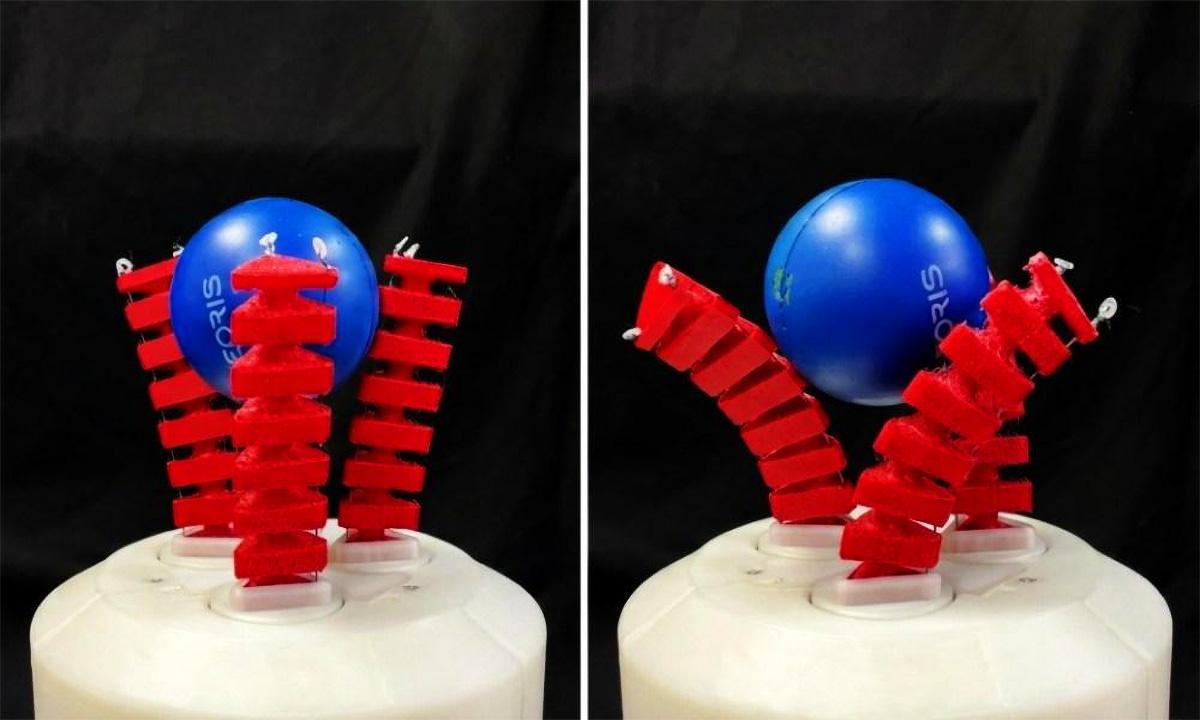
A team of researchers from the Public University of Navarre (UPNA) and the Carlos III University of Madrid (UC3M) has unveiled a soft robotic gripper that goes beyond simply grasping objects. The system can roll objects and change their orientation between its fingers without needing to release them or place them on a surface to re-grasp them. This dexterity, known as in-hand manipulation, is still uncommon in this type of mechanism.
The development aims to overcome a classic limitation. The flexibility of soft claws allows them to adapt to very different shapes, sizes, and rigidities, but achieving fine movements after grasping is often difficult. The researchers have published their results in the scientific journal Bioinspiration & Biomimetics , where they describe an architecture designed to enhance this manipulation capacity.
Three-finger design and coordinated movements
The gripper consists of three soft fingers, each with three degrees of freedom . In addition to bending, they can rotate on their own axis. By coordinating these movements, the device allows the object to rotate continuously while remaining gripped. The idea is to separate two actions that are linked in many flexible systems: closing the fingers around a piece and then changing its position.
The researchers compare the result to everyday gestures. It's similar to turning a jar in your hand to read the label without putting it down, or the motion of unscrewing a light bulb. For a person, it's almost automatic; for a soft robot, it requires controlling gripping forces, relative displacements, and deformations of materials that don't behave like a conventional rigid joint.
The team isn't trying to replicate a human hand, but rather to give the machine some of the manual dexterity used daily. In practice, this allows an object to be reoriented before use, placed in a different position, or prepared for a subsequent task without initiating a new gripping cycle.
Applications, testing, and funding
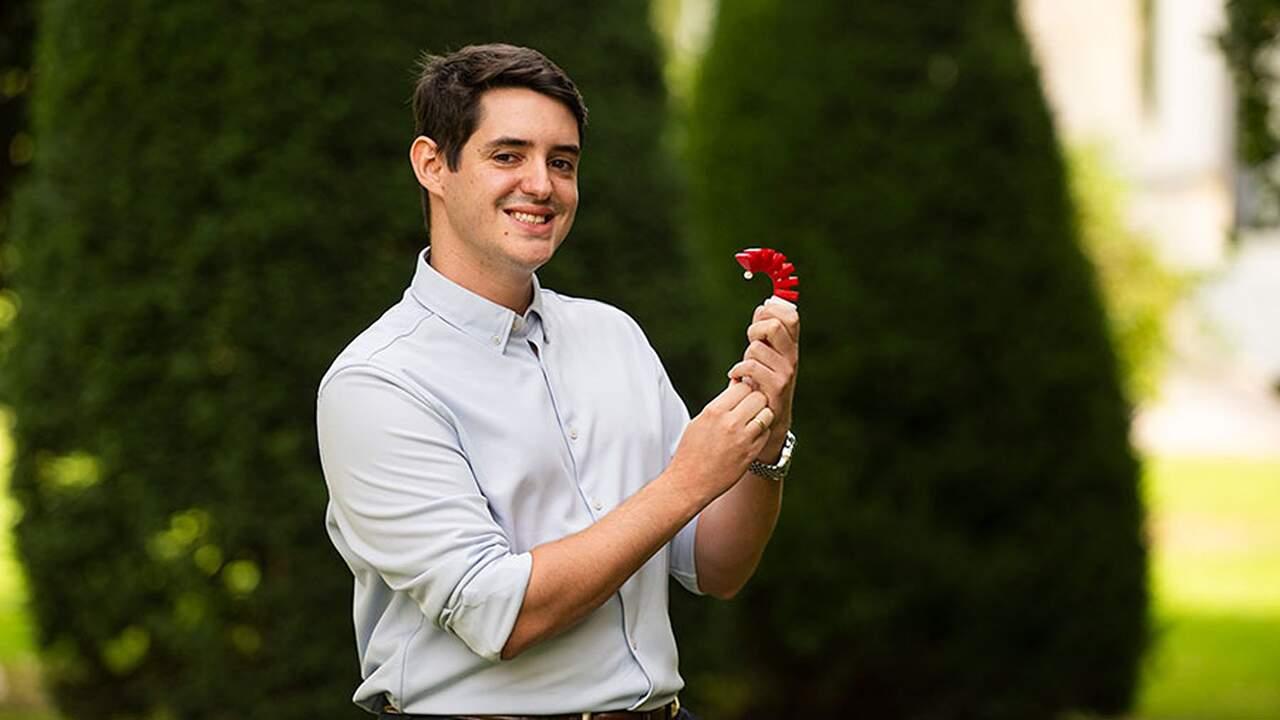
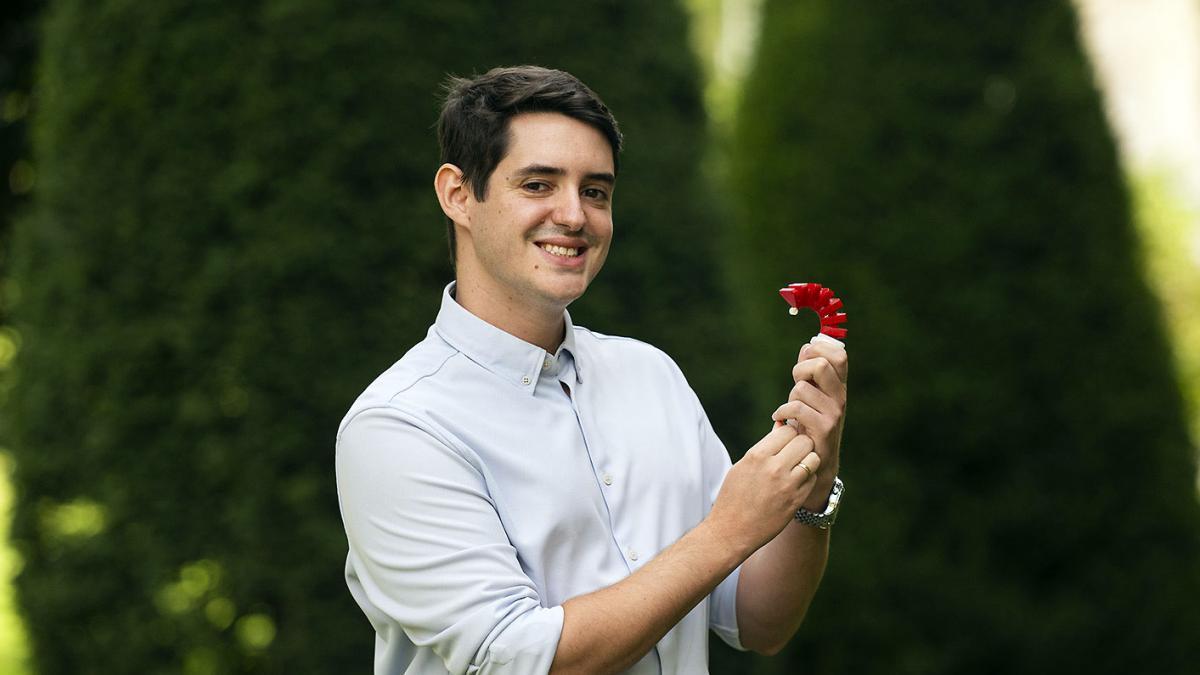
The design is also modular. Each of the three fingers can be assembled and disassembled separately , so a damaged element can be replaced without replacing the entire claw. This feature facilitates experimentation with different configurations and can simplify maintenance in future developments.
During the tests, the researchers used a wide variety of objects: a water bottle, a bucket, a pack of tissues, a fidget spinner, a 3D-printed figure, a rubber ducky, several stuffed animals, a screwdriver, and an artificial rose . The same strategy was used to hold objects of different sizes, shapes, and rigidities, and to rotate them without first releasing the grip.
Potential applications encompass tasks where a robot needs to adjust its grip on an object without having to release and re-grasp it. Examples include orienting a part before assembly , handling delicate or irregularly shaped products, sorting orders, preparing laboratory materials, or working with items that change shape. The sectors mentioned include food, logistics, laboratories, manufacturing, and assistive robotics.

Another field where this approach fits is collaborative robotics . In spaces shared by people and machines, soft systems can physically adapt to less structured environments than a traditional industrial cell. The ability to reorient an object within the gripper itself expands the operations that can be completed with a single grasp.
The project was funded by the ADAPTA and SIROCO projects , promoted by the Ministry of Science, Innovation and Universities, along with ERDF funds from the European Union. The authors of the study are Carlos Relaño Gibert, from the Public University of Navarre (UPNA), and Alberto Rodríguez-Sanz, Lisbeth Mena, and Concepción A. Monje, from the RoboticsLab at Carlos III University of Madrid (UC3M).
Unlike rigid industrial robots, which typically need to know the exact geometry of what they will pick up beforehand, soft robots offer greater adaptability to touch. This doesn't eliminate the need for vision, control, and planning, but it reduces dependence on a specific shape and opens the door to handling fragile or unpredictable objects with a greater margin of safety.
This advancement is still in the experimental research phase. Tests demonstrate that the architecture works with the studied set of objects, although its implementation on real production lines will depend on factors such as cycle speed, repeatability, maintenance, and integration with other systems. If these conditions can be met without sacrificing mechanical simplicity, the manipulation within the gripper could eliminate auxiliary operations in tasks that currently require releasing, repositioning, and re-gripping.