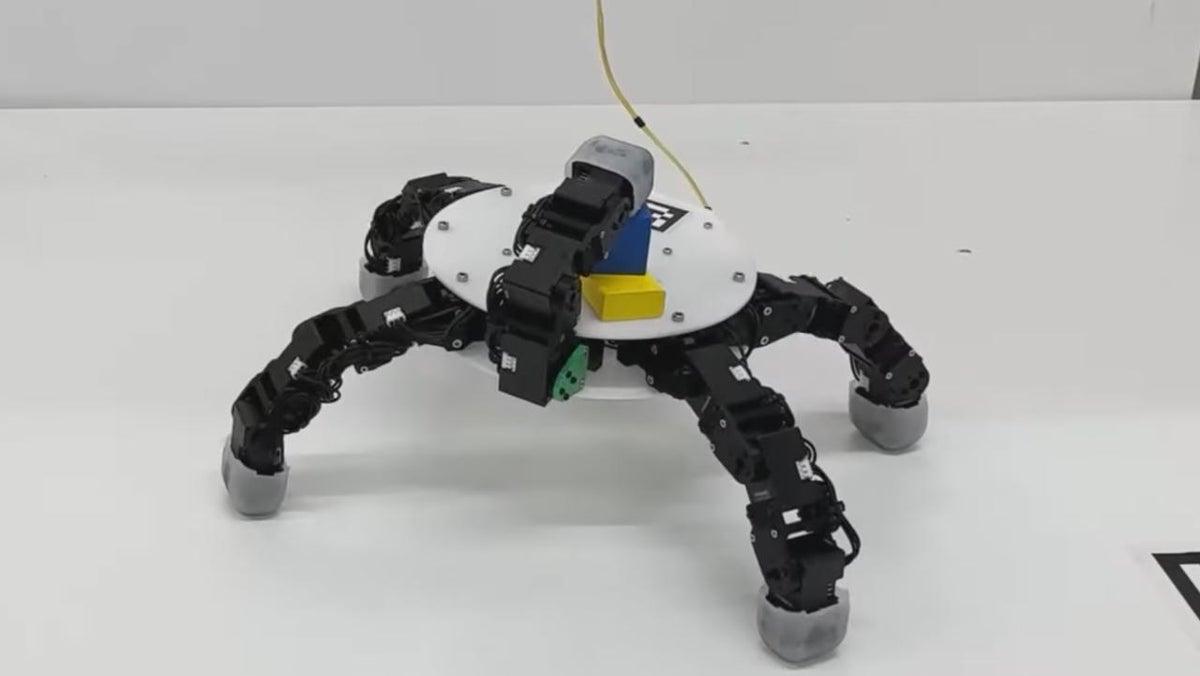
In this context, research teams in Europe and the United States have taken a remarkable step forward with the development of detachable, symmetrical robotic hands capable of independent movement . This concept breaks with the traditional approach of meticulously mimicking human anatomy and opens the door to high-precision operations in tight spaces, hard-to-reach areas, or scenarios where a fixed arm simply cannot reach.
A robotic hand that becomes independent of the arm
The project generating the most headlines stems from a collaboration between the Massachusetts Institute of Technology (MIT) and the Swiss Federal Institute of Technology Lausanne (EPFL) . Its central idea is as simple to state as it is impossible to replicate in a human being: to grant complete autonomy to the hand from the rest of the arm , so that it can work in conjunction with the main system or move on its own when the task requires it.
The team, which also included a group of EPFL engineers once led by researcher Xiao Gao, deliberately avoided creating an exact copy of the human hand. Instead of accepting its limitations, such as asymmetry or difficulty operating in confined spaces, they opted for a design specifically for robotics and to overcome these biological constraints.
In practice, the hand can function as part of a conventional robotic arm for general tasks, and when more specialized intervention is needed, it detaches and moves using its own fingers as points of support . This ability to "walk" on surfaces allows it to squeeze into gaps, cavities, or structures where the main robot would be unable to enter without dismantling half of its surroundings.
This approach aligns with the trend in so-called general-purpose robotics , which doesn't simply aim to match human dexterity but seeks to go a step further in terms of versatility, reach, and range of motion. The detachable hand is thus conceived as a functional evolution of the human hand rather than a mere mechanical copy.
Symmetrical design and variable finger configuration
One of the most striking features of the prototype is its completely symmetrical architecture . The researchers have developed two versions, one with five fingers and the other with six, both with a palm about 16 centimeters in diameter and a finger arrangement that breaks with the typical human configuration of four fingers and a thumb to one side.
Thanks to this geometry, any pair of fingers can function equally well when gripping . There is no "good side" and "bad side" of the hand, so it can approach an object from multiple directions without losing effectiveness. This symmetry is especially useful when the hand is detached and must maneuver in tight spaces, where the margin for repositioning is very small.
Furthermore, the engineers have worked to significantly expand the range of motion and gripping ability of each finger . The goal is for a finger to be able to oppose any of the others, not just a specific thumb, thus multiplying the possible gripping combinations. This added freedom translates into finer control of objects of different shapes and sizes.
Another key element is that the hand has been designed to offer both forward and backward gripping . That is, it is not limited to holding objects on its front surface, but can also support them while manipulating tools or working on other elements. This "dual-sided" capability allows, for example, holding one part and, at the same time, using a tool with another set of fingers without needing a second hand.
This focus on functional manipulation contrasts with the traditional approach of many robotics projects, which sought to reproduce human anatomy almost down to the smallest detail. Here, the priority is not biological fidelity, but operational efficiency , something that has direct implications in industrial or complex inspection environments.
Autonomous movement and serial object retrieval
When the hand detaches from the arm, its most striking feature comes into play: the ability to move autonomously across surfaces . Using its fingers as coordinated support points, the device can crawl, move forward, and reorient itself to locate and pick up objects beyond the main robot's usual reach.
In experiments described by the researchers themselves, the hand has demonstrated the ability to retrieve up to three objects consecutively and then return to the arm to reattach, maintaining a stable grip on the objects it carries at all times. This sequence, tested with everyday items, clearly illustrates the type of tasks for which it was designed.
During the tests, objects such as cardboard tubes, rubber balls, markers, and metal cans were used , all chosen to simulate typical scenarios in warehouses, workshops, or production lines. The results indicate that the hand can securely grasp a wide variety of shapes and textures, maintaining stability even while moving.
The device has been able to replicate 33 different types of human grip , a significant number considering the complexity of the biological hand. Furthermore, it has handled objects weighing up to approximately 2 kilograms without difficulty, a figure sufficient for a wide range of operations involving the manipulation of components, tools, or materials in industrial and service sectors.
This performance confirms, according to the authors of the work, that symmetrical architecture and functional decoupling allow overcoming some of the classic limitations of traditional robotic hands, which are designed more for repeating fixed tasks than for improvising in changing or difficult-to-access environments.
Applications in industry, rescue and exploration
The primary focus of this detachable hand is clearly industrial, both for inspection and repair of equipment and facilities . In factories or processing plants, the ability to extend only the hand into a recess, housing, or narrow conduit reduces the need to shut down entire lines or dismantle structures to access a specific point.
In maintenance scenarios, this autonomy offers an interesting alternative to using bulkier tools. The hand can be inserted into electrical cabinets, complex machinery, or enclosed areas where a rigid arm would have great difficulty reaching without causing collateral damage. Once inside, it can manipulate levers, screws, cables, or other components with precision similar to that of a trained human hand.
The researchers also highlight its potential in rescue and exploration tasks . In operations in confined spaces, collapses, or underground infrastructure, the detachable hand could act as a kind of tactile explorer capable of navigating narrow tunnels, checking the condition of structures, or retrieving delicate objects without exposing people to unnecessary risks.
In exploration missions, whether in hard-to-reach natural environments or in complex scientific or technical facilities, having a robotic hand that doesn't depend on a direct line of sight or the free space of a full arm opens up new possibilities. It could, for example, penetrate rock cavities, pipes, or conduits to take samples, place sensors, or operate mechanisms.
Overall, this technology fits well with the current trend toward more modular and versatile robotic systems , where different specialized "modules" collaborate to solve complex tasks . The detachable hand becomes one of those key modules, designed for fine manipulation in places where other robots or tools cannot easily reach.
Outstanding challenges and next steps in development
Despite the results obtained, those in charge of the project themselves insist that it is still a prototype in the laboratory phase . Before it can be used in real-world applications, several technical challenges and integration issues with other robotic systems must be overcome.
One of the outstanding issues is validating the hand's performance with larger, heavier, or more unconventional objects . So far, it has demonstrated solid performance with relatively manageable items, but daily use in industry or rescue operations presents additional challenges in the form of bulky parts, irregular surfaces, or more demanding materials.
Another aspect to refine is the hand's adaptability to varied working conditions , from environments with dirt, dust, or humidity to scenarios with vibrations or interference. To be truly useful, it must demonstrate the same robustness demanded of other industrial equipment, without sacrificing its characteristic precision.
The researchers also point to the need to integrate this technology into real-world workflows , beyond controlled trials. The idea is to implement it in concrete tasks in factories, service facilities, or critical infrastructure, where it can operate alongside already deployed robots and demonstrate its contribution in terms of efficiency and safety.
In the medium term, the team itself suggests that this line of research could represent a paradigm shift in the design of robotic hands . Instead of continuing to try to mimic human anatomy down to the last detail, research could focus on increasingly functional, symmetrical, and modular designs, optimized for the real needs of industry and exploration, both in Europe and in other regions where automation is gaining ground.
The combination of detachable robotic hands, symmetrical design, and high technical dexterity points to a much more flexible robotics than what we see today in factories or laboratories; if these solutions manage to pass tests outside the research environment, they could become a key piece for working safely and precisely in confined spaces, complex facilities, and missions where the agility of an autonomous hand makes all the difference.

Table of Contents